

A shopper scrolling puzzle book listings sees a thumbnail and a line of text. If that line says what the solver will do with a pencil (find the words, add up the cages, lay one track, decode the quote), the shopper knows what is inside before they click. If it says “fun puzzles,” they have to guess.
The short version: lead the puzzle book title with the solve, then the count and the type, then the audience. The rest of this guide shows how, with invented example titles for word, number, logic and path puzzles, and a check against your Look Inside pages.
Why “fun puzzles” tells the buyer nothing
“Fun,” “relaxing,” “brain-boosting” and “challenging” describe a feeling, not a page. Every listing in the results can claim them, so none of them helps a shopper choose yours. A title like “Fun Puzzles for Adults” could hold word searches, sudoku or mazes, and the buyer who wanted one of those has no way to tell.
A bare type name is better, but it still leaves work for the buyer. “Killer Sudoku” is a full answer for someone who already solves killers. To a sudoku fan who has never met one, it is just a word. Add the solve (“add up the cages”) and that second buyer knows what the page asks before opening the sample.
There is a cost to a title that points the wrong way, too. In an r/KDP thread about a word search book that had been taken down, one commenter said of its history-themed kids title: “I would assume this is a nonfiction history book for kids, not a word search activity book.” The theme was in the title; the pencil job was not where that reader looked.
Getting the type right is covered in puzzle book cover vs interior type. This guide is the next step: naming what the solver does.
Name the solve first, then count, type and audience
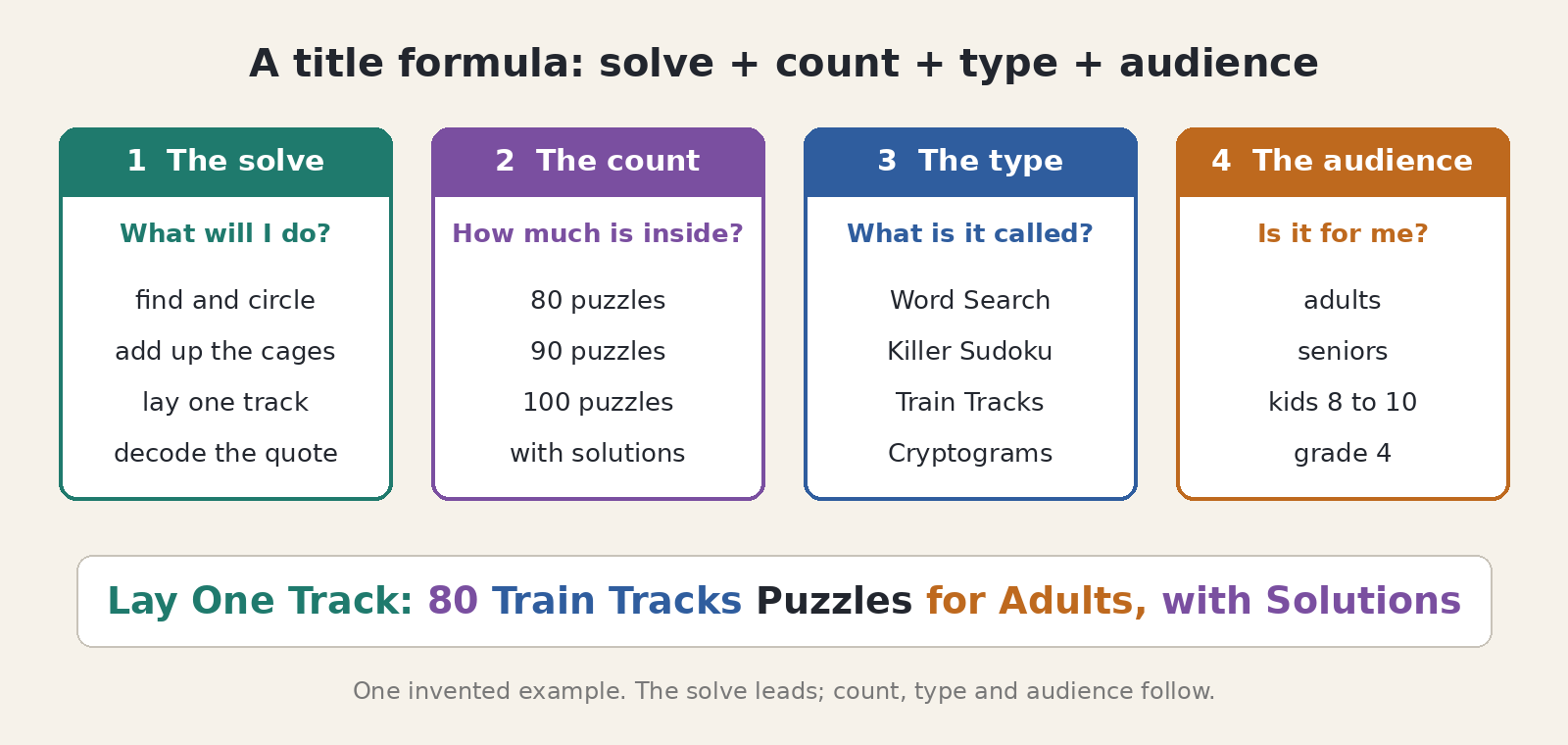
Build the title from four parts. The solve leads, the count and the type follow, then the audience.
- The solve. A verb phrase for the pencil job: find and circle, add up the cages, lay one track, draw one loop, connect the pairs, decode.
- The count. How many puzzles, and “with solutions” when the answers are in the book. On a printable pack, say pages or puzzles, whichever you count.
- The type. The name a solver would search for: Word Search, Killer Sudoku, Train Tracks, Cryptograms.
- The audience. Who solves it: adults, seniors, kids 8 to 10, grade 4. If you print an age band in the title, print the same band inside. One Amazon review of a Halloween activity book put the problem in a line: “the title says the book is for 5 – 8 and once you open it, it says 7 – 10.”
The solve goes first because it answers the shopper’s first question: what will I be doing? Theme (garden, holiday, travel) can sit beside the type or the audience, but it should never push the solve out.
Where the parts go depends on where you sell:
- Amazon. Put the solve in the title and let the subtitle carry the count, the type and the audience: “Lay One Track” / “80 Train Tracks Puzzles for Adults, with Solutions.”
- Etsy. Everything shares one line, so say what arrives: “Find and Circle: 30 Bird Word Search Printables for Seniors, Large Print PDF, Answer Key Included.” If you sell the same pack in both US Letter and A4, say so in the title, so a buyer printing at home knows the pages fit their paper.
- Teachers Pay Teachers. The grade and the subject lead and the solve follows: “Grade 4 Science Vocabulary: Find and Circle Word Search, 10 Worksheets with Answer Key.” Which puzzle type fits your audience notes that teachers search by subject and grade, and TPT logic puzzle worksheets names the three answers a teacher scanning results wants: which skill, which grade band, and whether the key is included. Put the grade band and “answer key” in the title when both are true.
If the same puzzles go out as a KDP book and an Etsy pack, keep the solve and the type identical in both titles; change the count and add the format words (“paperback” on Amazon, “printable PDF” on Etsy).
Puzzle book title examples by type
Every title below is invented for this article.
| Weak title | Strong title |
|---|---|
| Fun Puzzles for Adults | Find and Circle: 100 Garden Word Search Puzzles for Adults, Large Print, with Solutions |
| Sudoku Challenge Book | Add Up the Cages: 120 Killer Sudoku Puzzles for Adults, Easy to Tough, with Solutions |
| Brain Teasers Vol. 1 | Lay One Track: 80 Train Tracks Puzzles for Adults, with Solutions |
| Secret Messages | Decode the Proverb: 90 Cryptograms for Adults, with Solutions |
Word puzzles
For a word search, the solve is “find and circle,” and the theme lives in the word list: “Find and Circle: 60 Bird Word Search Puzzles for Seniors.” If the grid hides words forwards, backwards and on the diagonal, say so for an adult audience, but only if it is true. In Puzzle Maker Pro, our Windows software that makes puzzle pages and their answer keys with one module per puzzle type, the Standard Word Search module has Diagonals and Backwards as separate options, both off by default. A missing-vowel book is a different job with its own verb: “Fill the Missing Vowels: 50 Spelling Word Searches for Grade 3.”
For cryptograms, name what gets decoded: “Decode the Proverb” or “Decode the Quote” tells the buyer there is a hidden sentence, not a grid. Easy Cryptograms prints the code as letters, numbers (A=1) or double-digit numbers (A=01), and that choice belongs in the title when it changes the page: “Decode the Message: 40 Number Code Cryptograms for Kids.”
Number puzzles
For Killer Sudoku, the solve is the cage sum: “Add Up the Cages.” If the book is for experts, “Cage Sums Only, No Starting Digits” names what that buyer looks for. Make sure it is true: on the Very Hard, Tough and Extreme levels the cage sums are the whole puzzle, while Very Easy through Hard also print some starting digits. A book that ramps up from Easy cannot carry “no starting digits” on its cover, so check the first page of the run before you put that line on the cover. The 6×6 board suits its own audience: “Add Up the Cages: 60 Killer Sudoku Puzzles for Kids, 6×6 Grids.”
Logic puzzles
Loop, pair and track puzzles all ask the solver to draw a line; the verb tells them apart. “Draw One Loop: 100 Slitherlink Puzzles for Adults, with Solutions” and “Connect the Pairs: 100 Numberlink Puzzles for Adults, with Solutions” describe two different puzzles. Slitherlink vs Numberlink vs Train Tracks compares the three line puzzles if you are unsure which verb fits.
Path puzzles
On the classic board, Train Tracks asks the solver to lay one continuous track from the left edge to the bottom edge, using the counts beside each row and column. “Lay One Track” or “Connect the Rails” says that in three words. Leave out “maze”: a maze promises a corridor walk, and this is a counting puzzle. The full set of promises a Train Tracks listing makes, including the European name Rails, is in what a Train Tracks listing promises.
Matching the title to the Look Inside pages
The sample pages are where the shopper checks the title. Every promise in it should be backed by the first pages the preview shows.
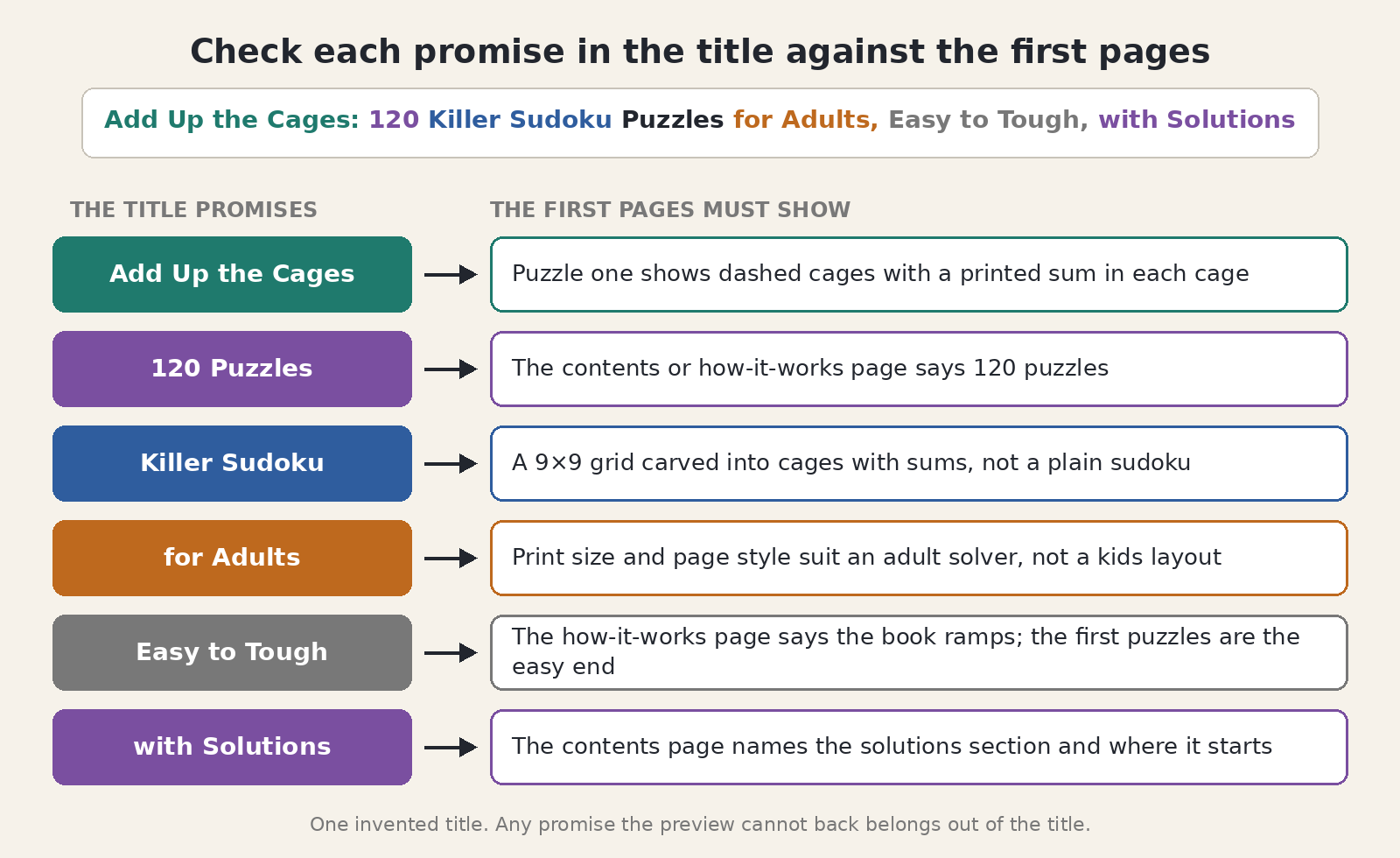
- The solve. If the title says “Decode the Quote,” the first puzzle is a coded line with a blank row under it, not a word search with a hidden phrase.
- The difficulty. “Easy to Tough” means the preview shows the easy end and the how-it-works page says the book ramps. A title that promises one level throughout must deliver that level on every page.
- The mode. Train Tracks boards are solvable without guessing by default. With Allow guessing turned on, a board still has one solution but may need a what-if guess, so a “no guessing” promise on the cover no longer holds for that book.
- The size and count. “Large Print” means large print on every page, and “100 Puzzles” means one hundred. “With Solutions” means the answer key is in the book, and the contents page should say where, because the preview never reaches it.
Puzzle book Look Inside covers what the sample has to prove beyond the title: a real puzzle at print size, the difficulty story, and the answer key promise. If you assemble your book in Puzzle Book Studio, the Puzzle Maker Pro tool that puts the front matter, puzzle sections and solutions into one book, page through its preview and read your planned title against the first pages before you export.
Every paid Puzzle Maker Pro edition lets you sell the finished books, worksheets and packs you make to your own readers and customers.
Get the free Puzzle Maker Pro demo now
Other puzzles you might like
Keep one look across the titles in different niches with one design system across puzzle niches.
Turn a narrow niche phrase into the settings that build the book in niche drill-down as a build spec.