


Spatial Reasoning Cube Puzzles Where One View Is Lying
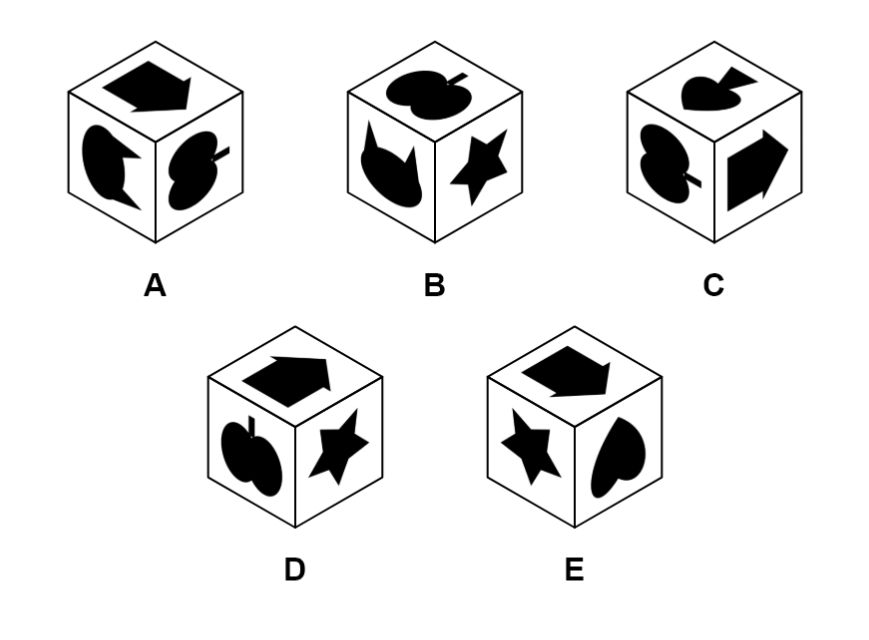
Five cubes on the page. The page says they are all the same cube, seen from different corners. Four of them are telling the truth.
Your reader checks the first against the second. The shapes line up. The third agrees. Then the fourth stops them: same shapes, same neighbors, and no matter how they turn it in their head, it never becomes the cube they were just holding. Maybe two faces have quietly swapped places. Maybe it is the mirror image. Either way, it cannot exist.
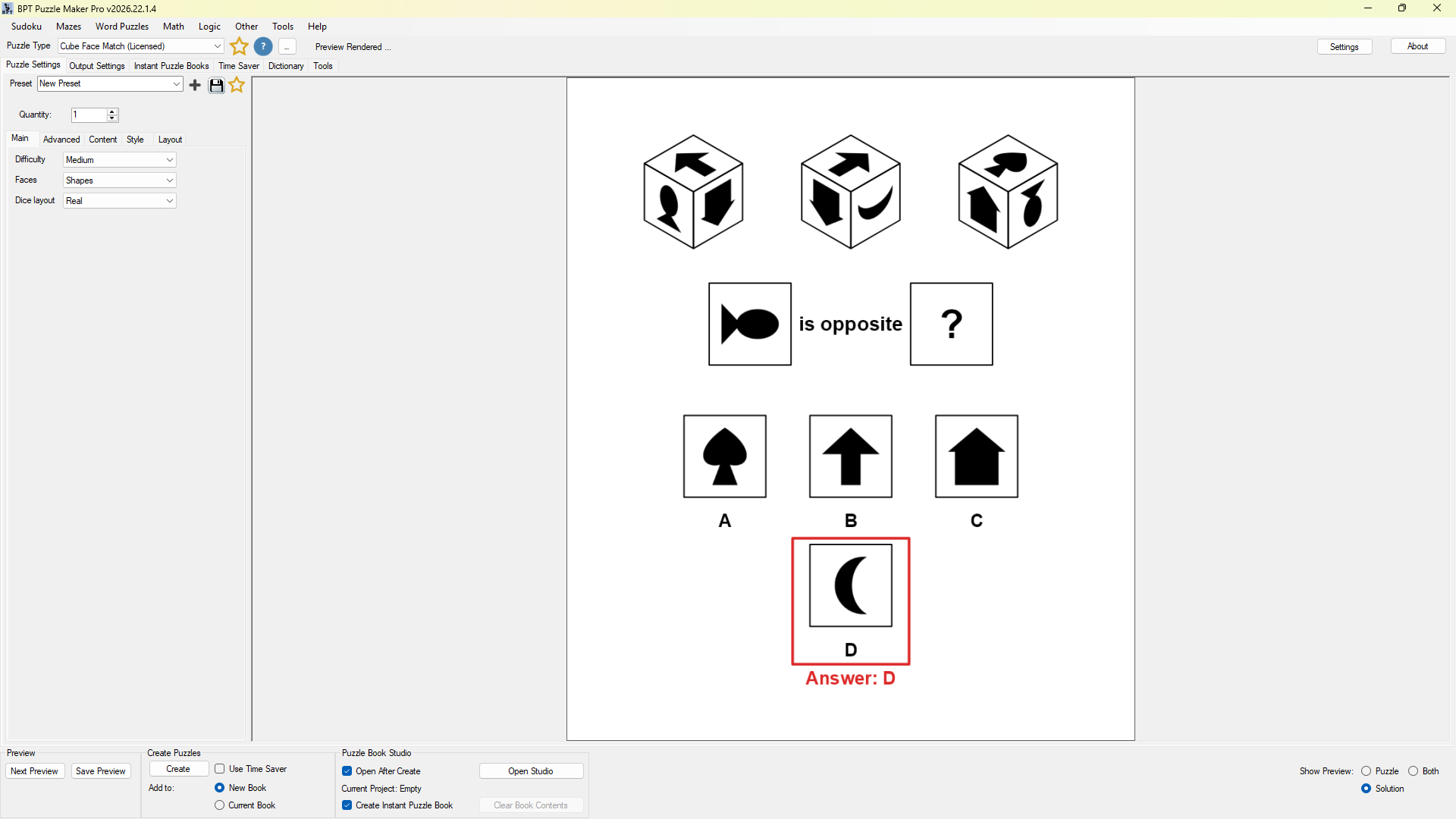
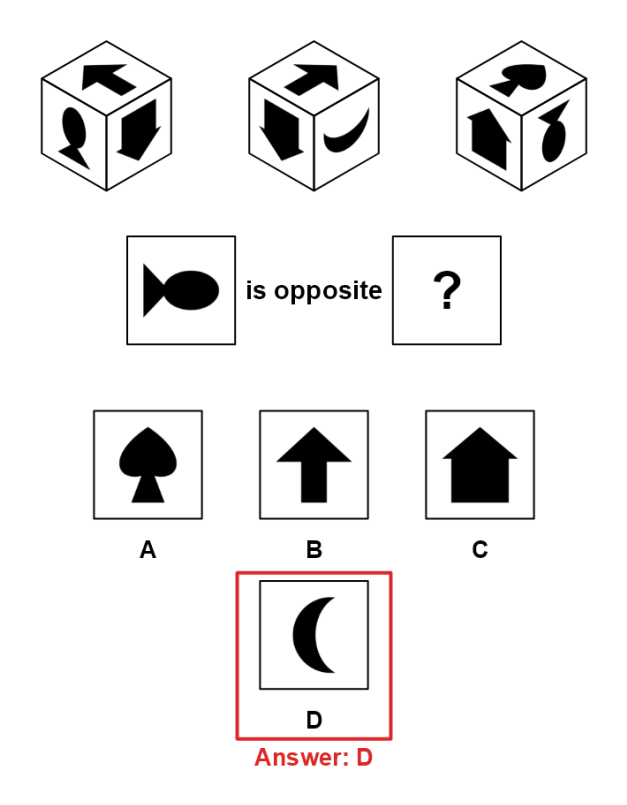
You could draw pages like that by hand, if you enjoy cutting out paper cubes to check that one stray face has not handed your puzzle two right answers. Or you pick a difficulty in Puzzle Maker Pro for Windows and print a page that a solver has already proven has exactly one. The answer key rings it and spells it out: “Answer: D.”
Teachers get wordless spatial-reasoning worksheets for grades 3 to 8 at three levels, each with its own answer sheet. Brain-training publishers get the cube question adults know from reasoning tests, graded from Easy to Hard, with a key no reader can argue with.
No words, no sums, just a cube to turn. Every edition makes all four kinds of cube question with a proven answer key; Creative adds your own faces, and Productivity makes whole graded sets in one batch. Try a cube puzzle free and see whether the lie catches you.

Four Questions, One Cube, a Different Kind of Page
Most puzzle pages ask what your reader knows. A cube page asks how they see: mental rotation, not memory. That is why it stands out in a book of word searches, and why a class that races through crosswords slows right down.
Each puzzle shows one cube from several corners and asks one of four questions:
- Hidden face. The views show five faces between them. Which picture is on the sixth?
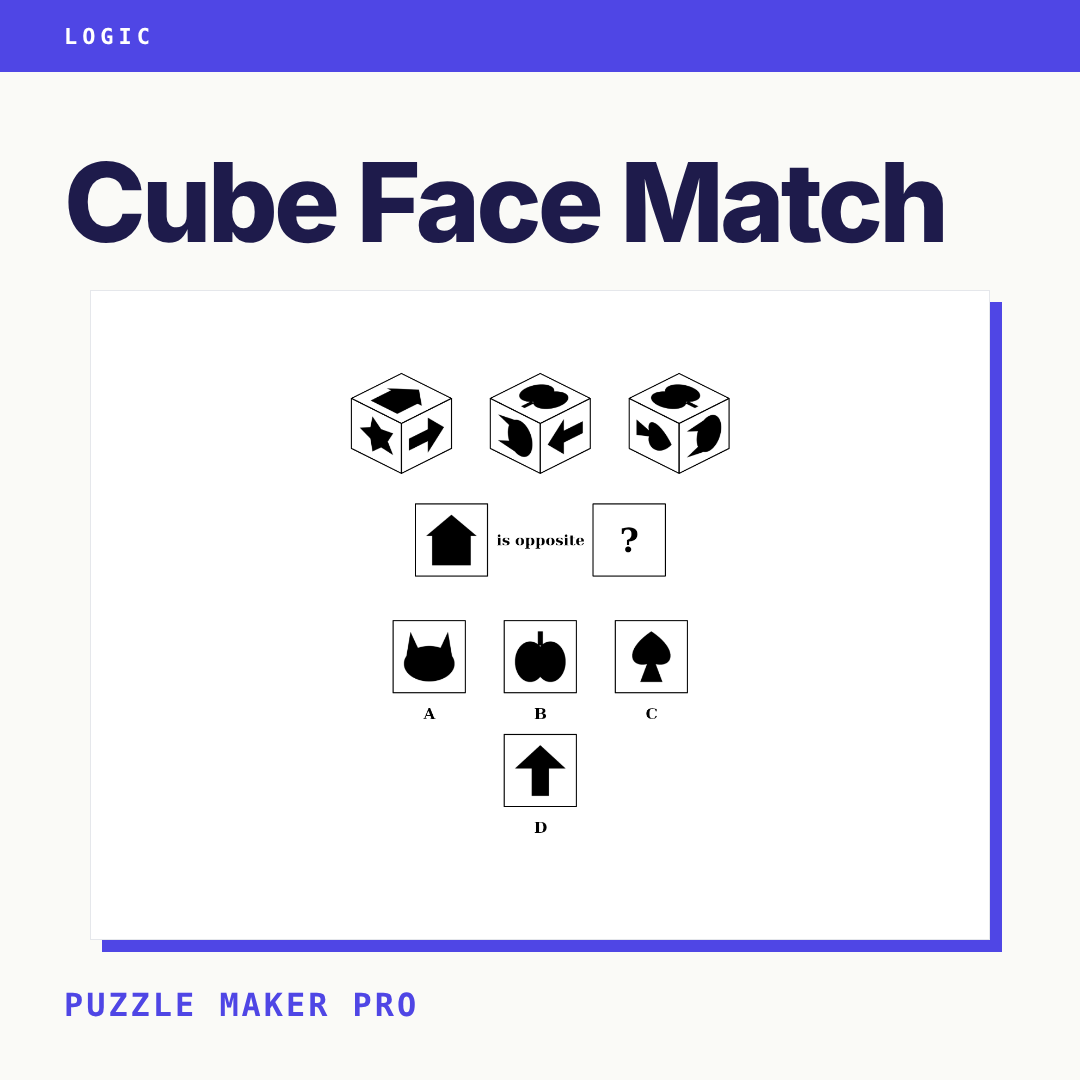
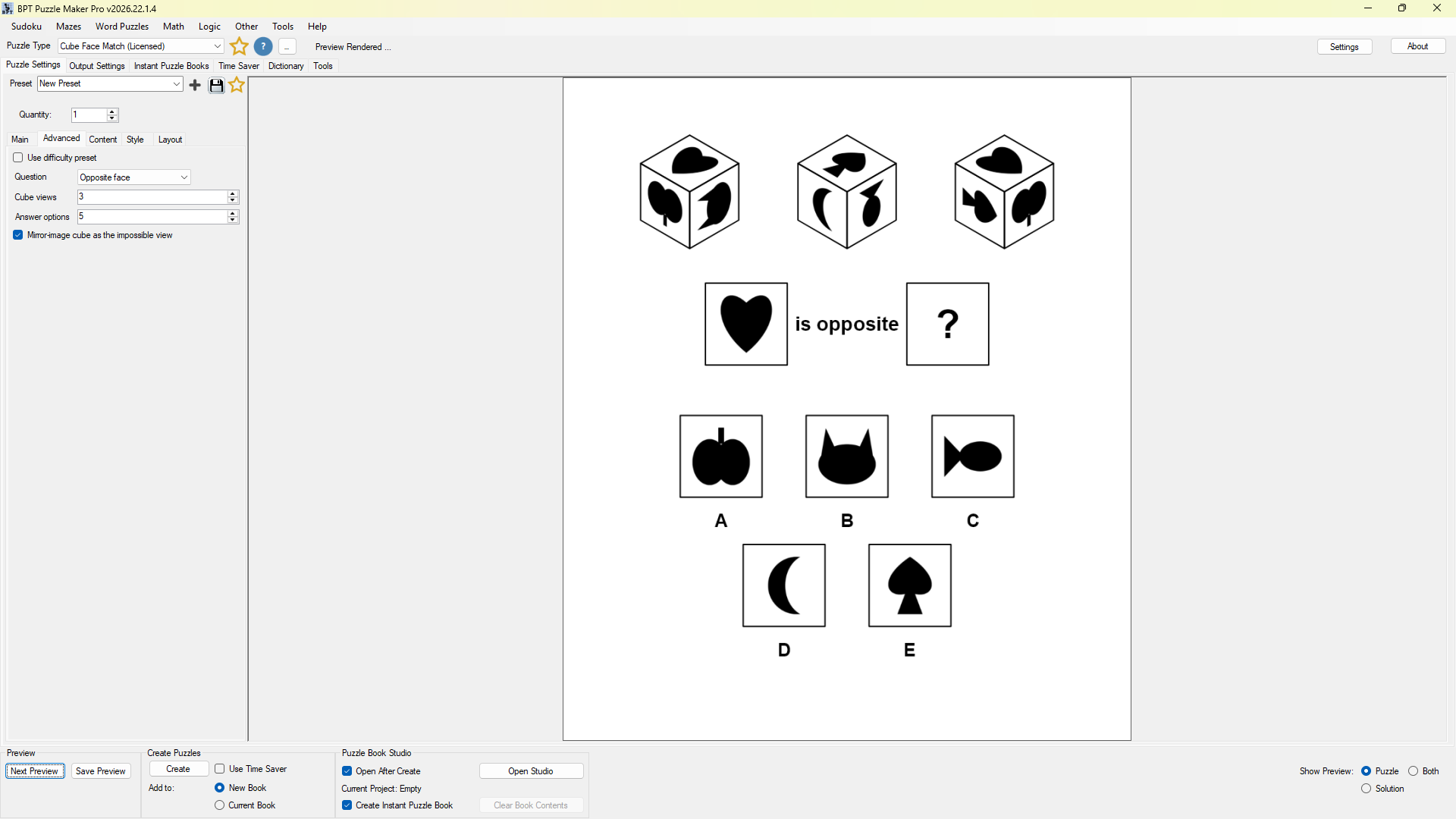
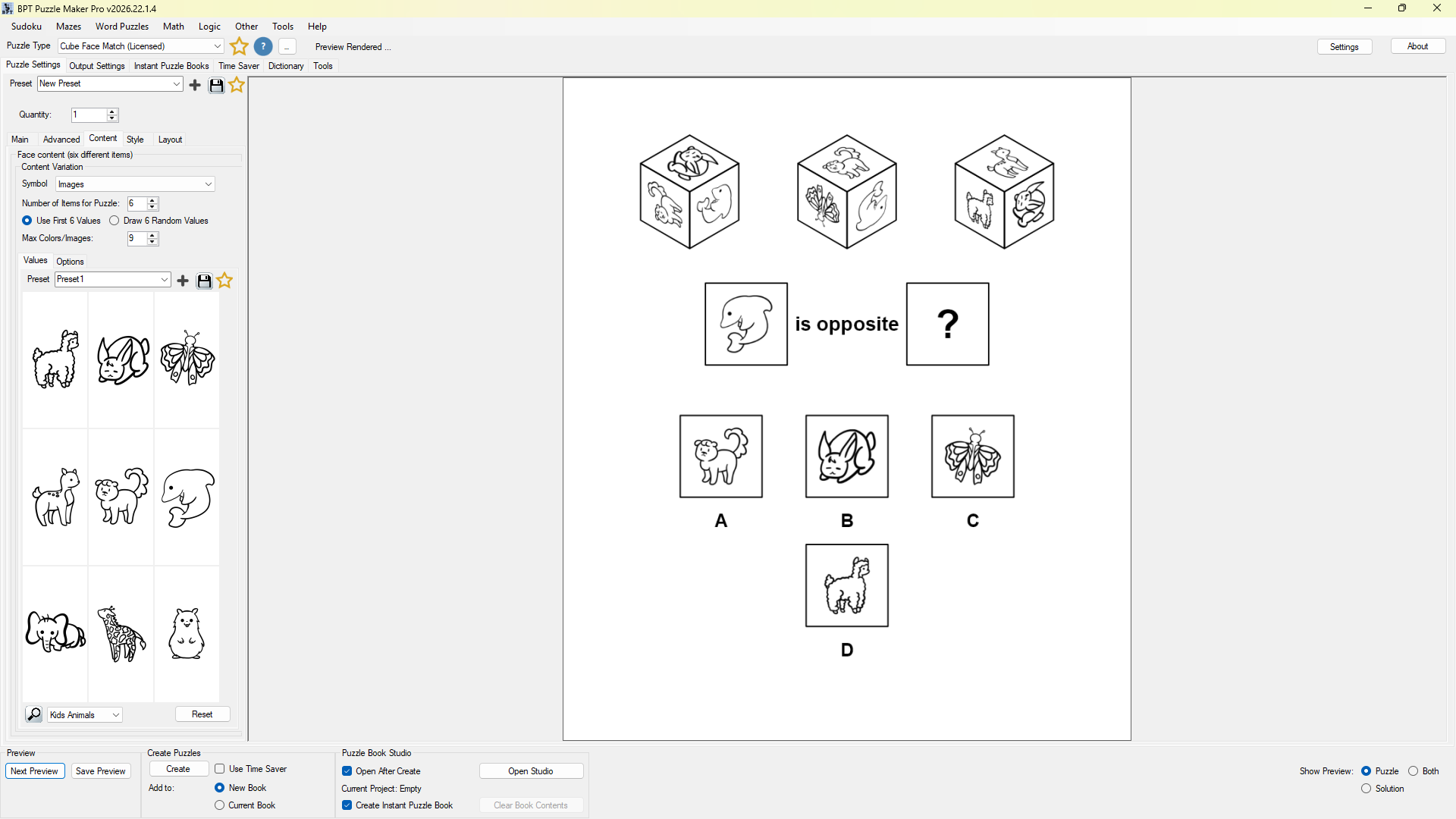
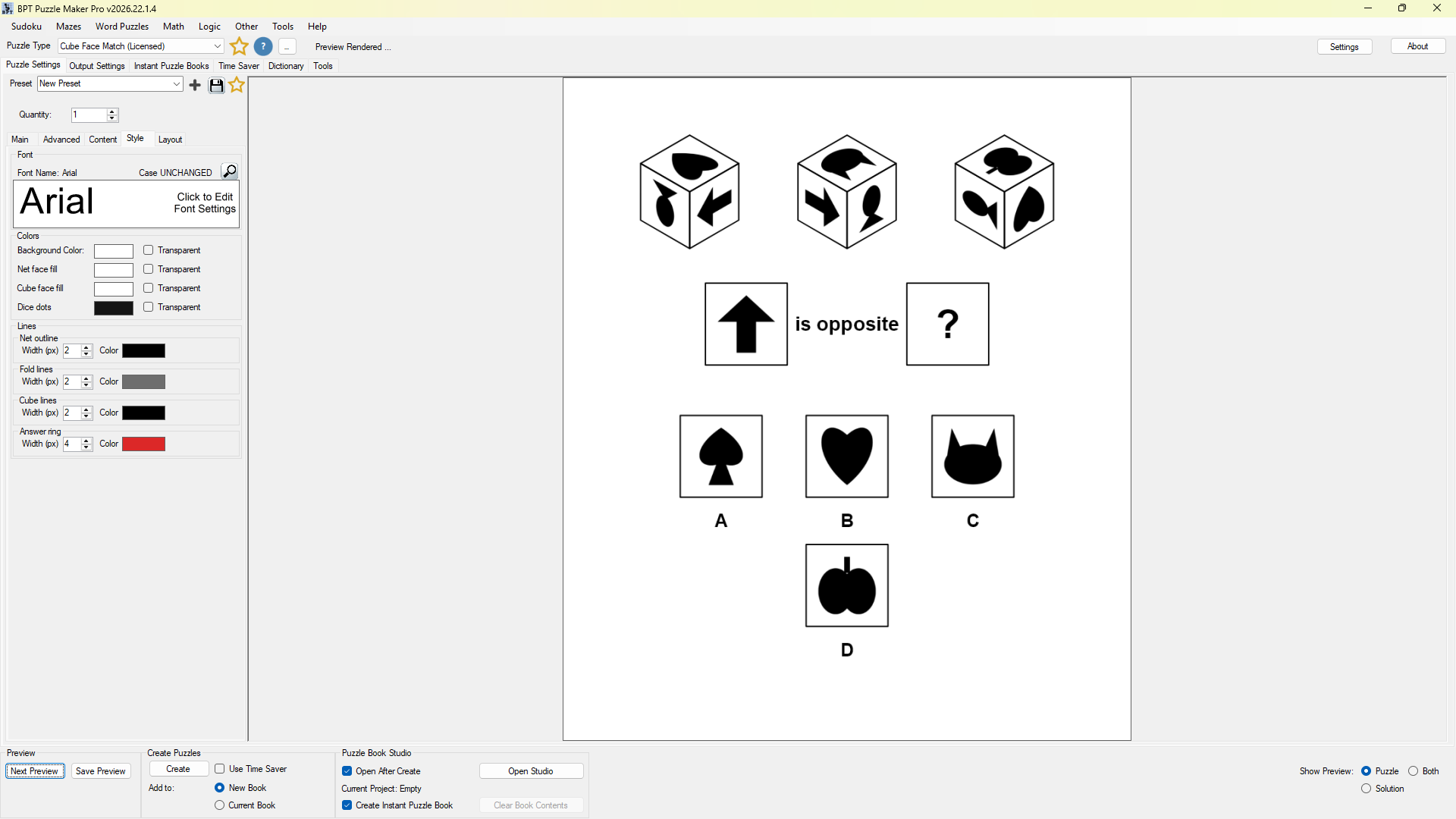
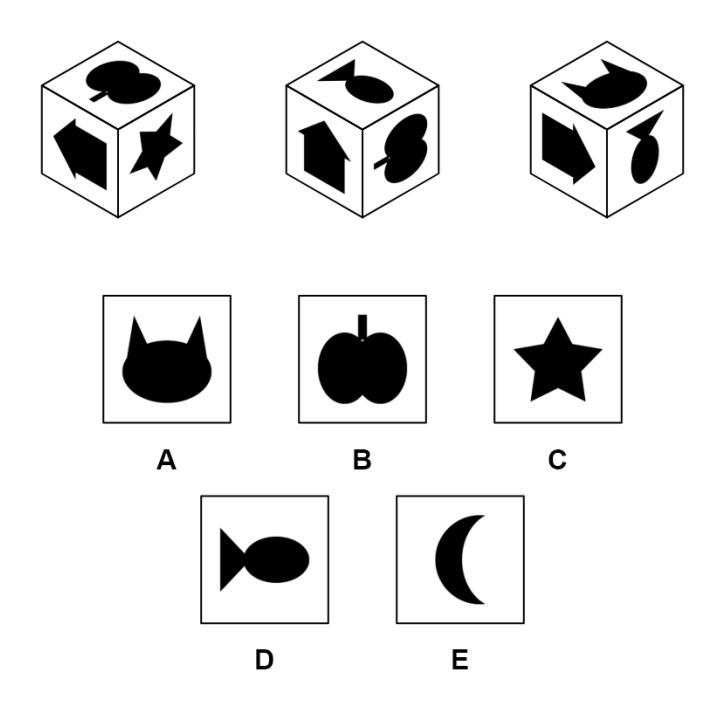
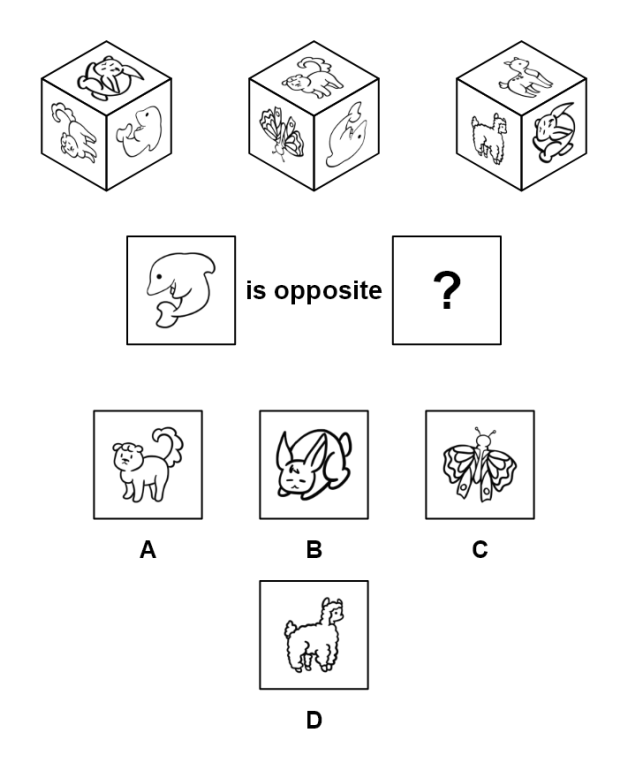
- Opposite face. “The fish is opposite ?” The views hold just enough clues to pin down the one face across from it.
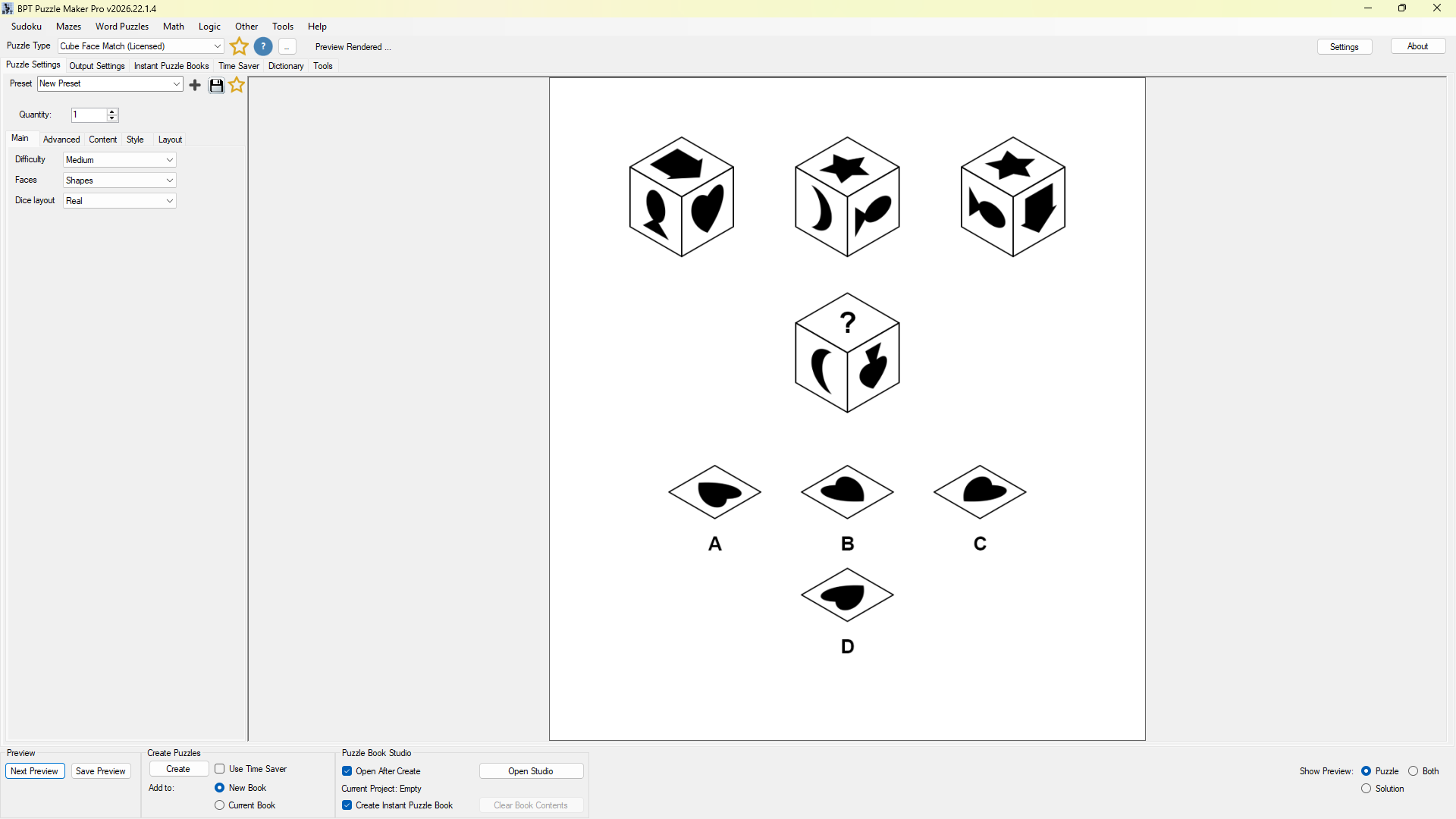
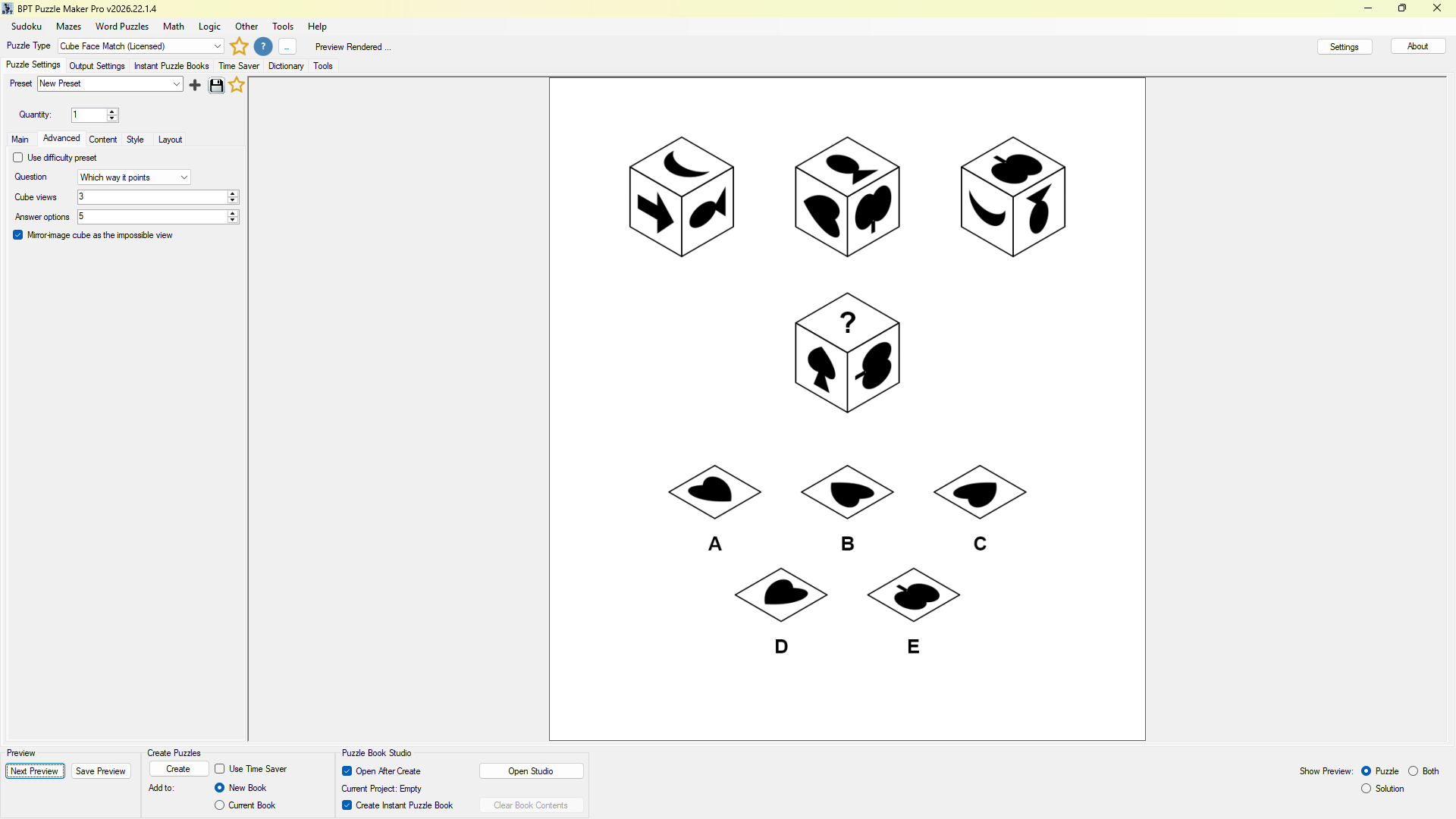
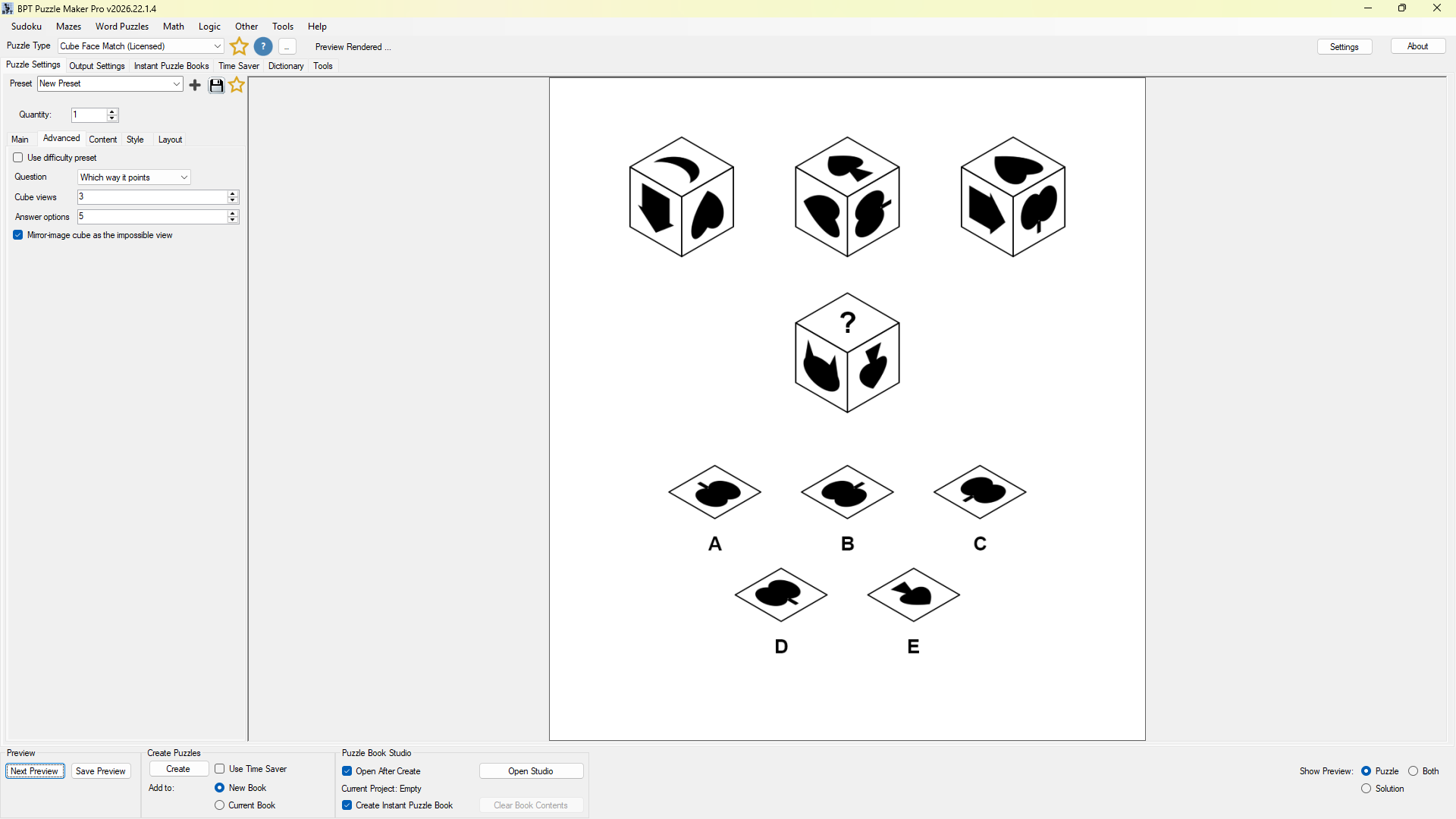
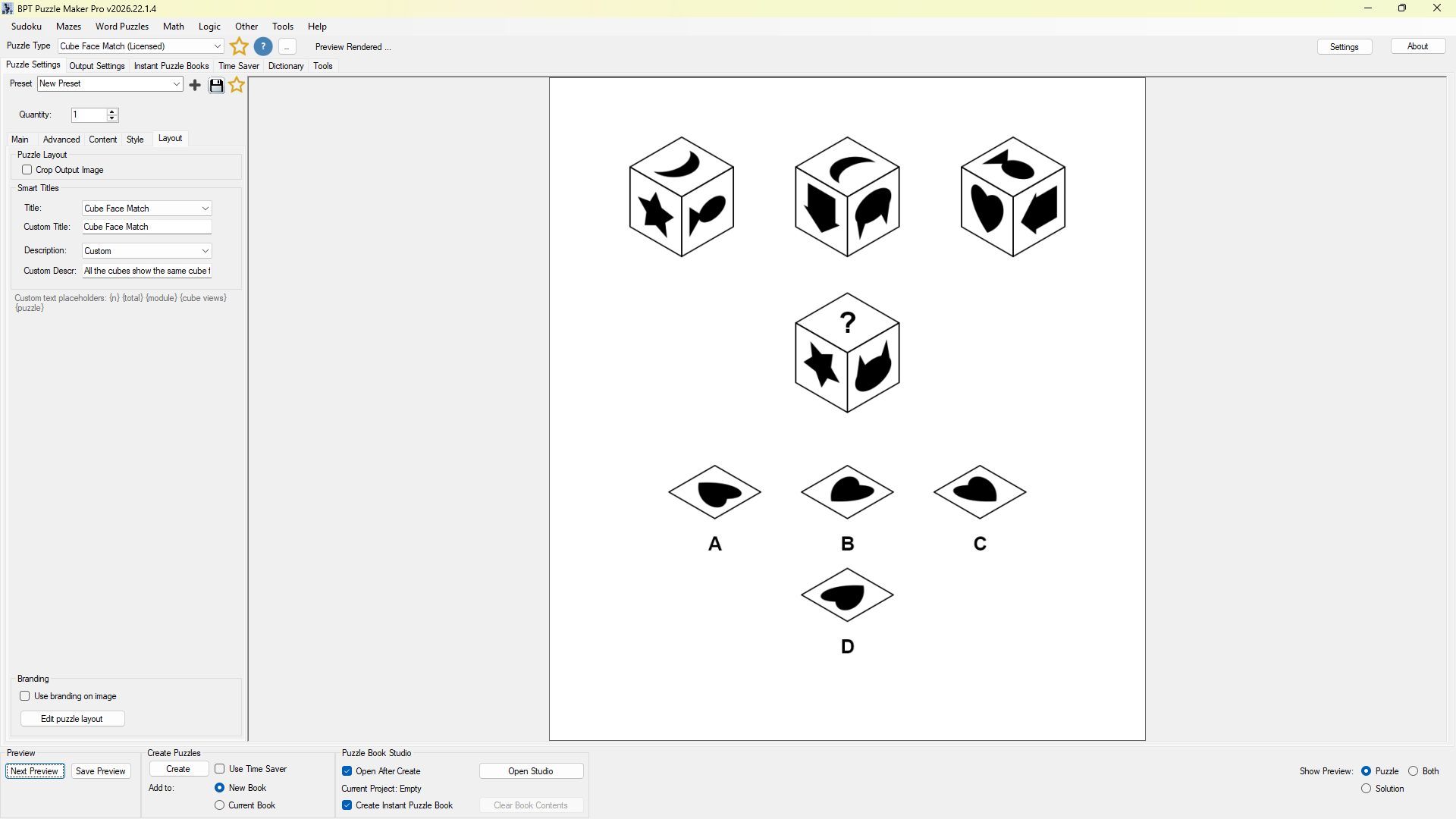
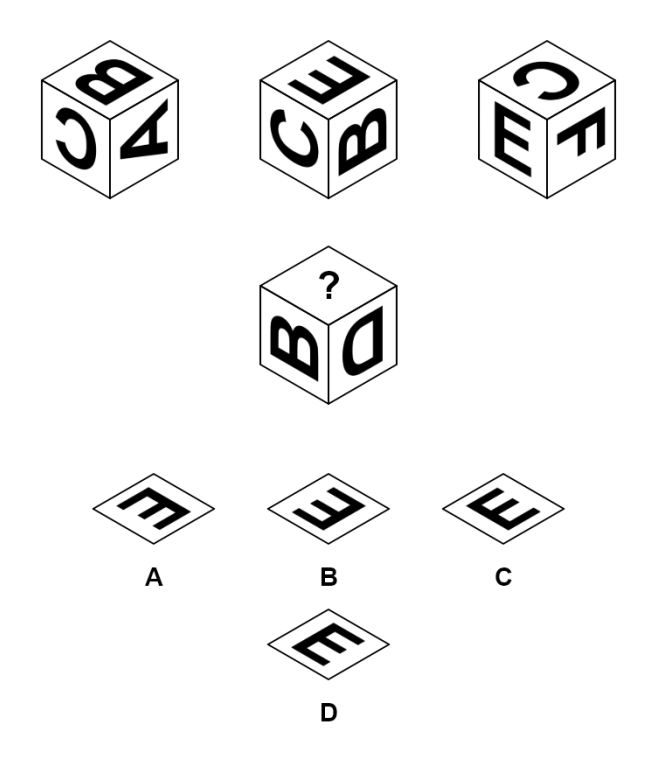
- Which way it points. A new corner of the cube with a question mark on top. What belongs under that question mark, and which way does it face? With the built-in shapes, picking the right face is not enough: the turn has to be right too.
- Impossible view. A row of three to six cubes, all claiming to be this one. One of them cannot be.
Or untick Use difficulty preset, choose Mixed, and every puzzle in the set draws its own question, so a reader never knows what the next page will ask.

Trap Answers That Reward a Careful Eye
A multiple-choice page is only as good as its wrong answers. Make them silly and the reader guesses; make them sneaky and the reader has to think.
You get sneaky ones. On an impossible-view puzzle, the cube that cannot exist might show two opposite faces side by side, two faces swapped, the same face twice, or, on Hard, the mirror image: a cube where every face checks out one by one and that still cannot be turned into the real one. It is the wrong answer that catches readers who check faces instead of turning the cube. On a “which way it points” puzzle with the built-in shapes, the right face turned the wrong way can sit among the options, waiting for a hurried solver.
The traps also know your content. If a wrong answer would look correct because of how a face picture is drawn, it is thrown out and replaced, so every option on the page earns its place.
And when your reader checks the key, the traps turn into the lesson. “I picked C. Oh. It’s flipped.” That moment is where the spatial reasoning actually happens.
One Proven Answer on Every Page
Your reader circles B, flips to the key, finds D, and spends ten minutes trying to prove the key wrong. If they ever succeed, that reader does not buy your next book.
So a solver tries to break every page before you ever see it. It tries every way the cube’s six faces could be arranged and confirms that the page allows exactly one correct option. Two answers that both fit? The puzzle is thrown out. The answer key then rings the right option and prints its letter underneath, so checking takes a second.

Easy to Hard: Fewer Clues, More Choices, Sharper Traps
Fast finishers who blow through every worksheet in three minutes? A brain-training book that has to get harder by the last chapter? You set the climb with one dropdown.
| Difficulty | Question | What the solver sees | Answer options |
|---|---|---|---|
| Easy | Hidden face | 4 views of the cube | 3 |
| Medium | Opposite face or Which way it points | 3 views of the cube | 4 |
| Hard | Which way it points, or Impossible view with the mirror trap on | 2 views, or 5 cubes to compare | 5 |
On the view-based questions the clues shrink as the puzzles get harder: four corners of a cube give away almost everything, two make the solver work for every face. Impossible-view puzzles work differently, because the options are the cubes themselves, and at Hard one of five may be the mirror image.
In a classroom the three levels span grades 3 to 8, and Hard reaches the level of adult spatial-reasoning tests, so the same tool serves your adult readers too. Want something in between? Untick Use difficulty preset and choose the question, two to four views and three to six answer options yourself (opposite-face puzzles go up to five; impossible-view puzzles show one cube per option instead of separate views).
Ask for forty and you get forty different puzzles: every edition makes as many as you set in one run, and the generator steers clear of repeats within the set. Every edition covers all four questions and all three levels, so pick yours in the switcher above.
Animal Cubes, Letter Cubes, Color Cubes (Creative)
The logic of a cube puzzle never changes. What is printed on the faces changes everything about who it is for.
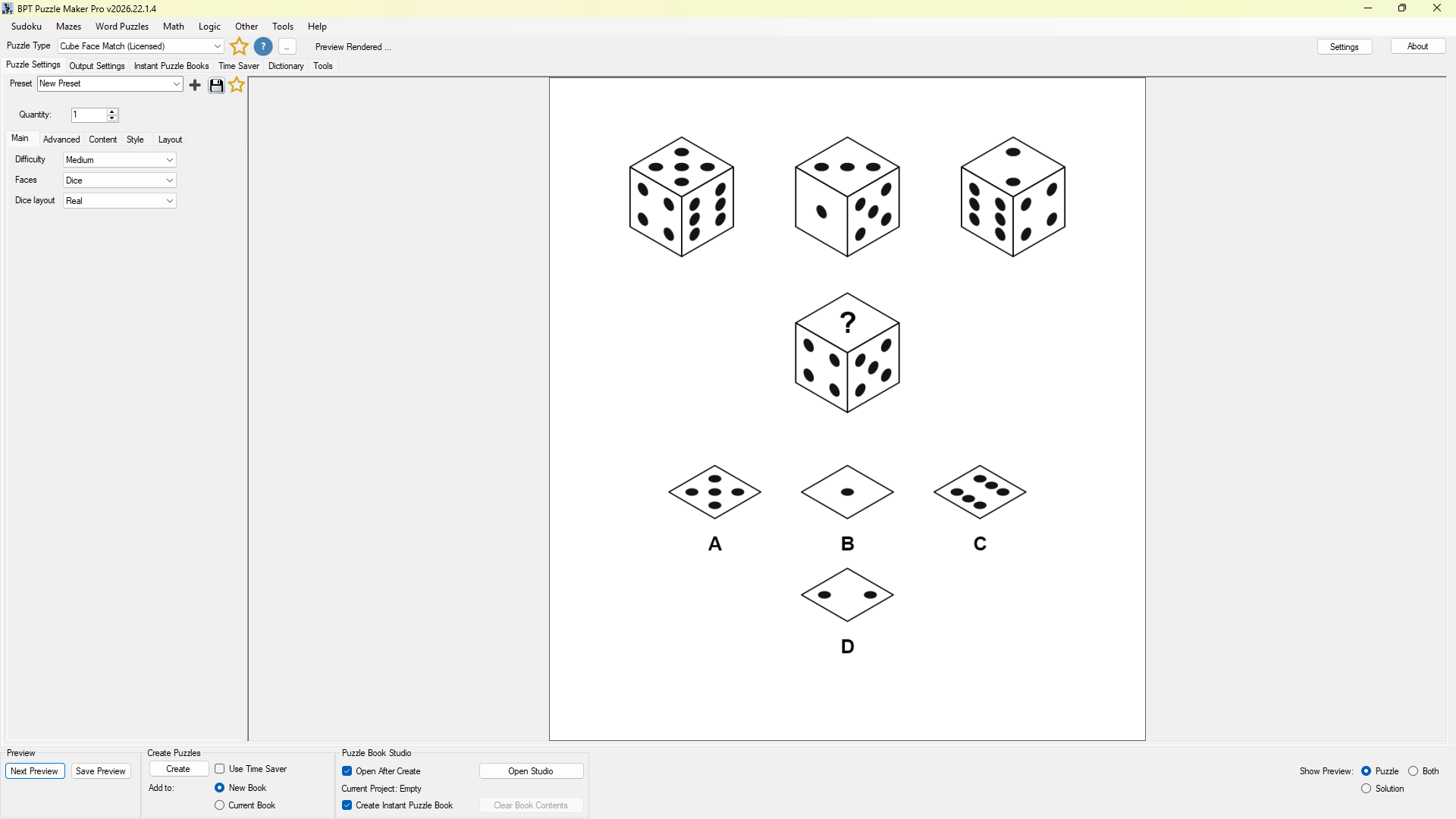
Out of the box, the faces wear one of three looks: nine bold built-in silhouettes (heart, star, arrow, crescent, house, fish, cat, apple, spade), classic dice dots, or the numbers 1 to 6. Pick the Real dice layout and opposite faces add up to seven, just like the die on a game table, so a sharp solver can use that rule as a clue.
With Creative, the cube faces become yours. Choose any six letters, numbers, colors or pictures, or pull them from an image list:
- Animal cubes at Easy for a younger brain-break folder.
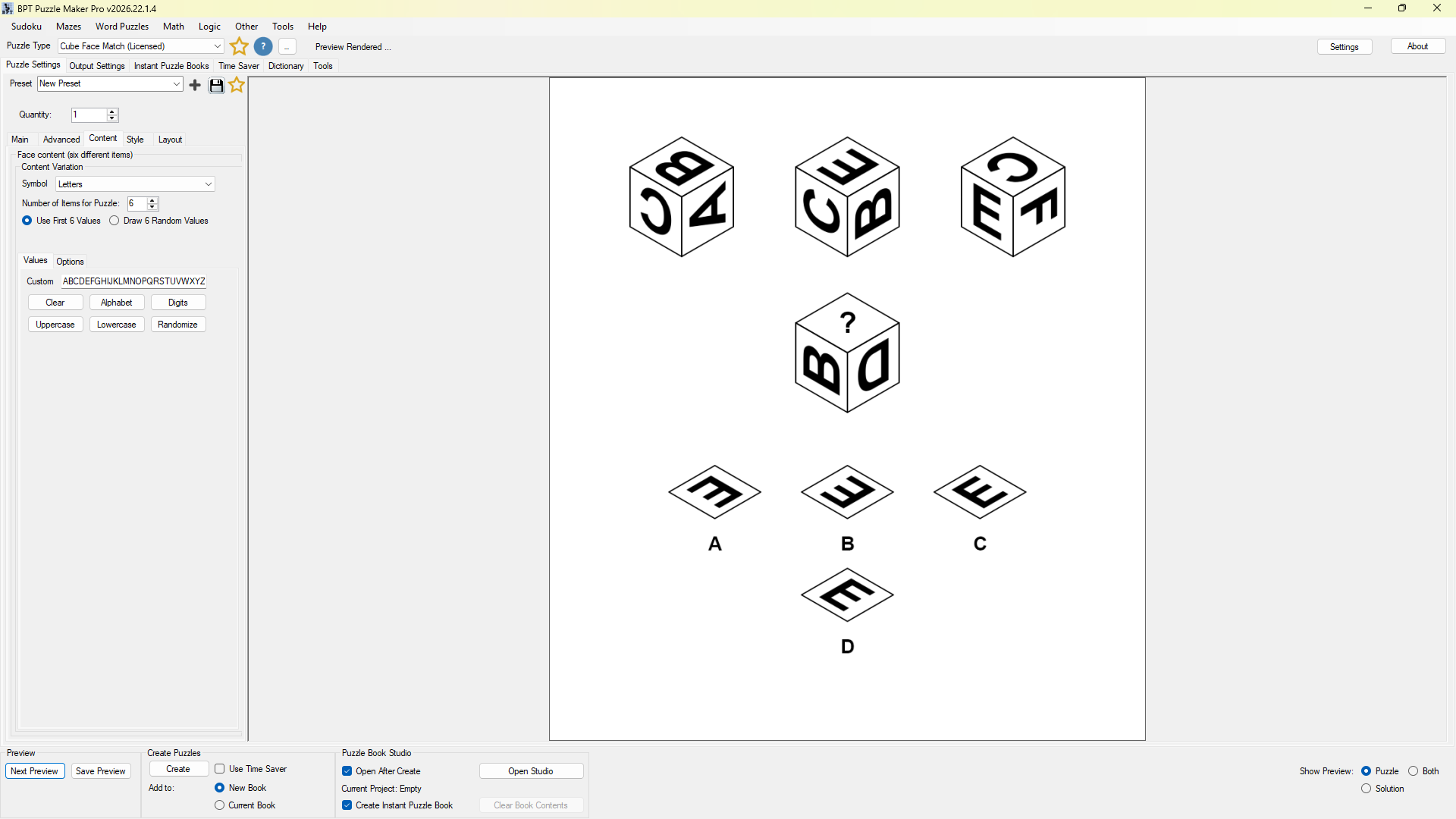
- Letter cubes for an adult puzzle book, where a turned E is easy to spot and easy to get wrong.
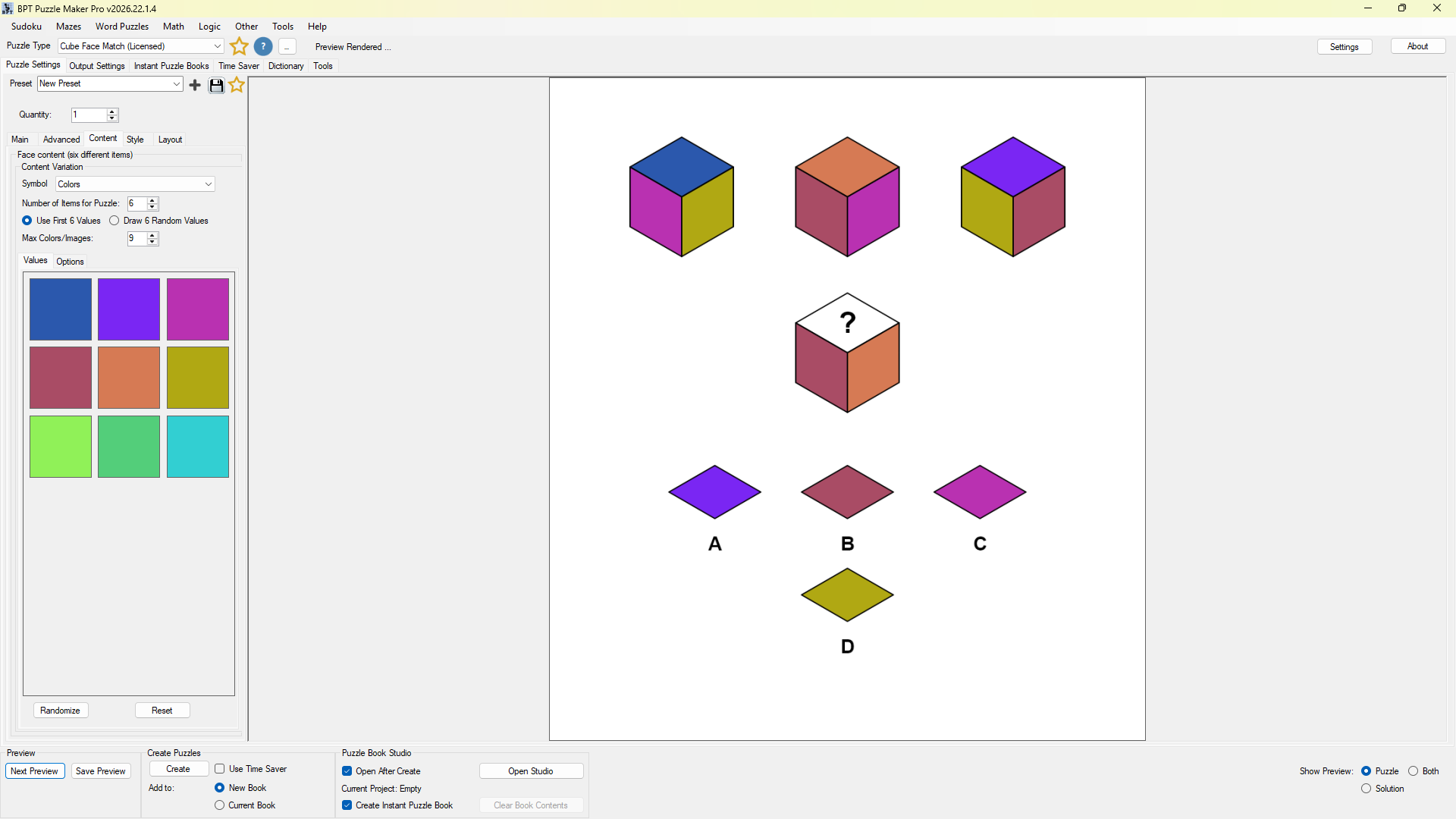
- Color cubes for young solvers on a screen, a projector or a color printer.
- Seasonal or school picture sets for a monthly packet that never looks the same twice.


Plain colors have no “which way”, so on color cubes the which-way question becomes a gentler one: which color is on top? That makes it a good first step for younger solvers.
One Cube Set, Five Places to Use It
The same set of cubes can fill a KDP chapter on Monday and an early-finisher folder on Tuesday.
- A spatial-reasoning chapter in an adult brain-training or mixed puzzle book, ramping from Easy to Hard.
- Early-finisher and brain-break packs for Teachers Pay Teachers, each puzzle with its own answer sheet.
- Themed activity pages: animal cubes, seasonal cubes, letter cubes (Creative).
- Game-night and dice-themed pages with the Real dice layout.
- Projector warm-ups: export a puzzle as an image and put it on the board for the whole class.
Every puzzle exports as JPG, PNG, SVG or print-ready PDF together with its answer sheet, so the key stays in your folder, not on the student’s desk. Running pages through a black-and-white copier or a grayscale KDP interior? Stick to the built-in shapes, dice dots or numbers, which are drawn in solid black. The answer ring is a style setting too: red for color books, black for grayscale, and bolder cube lines on the Style tab for a large-print edition.
From One Cube to a Whole Puzzle Book
One puzzle is a page. A book is forty of them in the right order, with the answers in the back and a reader who can find them.
Both book builders come with every edition. Instant Puzzle Books turns your settings into a finished book in one step: title page, table of contents, the puzzles, then the answers, and every puzzle page points the reader to the exact page of its answer. Puzzle Book Studio lets you lay out the same book page by page, with book themes, page art, how-to-play pages and your own titles, for one collection of puzzles.
With Productivity, Time Saver builds the graded set for you: one Easy row, one Medium row and one Hard row, each with its own settings, finished in a single batch. Puzzle Book Studio Productivity then combines several collections in one book, so the cube chapter becomes one section of a larger mixed puzzle book. Productivity also exports JSON, the puzzle data files for your own apps and workflows.
Play Cube Face Match on the Web (Interactive editions)
Hand a website visitor one cube and one question, and they learn what your book feels like better than any blurb could tell them.
Publish the set through the free BookPublisherTools WordPress plugin and your visitors are solving cube puzzles on your own site the same day. They see the puzzle as it prints, tap the option they believe, and find out at once whether they were right.
Pick the presentation that suits your site:
A puzzle list. Visitors pick a cube puzzle from a dropdown and start solving.
A leveled game. Your set turns into a trail of levels that can open one after another, with each visitor’s progress kept in their own browser. Finish the trail and your own message and button appear, for example “Enjoyed these? Get the full book,” linking wherever you choose.
Teachers can assign the trail as at-home spatial practice that climbs from Easy to Hard, and the player’s test mode ends a set on a results page, which turns the same puzzles into a quick check. Play a Cube Face Match puzzle to see how it feels.
Who This Is For
Adult brain-training and puzzle book publishers. Hand-drawn cube pages are slow to make and easy to get wrong. Yours can carry a graded chapter instead: four question types, Easy to Hard, every answer machine-checked. It is the page your large-print reader saves for last: no words to read, no sums, just a cube to turn.
Teachers, tutors and Teachers Pay Teachers sellers (grades 3 to 8). Build a leveled spatial-reasoning line you own: Easy, Medium and Hard packs titled with your own name, every puzzle with its answer sheet, and with Creative, themed to the month. In class it is a wordless early-finisher task that still takes a fast student more than a few minutes.
Activity-book publishers. Dice and number cubes in every edition, plus color, animal and letter cubes with Creative, so one tool covers your youngest solvers and your oldest.
Already a Puzzle Maker Pro user? Cube Face Match appears in the Puzzle Type list of the app you have, with the presets, Smart Titles and book builders you know. Productivity puts your cube sets in the same Time Saver grid as your other puzzle types.
Site owners and course creators. A playable cube trail gives visitors something to do, and the finish screen hands them your book while they are enjoying it.
Which Edition Should You Choose?
Start with what you want on the faces next month and how many graded sets you need. Every edition makes all four question types, the trap answers and a proven key, in any quantity per run. The editions part ways on three things: the faces, graded batching, and web play.
Cube Face Match (Standard). For cube pages in your books and packets now, with shapes, dice dots or numbers on the faces.
Creative. For when the look of the cube is the selling point: your own letters, numbers, colors, pictures and image lists.
Productivity. For when the cube chapter is one part of a bigger book or a product you supply: Time Saver makes Easy, Medium and Hard in one batch, Puzzle Book Studio Productivity combines several collections in one book, JSON export feeds your own tools, and you may supply the generated puzzles to other publishers.
Every edition includes: all four questions plus Mixed; trap answers including the mirror image; one solver-proven answer per puzzle; Easy, Medium and Hard presets or manual settings; built-in shapes, dice dots (Real or Random layout) or numbers 1 to 6; JPG, PNG, SVG and print PDF with answer sheets; styling; Instant Puzzle Books and Puzzle Book Studio.
| What changes between editions | Standard | Creative | Productivity |
|---|---|---|---|
| Your own letters, numbers, colors, pictures and image lists on the faces | ✓ | ✓ | |
| Time Saver: graded Easy, Medium and Hard sets in one batch | ✓ | ||
| Puzzle Book Studio Productivity: several collections in one book | ✓ | ||
| JSON export of the puzzle data for your own apps and workflows | ✓ | ||
| Web play on your own site, as a puzzle list or a leveled game | + Interactive | + Interactive | |
| License to sell finished books, worksheets and packs to your own readers and customers | ✓ | ✓ | ✓ |
| License to sell or supply the generated puzzles to other publishers and sellers | ✓ |
Want nets too? Cube Net Match asks the folding question: which cube does this flat net become? The Cube Match bundle gives you both puzzle types in the same five editions, for less than the two bought one at a time.
Pick your edition in the switcher above. Moving up later is always open, so start with what fits the book or packet in front of you.
Try It Before You Buy
Make a cube puzzle, solve it and check its key, all before you pay. The free Puzzle Maker Pro demo makes real Cube Face Match puzzles one at a time, as watermarked images; every paid edition lifts those limits and adds SVG and print PDF. Get the free demo, solve one cube, then come back to the edition switcher.
Licensing and Commercial Use
Cube Face Match and Cube Face Match Creative both let you sell the finished books, worksheets and packs you make to your own readers and customers, on KDP, Etsy, Teachers Pay Teachers or your own store. You pay once for a commercial-use license, and nothing you make carries a watermark.
Cube Face Match Productivity adds the right to sell or supply the generated puzzles to other publishers and sellers.
Editions differ in what you can make, never in whether you may sell it. Delivery is immediate: the download and your license land in your member area as soon as the order completes.
Product Details
| Product | Puzzle Maker Pro – Cube Face Match |
| Editions | Cube Face Match (Standard); Creative; Creative + Interactive; Productivity; Productivity + Interactive |
| Also in | The Cube Match bundle with Cube Net Match, same five editions |
| Platform | Windows desktop |
| Puzzle | One cube seen from several corners (2 to 4 views; impossible-view puzzles show one cube per option) and one multiple-choice question about it |
| Questions | Hidden face; Opposite face; Which way it points; Impossible view; Mixed |
| Answer options | 3 to 6 per puzzle (opposite face up to 5) |
| Solution | Exactly one correct option, proven by a solver; the answer sheet rings it and prints the letter, ring color set on the Style tab |
| Difficulty | Easy, Medium and Hard presets; on the view-based questions harder presets show fewer views and more options |
| Classroom range | Grades 3 to 8; Hard reaches adult spatial-reasoning test level |
| Wrong answers | Impossible view: opposite faces side by side, two faces swapped, a repeated face, or the mirror image (Hard, or when switched on). Which way it points: the right face turned the wrong way, on faces whose turn shows |
| Faces | Built-in shapes, dice dots (Real or Random layout) or numbers 1 to 6; your own letters, numbers, colors, pictures or image lists in Creative and up |
| Output formats | JPG, PNG, SVG, PDF, each puzzle with its answer sheet |
| Puzzle books | Instant Puzzle Books and Puzzle Book Studio on every edition; title page, table of contents and solution cross-references; several collections per book in Productivity |
| Batch creation | Any quantity per run on every edition; graded Time Saver batches in Productivity |
| JSON export | Productivity editions |
| Web play | Tap-to-answer play on your own site through the WordPress plugin, as a list or a leveled game (Interactive editions) |
| Upgrades | Move up to any higher edition after you buy |
| Commercial license | Sell finished books, worksheets and packs to your own readers and customers (Standard and Creative); Productivity adds selling or supplying the generated puzzles to other publishers and sellers |
| Free demo | Yes |
| Delivery | Immediate, in your member area |
Questions Before You Buy
Is there a free demo?
Yes. Get the free Puzzle Maker Pro demo, generate a Cube Face Match puzzle, solve it and check its answer before you buy. The demo makes one puzzle at a time, as a watermarked image.
Which edition do I need?
Start from what goes on the faces and how many sets you make. Built-in shapes, dice dots and numbers with every question and both book builders: Standard. Your own pictures, letters or colors: Creative. Graded sets in one Time Saver batch: Productivity. Add Interactive to Creative or Productivity for play on your website. The full ladder is on Puzzle Maker Pro Editions Explained.
What grades is it for?
Grades 3 to 8 in class, with Easy for the youngest solvers. Hard reaches the level of adult spatial-reasoning tests, so the same puzzles work in an adult brain-training book.
Does it print in black and white?
Yes. The built-in shapes, dice dots and numbers are drawn in solid black, so they copy cleanly. Switch the answer ring from red to black on the Style tab for a grayscale interior, and save color faces for screens, projectors and color printing.
Can I sell what I make?
Yes. Cube Face Match and Cube Face Match Creative both let you sell the finished books, worksheets and printable packs you make to your own readers and customers. Productivity adds the right to sell or supply the generated puzzles themselves to other publishers and sellers.
Does every puzzle really have only one right answer?
Yes. Before a puzzle is printed, a solver checks every possible arrangement of the cube’s faces against the page and confirms that exactly one option fits. If two options could both be right, the puzzle is never used.
How do I make puzzles easier or harder?
Pick Easy, Medium or Hard. On the view-based questions, harder puzzles show fewer views of the cube (four, then three, then two) and give more answer options. Hard also brings in impossible-view puzzles, where five cubes sit side by side and the mirror trap is on. For full control, untick Use difficulty preset and choose the question, the number of views and the number of options yourself.
What is the mirror trap?
On an impossible-view puzzle, one of the cubes can be the mirror image of the real one: every face looks right, but no amount of turning makes it match. Hard switches it on for you, and with the preset off you can switch it on or off yourself.
Can I put my own pictures on the cube?
Yes, with Creative and up. Choose six different letters, numbers, colors or pictures, or pick them from an image list, and every puzzle in the set uses them.
Will my readers know what to do?
Each puzzle shows its question on the page: a question mark on top of a new view of the cube, “is opposite” between two faces, a row of cubes where one cannot be the real one, or, for the hidden face, views that show five faces above a row of possible sixth faces. Every puzzle also carries a title and a one-line description you can edit, such as “All the cubes show the same cube from different sides. Use them to answer the question.”
Cube Face Match or Cube Net Match?
Cube Face Match shows a cube from several corners and asks about its faces. Cube Net Match shows a flat net and asks which cube it folds into, or the other way round. Both run in the same Puzzle Maker Pro app, and the Cube Match bundle gives you both for less than buying them separately.
Can my readers play these online?
Yes, with Creative + Interactive or Productivity + Interactive. Publish the set through the free WordPress plugin, and visitors tap an answer and see right away whether they got it.
Can I upgrade later?
Yes. Move up the ladder whenever you need more production power, or add Interactive on top of Creative or Productivity, at any time after you buy. Nothing you choose today locks you in.
Give Your Readers the Page They Have to Turn in Their Heads
Without a page that makes readers turn something in their heads, your next puzzle book is another stack of grids, and your early-finisher folder is another stack of word searches.
Now picture the chapter that opens with four friendly views of a cube covered in dice dots and ends with five cubes that all swear they are the same one, a mirror image hiding among them. A reader stares at option C, turns it once more in their head, laughs, and circles D. Then they reach for the next page.
Pick your edition in the switcher above, or grab the free demo first, set Difficulty to Hard, and see how long one cube can hold you.


