

A niche drill-down ends in a phrase such as “large print pickleball word search for seniors”. Treat that phrase as a build spec, not just a search phrase. Every part of it is a setting: a trim size, a grid size, a word list, a puzzle type, the directions words run and a place for the answer key. Write those settings down before you generate anything, then do one sum: can the theme fill the book the phrase promises? Some niches cannot, and it is better to find out on paper than in the reviews.
Puzzle book niche research is the short half. Narrow by audience, theme, format and benefit, and check the phrases buyers type in Amazon’s search suggestions and, if you run ads, your own search-term report. Amazon publishes no search volume, so any number a tool shows for a phrase is an estimate. Research says whether people want the book. This guide is about whether you can build it well.
From a niche phrase to a list of settings
Take the example phrase apart, one part at a time:
| Part of the phrase | What it decides | Setting in the spec |
|---|---|---|
| large print (benefit) | Type size and cells per page | 8.5×11 trim, one puzzle per page, a 12×12 grid |
| for seniors (audience) | Which directions words run | Diagonals and Backwards off (easier to read) |
| pickleball (theme) | The words | One list file, pickleball-seniors-en.txt |
| word search (format) | The puzzle type | Standard Word Search |
| (implied by all four) | The answer key | Solutions at the back (Puzzles First, Then Solutions), full size |
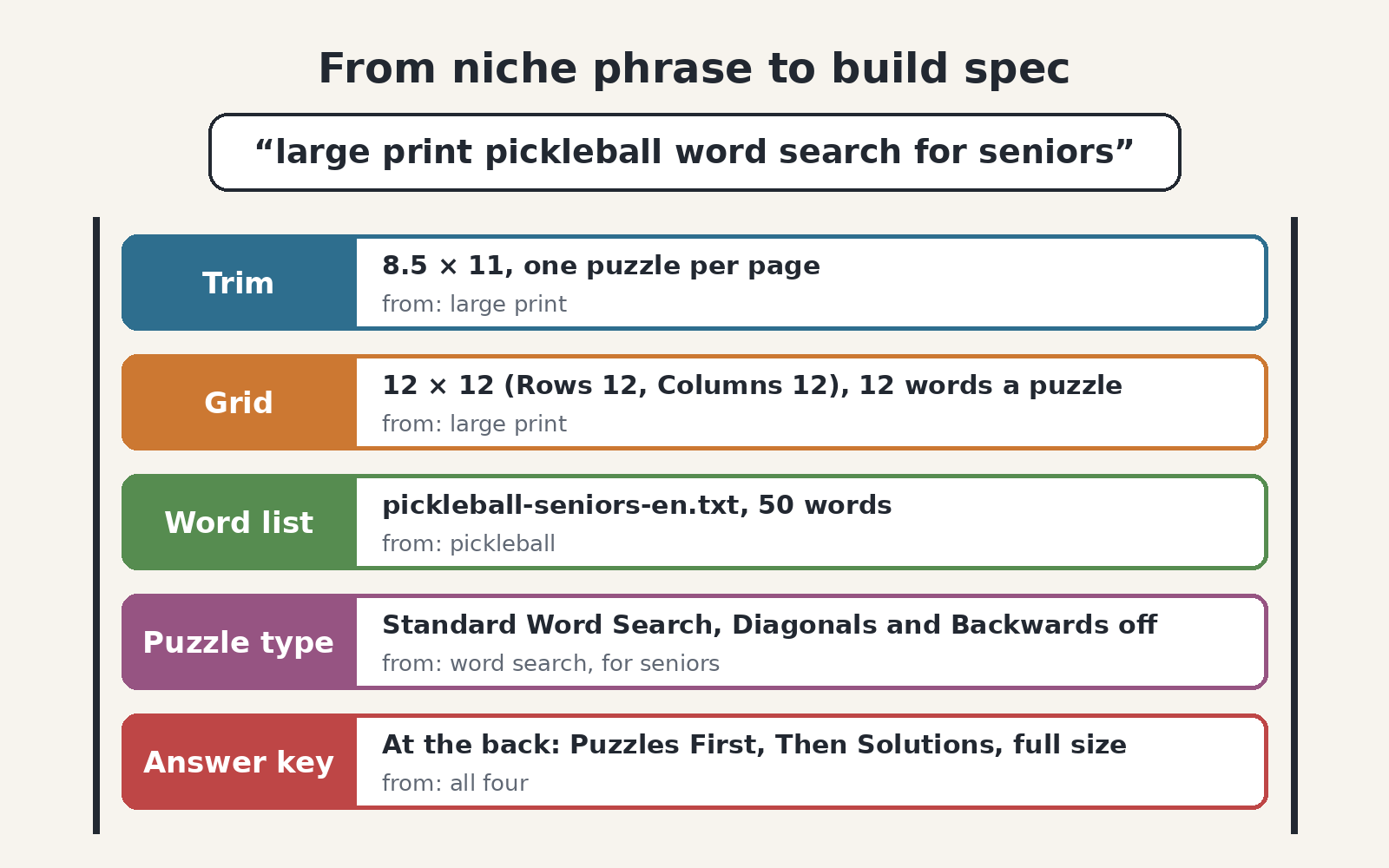
In Puzzle Maker Pro, a Windows puzzle maker for publishers, each row of that table maps to a setting you can save, in the puzzle module or in the book settings. That makes the phrase a build spec.
Audience and benefit set the grid size and print size
Large print means bigger cells, and bigger cells mean fewer of them on the page. Large print puzzle books for KDP covers why a 20×20 word search does not survive as large print on the same trim: the grid drops to something like 12×12, the trim grows, or both. Settle the grid with a test print at final size, on the paper KDP will print on (white or cream), then write it into the spec.
The word list must grow with the grid. One Amazon review of a large print word search book complained that only the word list was large: “The puzzle itself has small letters… headaches!” So a large print page carries a large grid and a large list, and that leaves room for fewer words per puzzle.
On Standard Word Search, Rows and Columns run from 5 to 200. Any word longer than the larger of the two is dropped before placement, so on a 12×12 grid a 13-letter entry such as NONVOLLEYZONE never appears. To cap words per puzzle, clear Unlimited Words on the Options tab and set Max Words (1 to 50). Diagonals and Backwards are off by default, so every word reads left to right or top to bottom. The example spec uses 12 words a puzzle; the Stats tab shows used and unused words after a test run, so you can confirm your own number.
Theme sets the word list, and the word list sets the limit
This is where narrow niches fail. For this example we drafted a pickleball list by hand: 50 single words, from PADDLE and KITCHEN to DINK and BACKSPIN. Many of them are plain sports words (BALL, NET, GAME, SCORE). The words that belong only to pickleball are a short list.
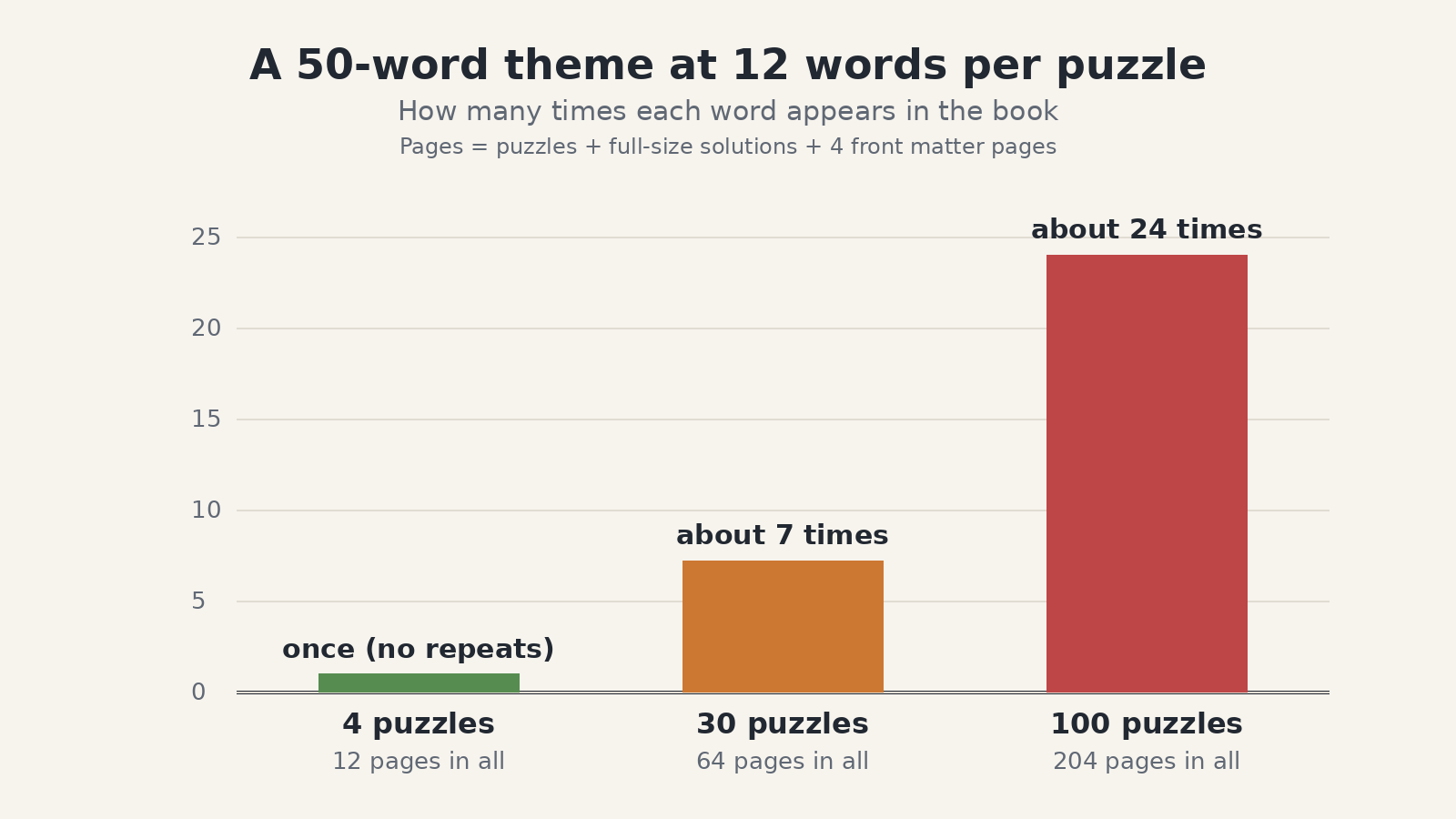
Now the sum. At 12 words a puzzle, 50 words cover four puzzles before any word repeats. A 100-puzzle book needs 1,200 word placements, so each word turns up about 24 times. One review of a word search book put that experience plainly: “be prepared to look for the same words over and over again!”
You can see the limit before you promise anything. Tick Use Words Only Once on Standard Word Search and set Min Words to your words per puzzle (12 here). When the unused words drop below that number, it tells you all words have been used and asks whether to create more puzzles. Run the theme list once that way and you see roughly how many puzzles it can carry.
Other puzzle types read the same list differently:
- Wordoku (a sudoku that uses letters and hides one word in the grid) in its classic mode needs one word per puzzle with exactly 4, 6, 8 or 9 letters and no repeated letter. Only 11 of the 50 pickleball words qualify (DINK, PICKLE and BACKSPIN do; KITCHEN and PADDLE do not), so the theme gives at most 11 different hidden words. Verify Word List reports which entries work. Long qualifying words are scarce: in the 44,718-word English list we checked, about 82% of four-letter words have no repeated letter, but only about 11% of nine-letter words do.
- Hexagon Word Search sets the longest word on a hexagon board at one short of double the board size (9 letters at size 5) and shows that limit live as you change the board, so you can see which long words will not fit a smaller large print board before you paste the list.
- Easy Cryptograms carries a theme in phrases. With Entire List on and Multiple Words Per Image at 1, forty sayings you wrote yourself make forty pages.
How to build and keep the list itself is covered in word lists for puzzle books.
When a niche cannot fill a book
The theme limit changes the page count, and the page count is part of what your listing promises. “100 large print puzzles” with full-size solutions is 100 puzzle pages, 100 solution pages and about four pages of front matter: around 204 pages. The arithmetic is laid out in puzzle book trim size and page count.
When the sum fails, you have four honest choices:
- Promise fewer puzzles. Thirty puzzles is about 64 pages, with each word used about seven times. That is a slim paperback, so put the real count in the title and price it as a short book.
- Make it a printable pack instead. A 20-page Etsy pack, delivered as a PDF, can be a good product where a paperback would be thin: 8.5×11 is US Letter, so the same spec prints at home. A thin theme that cannot fill 100 puzzles fills ten puzzles and ten answer pages, with each word used two or three times.
- Widen one rung and say so. “Racket sports” carries more words than pickleball alone. The listing then has to say racket sports, not pickleball.
- Park the niche. If the honest book is smaller than the buyer expects, skip it and build the next phrase on your list.
Do not pad the list with words nobody connects to the theme. Buyers notice.
Turning the spec into a project you can repeat
Keep the spec as a short card next to the word list: phrase, trim, Rows and Columns, Max Words, directions, list file, puzzle count, repeats per word and page count, so the listing promises only what the book holds. Save the puzzle settings as a preset, so the next large print title starts from the same numbers.
Puzzle Book Studio, the book layout workspace in Puzzle Maker Pro, saves the whole book as a project: puzzle sets, layout settings and your own pages. Its Warnings panel flags a word list that does not fit its space, which matters once large type makes the list longer. By default each puzzle page holds one puzzle and each solution page one solution; set Puzzles First, Then Solutions to put the answer key at the back. A book made from one puzzle set works on every edition. A book with more than one puzzle set, for example a section per subtheme from separate runs, needs the Productivity edition (the batch level), or an older Time Saver (batch add-on) purchase, on every module whose puzzles go into it. You can move up to any higher edition later.
The next niche is a new phrase run through the same card. Niche puzzle catalog architecture shows how those lists sit in folders under one look, one design system across puzzle niches covers keeping that look fixed, and 104 KDP books a year covers how many finished specs one person can proof. When the spec is settled, a listing title that names the pencil job helps you write the title.
Every paid Puzzle Maker Pro edition lets you sell the finished books and printable packs you make to your own readers and customers, on KDP, Etsy or your own store. The Productivity level adds the right to sell or supply the generated puzzles to other publishers and sellers. Your word lists and phrases still need to be yours or used with permission for where you sell.
Get the free Puzzle Maker Pro demo now
Other puzzles you might like
- Large print puzzle books for KDP: what changes on the page when the print gets bigger.
- Word lists for puzzle books: building lists that feed more than one product.
- Puzzle book trim size and page count: the page count arithmetic in full.
- Niche puzzle catalog architecture: niches as content folders under one design.
- One design system across puzzle niches: what stays fixed when the theme changes.
- A listing title that names the pencil job: titles that say what the solver does.