

When you publish a book on Amazon KDP, the setup asks about AI content. For a puzzle book, the Amazon KDP AI disclosure question is less tidy than it sounds. The grid came from software, the word list may have come from a chatbot, the clues may have been drafted by an AI word tool and then rewritten by you, and the pictures could have come from anywhere.
This guide splits a puzzle book into its parts so you can see which ones an AI tool touched. It doesn’t tell you how to answer. That’s your decision, and KDP’s own wording governs, not ours. Nothing here is legal advice.
What KDP asks about AI content
When you publish on KDP, it asks whether your book contains AI-generated content. KDP’s content guidelines explain what counts. We don’t restate them here: the wording can change, and your answer has to match it on the day you publish, not a summary written earlier.
So before you answer, know how each part of the book was made. Then read KDP’s current wording and answer from what you know. If the wording leaves you unsure about one part, ask KDP before you publish rather than guessing.
Generated grids vs AI-written content
“AI” gets used for two very different kinds of software in puzzle tools, and it helps to keep them apart.
A language model writes words. That’s the kind of AI behind chatbots such as ChatGPT. Give it a theme and it drafts vocabulary, clues, facts or questions. It can be wrong, and it doesn’t know whether a clue has two answers.
A procedural generator builds the puzzle. It’s ordinary code that follows rules. It places words in a word search grid, carves a maze, fills a sudoku and removes givens. It also knows the solution, because it built it. That’s where the answer key comes from.
Puzzle Maker Pro, our Windows desktop software for making puzzles and puzzle books, works the second way. Its word search generator places your list in the grid by rule and records where each word sits, and its sudoku and maze generators work the same way. No language model writes those grids or their keys.
Whether KDP’s definitions put a rule-based grid inside or outside “AI-generated” is for you to judge against its wording. What you can log is a plain fact: the grid came from a named generator, not from a chatbot.
Buyers ask their own version of the question. One poster on Reddit’s r/sudoku shared a puzzle from a Facebook ad about making and selling puzzle books and wrote: “I’m not sure what puzzle somebody thinks this is, but it’s not a sudoku I have ever seen before!” In an r/crossword thread where someone asked for a good print crossword book for kids aged 8 to 10, one reply read: “ugh that just makes me sad that people are trying to sell that AI garbage”. Solvers notice when a puzzle doesn’t follow its rules, and some are already wary of AI books before they open one.
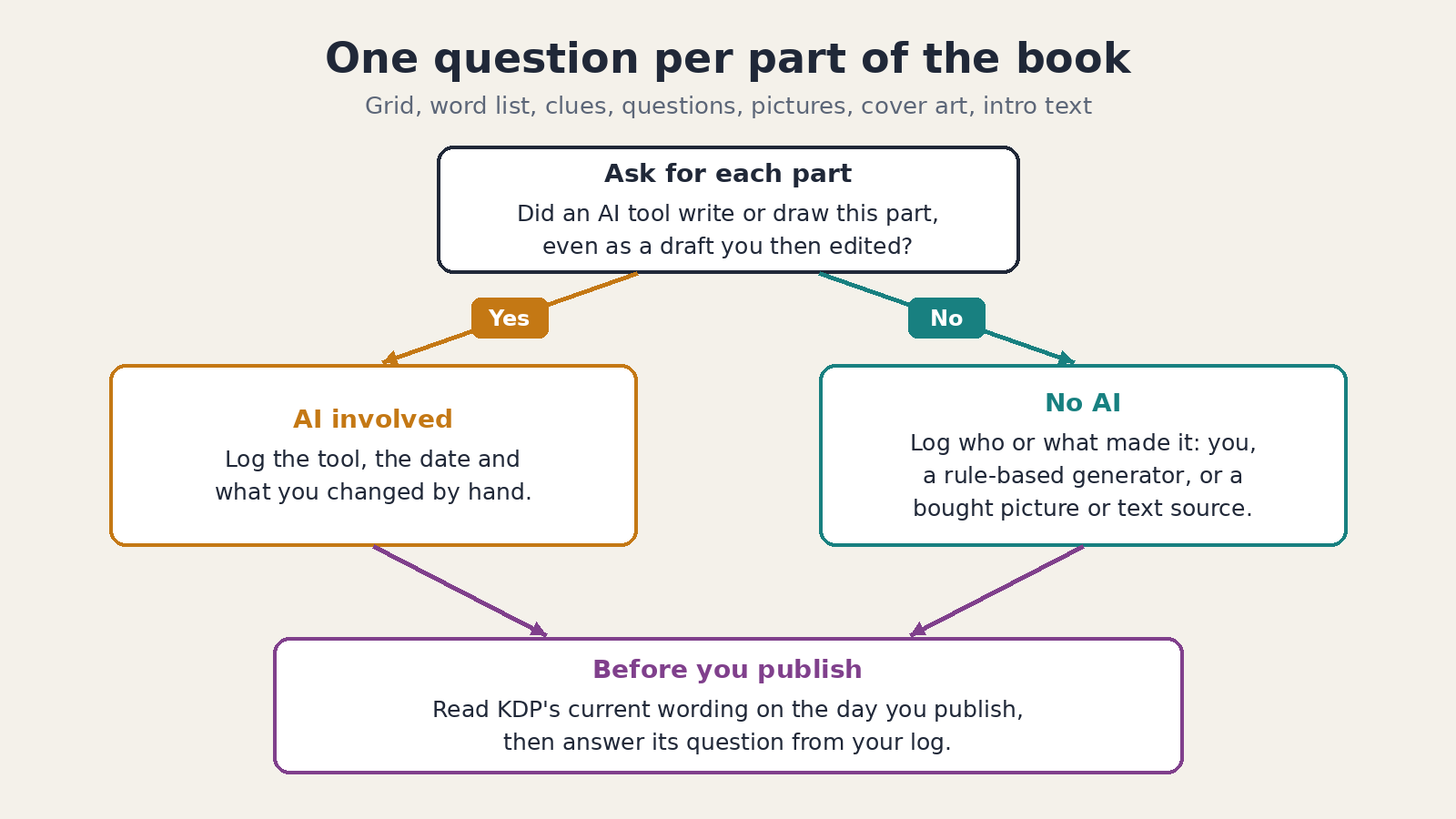
Word lists, clues and images: where AI may apply
This is where AI slips into a puzzle book without the publisher noticing.
Word lists. If you asked ChatGPT for “50 jungle animals” and pasted the result in, an AI tool wrote that list. Our AI word list to puzzle book guide walks through exactly that workflow. Inside Puzzle Maker Pro, AI is optional. Many word puzzles have an AI… button next to the word list that opens the AI Word Assistant. It drafts themed words for you to check or uncheck, and nothing reaches the puzzle until you click Apply. It runs on Puzzle Maker Pro AI credits or on your own OpenAI or Anthropic API key, and the credits page lists “Wordlists for Word Search or Crossword” at 1 credit. A list you typed yourself is not AI-written. For a list from anywhere else, find out how it was made.
Clues. The same assistant can add clues to the words you checked. If an AI tool drafted a clue and you then rewrote it, log both facts: AI draft, your edit. Read KDP’s wording to see how it treats AI text you have edited.
Quiz questions. Quiz Builder can draft multiple-choice questions from a text you supply, from Creative up. It also ships with ten ready-made topic banks of hand-checked questions, and you can type or import your own. Each bank already keeps a log for you: every question remembers how it got there, “drafted and checked by AI, edited by you, or typed by you.” “Edited by you” marks an AI draft you changed, so log it as an AI draft plus your edit. A question imported from a spreadsheet is recorded as typed by you, so note where that file came from.
Translations. Vocabulary Quiz Builder turns your own English word list into translation questions. From Creative up, Translate with AI drafts each translation and its wrong answers; you can also type them yourself or start from its nine ready word lists. Log which of those a quiz uses.
Pictures. Puzzle Maker Pro has no AI image generator. Picture puzzles use pictures you load or the built-in picture sets that come with some modules. Some of those built-in sets were made with AI image tools, so a page that uses one has an AI-made picture on it. Covers, spot art and coloring pages made in an image generator count the same way in your log.
Book text. An introduction, how-to-play notes, trivia facts or a story page drafted by a chatbot is AI-written text, whatever tool built the puzzles around it.
Comparing AI activity book generators? Use the same check: ask each one which parts a language model writes and which parts rule-based code builds. If a tool can’t tell you, you can’t answer KDP’s question with confidence.
Keeping a record of how each part was made
A short log per title makes your KDP AI disclosure quick and consistent across a series. One row per part is enough:
| Part of the book | Made by | AI involved? | What you changed | Date |
|---|---|---|---|---|
| Word search grids and answer key | Puzzle generator | No language model | Grid size, word count | |
| Word list | AI Word Assistant draft | Yes | Removed 9 words, added 4 | |
| Clues | Typed by you | No | ||
| Pictures | Built-in set or your own art | Depends on the set | ||
| Cover | Your designer or your own tool | Note it | ||
| Introduction page | Typed by you | No |
A few habits keep the log honest:
- Save the AI draft separately from your edited list. If anyone asks later, you can show what the tool gave you and what you changed.
- Note the date you read KDP’s wording. If it changes before your next title, you’ll know to read it again.
- Carry the log forward. A list drafted by AI for volume 1 is still AI-drafted when you reuse it in volume 3.
- Check each picture set before you use it. If you aren’t sure whether a built-in set was made with an AI image tool, ask us before you publish.
The log also helps with proofing. AI text can be wrong: a trivia answer can be outdated, a “fact” can be invented, a clue can have two answers. Read every AI-drafted line, and solve a few puzzles of each type yourself. Our guide to publishing puzzle books on KDP walks through the steps from choosing a puzzle type to the upload, including a printed proof copy.
Disclosure and rights are separate questions. Telling KDP how a part was made doesn’t settle whether you may use it. For that side, see are sudoku and crossword puzzles copyrighted?, which covers clue text, word lists and art.
Want to see a rule-based generator build a grid and its key? The demo makes real puzzles, one watermarked puzzle at a time.
Get the free Puzzle Maker Pro demo now
Other puzzles you might like
- AI puzzle book generator: what it automates, what you still control compares whole-book tools with dedicated generators.
- Low content books on KDP vs puzzle books explains why KDP treats a puzzle book differently from a blank journal.
- Tents and Trees puzzle books pairs two logic types in one book.
- Picture math worksheets for kindergarten builds counting, adding and subtracting pages from one picture set per theme.