

Short answer: in the US, copyright protects original expression, not ideas, systems or methods (17 U.S.C. §102(b)). A sudoku grid is widely viewed as a logic result, not protected expression. Clue text, quotes, word lists, art, and a creative selection of puzzles can be protected, and the US Copyright Office requires human authorship. Other countries differ; this is not legal advice.
So the real risk is rarely the grid. It is copied pages, clues, lists, fonts and art. If you are about to sell a sudoku interior on KDP, a crossword printable on Etsy, or a vocabulary word search on Teachers Pay Teachers, the question is whether the file in your upload folder is yours to sell.
The four checks before you upload
That question breaks into four practical checks:
- Did I copy another publisher’s puzzle pages instead of generating my own?
- Did I paste clue text, quotes, or a word list I do not have rights to use?
- Does my puzzle software actually let me sell the exported pages where I plan to list them?
- Does the marketplace still have its own rules after I clear the first three?
Sudoku sellers often worry that every grid looks alike. Crossword and word-search sellers worry about clue books and themed lists they bought once and reused everywhere. Both are really asking whether their product (the book, pack, or worksheet they are about to publish) is clean.
What is usually protected, and what usually is not
Amazon KDP’s intellectual-property help defines a copyright as protection for original works of authorship, with books and similar creative works among the examples it lists. It also states that KDP’s terms require you to hold the publishing rights to content you upload, and that uploading content without those rights can lead to rejection, removal, account impact, or loss of royalties. KDP’s guidance does not treat a bare grid as a protected work in its own right; the risk sits in what you put around and inside it.
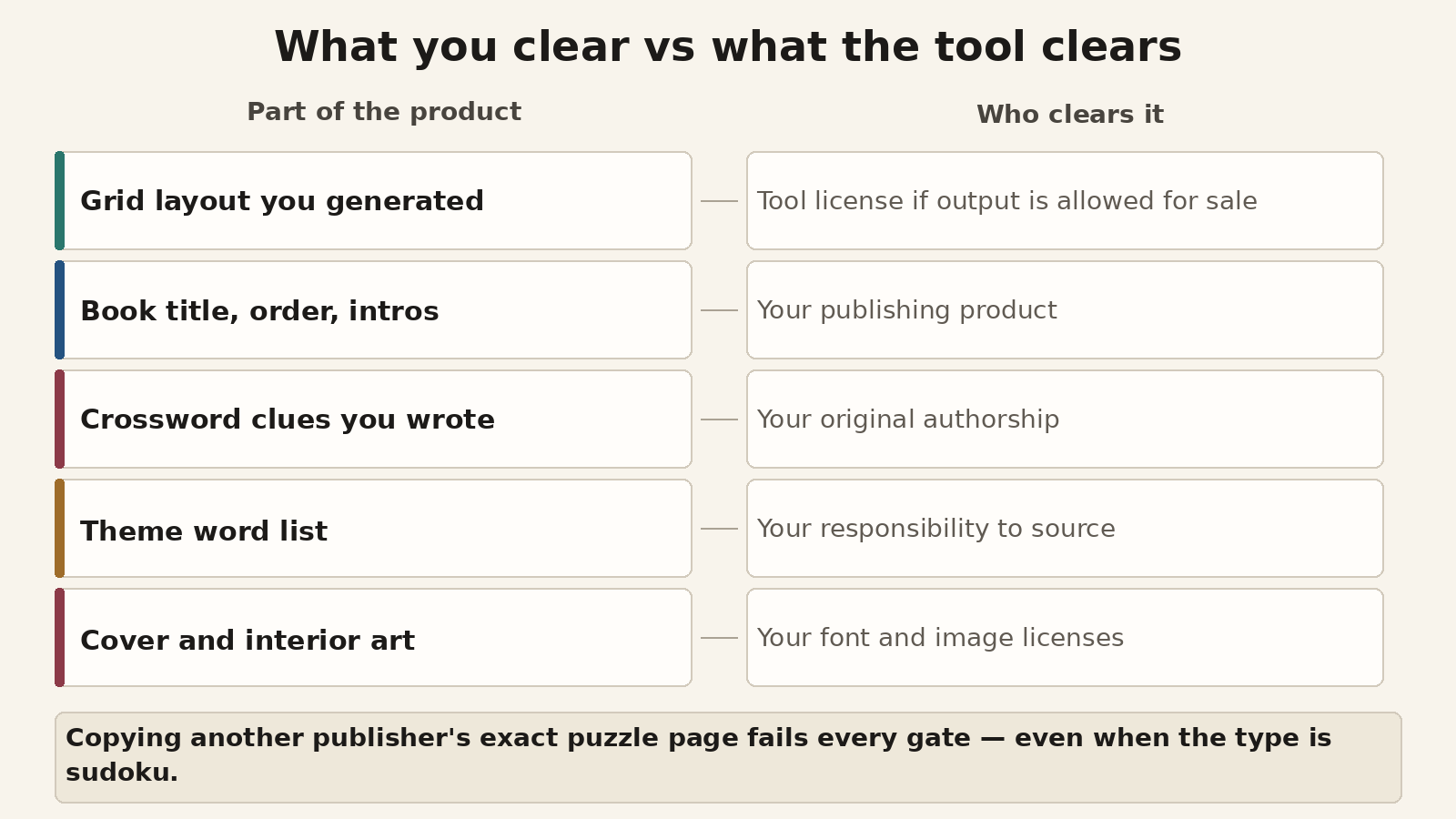
Publisher experience sorts the puzzle into parts that fail on their own:
The grid or layout you generated. A new sudoku or crossword layout you produced with software you may use commercially is your own output file. Lifting puzzles out of a newspaper, a competitor’s PDF, or a digital archive without permission is the classic failure mode, regardless of puzzle type.
The collection as a product. Title, section order, difficulty ramp, instructions you wrote, and how pages are numbered and keyed together describe the book, pack, or worksheet bundle a shopper buys. KDP’s help also notes that a copyright line inside your file is not sufficient on its own to prove you hold the necessary publishing rights if Amazon asks for documentation.
The word list or source text. Theme lists, crossword entries, cryptogram quotes, and clue sentences are where infringement notices often start. A tool’s commercial output rights do not clear copyrighted text you feed in: quotes, lyrics, and modern prose still need your own rights review.
The clues. For crosswords and clue-led word searches, the clue wording is creative text. Reusing someone else’s clue set without a license carries a different risk than generating a grid with your own clues tied to your own list.
Word searches. The letter grid itself is a generated arrangement; the word list and any clues are where the rights questions live. A themed list copied from another seller’s pack is the usual problem, not the grid.
Fonts and art. The puzzle logic can be clean while the cover illustration, spot art, or display font is not. Font files and stock images carry their own grants. A generator does not fix a background you downloaded without a commercial-use grant.
AI-written clues or lists. If AI wrote your clues or word list, KDP asks you to disclose AI-generated content when publishing.
What the tool grant covers. A desktop license that allows selling finished books, worksheets, and packs answers whether you may sell the pages you export, not whether every ingredient inside them was lawful to use. The details are in puzzle maker with commercial rights.
Why the generator license still decides what you can sell
Copyright questions and software-license questions stack. You can own your word list, infringe a font, and still be forbidden from selling any output because a generator’s free tier forbids commercial use or watermarks every page.
Before you argue fair use or public domain, read what the tool already grants:
- Whether commercial use of exported puzzles is stated on pages you can cite later
- Whether paid tiers remove watermarks and forced attribution
- Whether rights survive after you stop maintaining a subscription account
- Whether supplying puzzles into someone else’s publication is covered, as distinct from selling finished books under your own name
Every Puzzle Maker Pro edition lets you sell finished puzzle books, worksheets, and packs to your own readers and customers on KDP, Etsy, Teachers Pay Teachers, and your own store. Productivity adds the right to sell or supply the puzzles you generate to other publishers, businesses and sellers, such as a newspaper, an app, or another imprint. You can move up to any higher edition at any time after you buy.
None of that replaces marketplace rules. KDP’s intellectual-property help is explicit that this information is not legal advice and that you should consult a lawyer for specific questions about your rights or others’ rights.
The same question on KDP, on a printable, in a worksheet, and in a playable embed
The interiors vs printables vs worksheets vs embeddable puzzles map describes what changes per channel. Copyright and publishing-rights worries show up in different places on each listing:
KDP. You are publishing a book under your name. KDP requires publishing rights to uploaded content and may request documentation when content was previously published elsewhere. A themed sudoku series is a sequence of your interiors, not a single grid repeated from a stranger’s book with a new cover.
Etsy printables. Buyers download the file instantly. The risk is often a scraped page pack: grids plus a word bank copied from another seller’s themed set. Original generation with a tool you may use commercially does not excuse stolen theme copy or clipart from a non-commercial search result.
TPT worksheets. Teachers need a key they trust. Copying another seller’s puzzle and their answer key is a double strike: layout and instructional trust. One-skill worksheets also expose clue or list choices fast; a vocabulary list you do not have rights to share will surface the first time a district asks.
Playable embed on your site. The visitor solves in the browser; you still shipped creative assets (clue text, art, styling). Playable output comes with the Interactive editions (Creative Interactive and Productivity Interactive) on supported modules, and you can add it to the edition you own later. The embed is still your publication on your site, not a pass around attribution for third-party text you dropped in.
On all four, check the same things in the same order: the tool grant on output, your clearance on words and art, your proof that you are not republishing someone else’s edition, then each site’s content policies.
This is not legal advice
This article is publisher orientation, not legal advice. It does not know your jurisdiction, your agreements with licensors, or whether a specific clue book is still under protection.
For what Amazon expects when you publish, read KDP’s intellectual-property help. It restates the publishing-rights requirement, defines copyright and trademark at a high level, and directs sellers with specific questions to a lawyer.
When a point is not on those pages and not on a live product page you verified yourself, treat it as unchecked. Copied competitor interiors, celebrity-themed lists, and song-lyric cryptograms are where sellers still get surprised; if you cannot document your rights, generate a different list or write your own clues before you upload.
Other puzzles you might like
For where word lists enter the stack and how to store them so they stay reusable, see word lists for puzzle books.
For how the same assets split into KDP, Etsy, and TPT product shapes without reusing the wrong PDF, read TPT vs Etsy vs KDP puzzle products.
For quote-based puzzles where source text is the whole risk, Easy Cryptograms is the module, and the list rules in the word-lists article apply even harder there.