
Summary: Renzoku is a number logic puzzle: fill the grid so every row and every column holds each number once, and use the small bars between cells, which mark pairs of neighbours whose numbers are consecutive. A well-made Renzoku has exactly one solution and needs no guessing. Here are the rules, a complete solve of a real 5×5 board, and what changes when only some bars are shown.
Want to make your own? The Renzoku puzzle generator creates Renzoku puzzles with answer keys, ready for print, and for online play with an Interactive edition.
Overview
Renzoku (Japanese for “consecutive”, also called a consecutive or adjacent puzzle) looks like a small sudoku without boxes. The twist is in the gaps between the cells: a short bar between two neighbours says their numbers sit next to each other on the number line, like 3 and 4, or 5 and 4. On an All bars board, the standard rule, every such pair is marked, so the empty gaps are clues too: two neighbours without a bar are never consecutive.
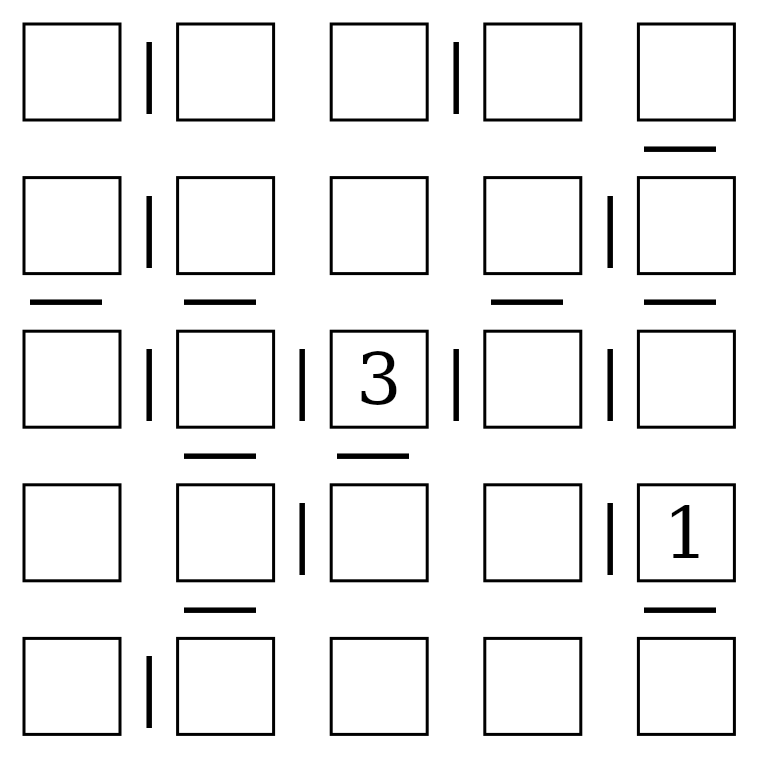
An Easy 5×5 Renzoku as printed: two numbers are given, and the bars do the rest.
The Goal
Write a number in every empty cell. On a 5×5 board the numbers are 1 to 5, on a 6×6 board 1 to 6, and so on up to 9×9. When you are done, every row and every column holds each number once, and every bar sits between two consecutive numbers.
The Rules
- Each row and each column holds every number once. On a 5×5 board that is 1, 2, 3, 4 and 5 in each row and each column.
- A bar means consecutive. Two cells joined by a bar differ by exactly one: 2 and 3, or 5 and 4.
- No bar means not consecutive. On an All bars board every consecutive pair has its bar, so two side-by-side or stacked cells without one can never be 2 and 3, or 4 and 5.
- The ends do not wrap. 1 and 5 on a 5×5 board are not consecutive, so they never share a bar.
A bar between side-by-side cells stands upright; a bar between stacked cells lies flat. Both mean the same thing.
How to Solve a Consecutive Puzzle, Step by Step
You never need to guess. This walk-through solves the whole board pictured above, counting rows from the top and columns from the left.
1. Look for long chains of bars. Row 3 has a bar in all four gaps, so its five numbers form one unbroken chain, each one more or one less than the last. In a row that holds 1 to 5 once, the only chains are 1 2 3 4 5 and 5 4 3 2 1.
2. Bars on opposite sides squeeze a cell into the middle. Row 3, column 2 is still empty, and it has a bar on its left and on its right. Its two partners share its row, so they must be different numbers: one less and one more. That means it can never be 1 or 5, and the same goes for row 3, column 4. With the given 3 between them, those two cells hold 2 and 4, so the two ends of the row hold 1 and 5.
3. Use the givens to pick the direction. Column 5 already has its 1, in row 4. So row 3 cannot end with 1, and it must read 1 2 3 4 5 from left to right. Fill it in.
4. 1 and the top number have only one possible partner. A 1 can only be consecutive with 2, and on a 5×5 board a 5 only with 4. The given 1 in row 4, column 5 has a bar to its left and a bar below it, so both of those cells are 2: row 4, column 4 and row 5, column 5.
5. Follow the bars from what you know. The 2 in row 3, column 2 has a bar below it, so row 4, column 2 is 1 or 3. Row 4 already has its 1, so it is 3. Then row 4, column 3 sits under a bar from the 3 above it, so it is 2 or 4; row 4 already has its 2, so it is 4. The last cell of row 4, column 1, is the number left over: 5. Check it against the empty gap beside it: 5 and 3 are not consecutive, as the missing bar says.
6. Read the empty gaps too. There is no bar between row 2, column 3 and the 3 below it, so that cell is not 2 or 4. Column 3 already has its 3, so it can only be 1 or 5; keep that in mind for move 7. Column 5 runs on bars: row 2, column 5 has a bar down to the 5 in row 3, so it is 4, and row 1, column 5 has a bar down to that 4, so it is 3 or 5. Column 5 already has its 5, so it is 3.
7. Finish row 2. Row 2, column 2 has a bar down to the 2 in row 3, so it is 1 or 3, and column 2 already has its 3 (row 4): it is 1. Now row 2 has its 1, so row 2, column 3, the cell from move 6, is 5. Row 2, column 1 has a bar to that 1, so it is 2, and the last cell, row 2, column 4, is 3. Both of its bars agree: 3 sits next to the 4 on its right and the 4 below it.
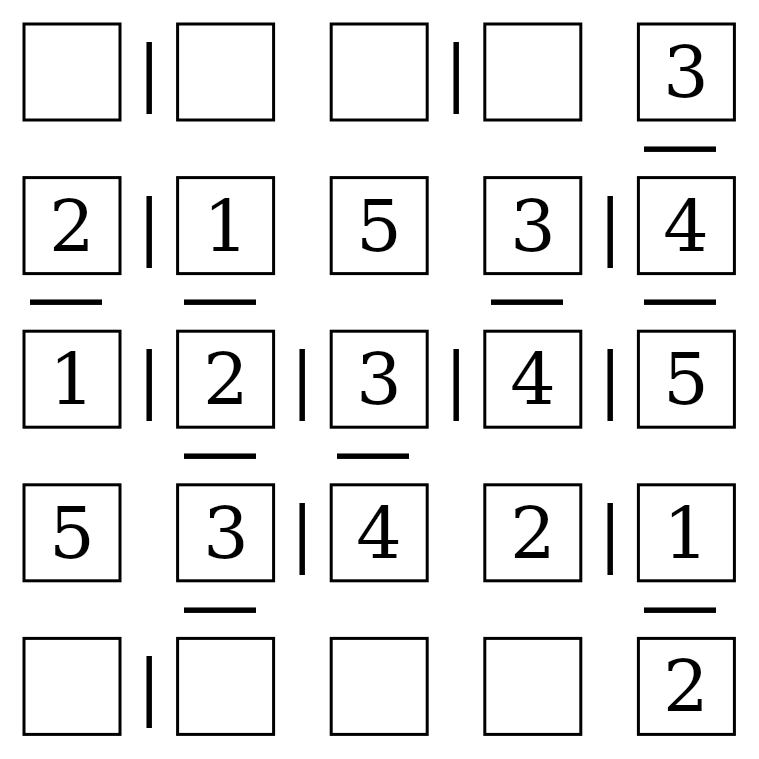
Halfway: rows 2 to 4 and column 5 are done. Check your grid against this one before you go on.
8. Finish rows 1 and 5. Column 1 already has 2, 1 and 5, so rows 1 and 5 share 3 and 4 there. Row 1 already has its 3, so row 1, column 1 is 4 and row 5, column 1 is 3. Each has a bar to its right: the 4 makes row 1, column 2 a 3 or 5, and row 1 has its 3, so it is 5; the 3 makes row 5, column 2 a 2 or 4, and row 5 has its 2, so it is 4. That leaves 1 and 2 for row 1, columns 3 and 4. Column 4 already has its 2, so row 1, column 4 is 1 and row 1, column 3 is 2. Row 5 takes the last two numbers: column 3 already has its 5, so row 5, column 3 is 1 and row 5, column 4 is 5.
Every move above is one you can repeat on any Renzoku: each number you write gives the bars and the empty gaps around it something new to say. Because the solution is unique, a cell that still looks open both ways means the deciding move is somewhere else on the board.
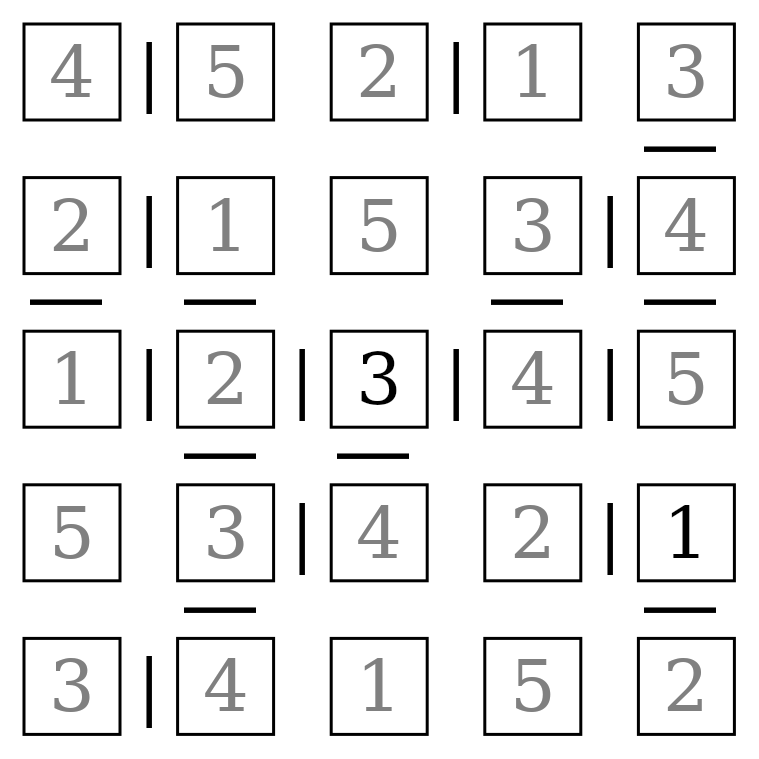
The same board solved. Row 3 reads 1 2 3 4 5, and no two neighbours without a bar are consecutive.
When Only Some Bars Are Shown
Some Renzoku books use a gentler rule, Some bars: the bars, or dots, are hints, and an empty gap says nothing. Rules 1, 2 and 4 stay the same, but rule 3 goes away, so you cannot rule anything out from a missing mark. These puzzles print more given numbers to make up for it, and they solve more like a sudoku, with the marks as extra help.
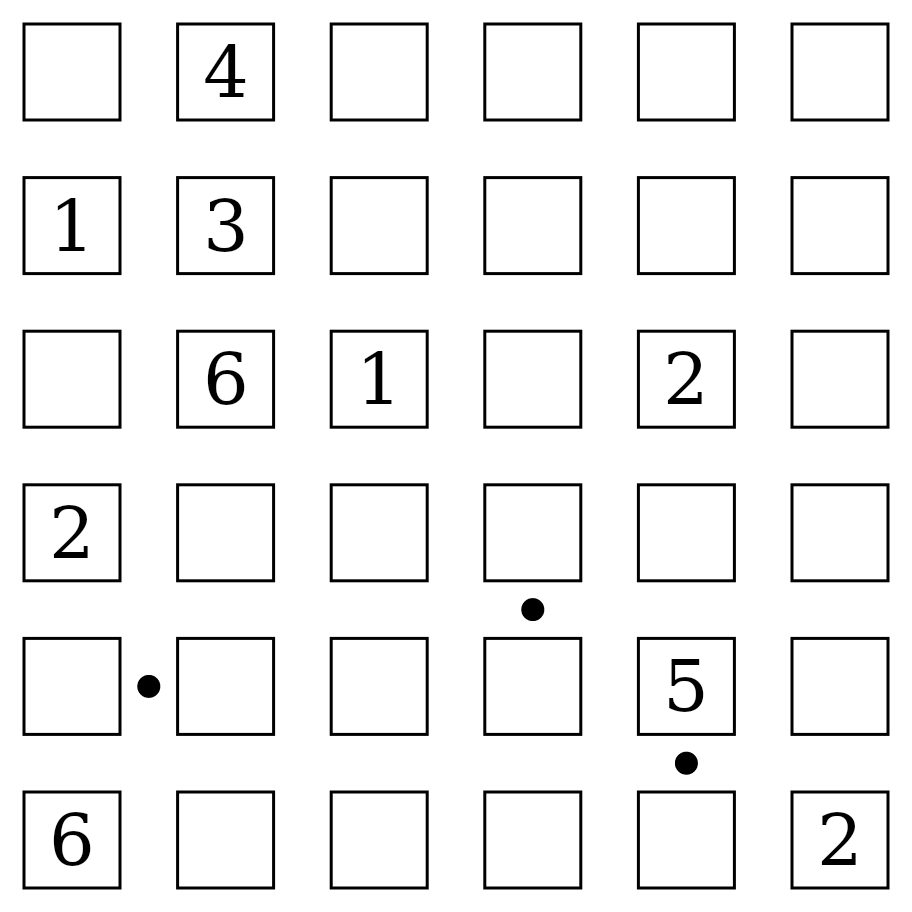
A Medium 6×6 with only some marks shown, drawn as dots. Each dot still means consecutive; the empty gaps tell you nothing.
On this board, the dot below the given 5 in row 5, column 5 says the cell beneath it is 4 or 6. But the empty gap beside the given 2 in row 4, column 1 rules nothing out: the gap alone does not stop the cell to its right from being 1 or 3. The puzzle’s description line tells you which rule it uses.
Letters, Dice and Other Looks
The same puzzle can be printed with letters or dice instead of numbers. Consecutive then means next in the run: B and C, or a die with three pips beside a die with four. Some books start the numbers somewhere else, such as 10 to 15, and the marks can be bars, dots or a small picture. The rules never change.
Difficulty (and why there is no guessing)
Every Renzoku made in Puzzle Maker Pro has exactly one solution that you can reach by logic alone. The difficulty level sets how hard the logic gets:
- Easy puzzles fall to the moves above: chains of bars, squeezed cells, the one partner of 1 and the top number, following bars, and reading empty gaps.
- Medium puzzles ask for more of those moves in a row, plus pairs: when two cells in a row can only hold the same two numbers, say 2 and 4, no other cell in that row can be 2 or 4.
- Hard puzzles need at least one advanced pattern from sudoku, such as an X-Wing: when, in two rows, one number can only go in the same two columns, it is ruled out from the rest of those two columns.
A 4×4 board is always Easy, a good first puzzle. Harder puzzles do not simply print fewer numbers; the difference is the reasoning.
Outcome
You now know the four rules, how to read both the bars and the empty gaps, the moves that solve a board from the first chain to the last cell, and how the Some bars version and the three difficulty levels differ. Ready to make your own? See How to Create Renzoku Puzzles in Puzzle Maker Pro.
Try It Online
Solving Renzoku in the browser feels just like on paper: click a cell, then type a number or tap it on the on-screen keypad, and use the arrow keys to move around. Given numbers are locked, and a mistake, such as a number repeated in a row or a bar between two numbers that are not consecutive, is highlighted as you go. Press Check when the grid is full.
Play Renzoku online in your browser. New to online puzzles? See How to Play Puzzles Online.
FAQ
What is a Renzoku puzzle?
A logic puzzle where you fill a grid so every row and column holds each number once. A bar between two cells means their numbers are consecutive, and on an All bars board, no bar means they are not.
What does “consecutive” mean in Renzoku?
The two numbers differ by exactly one, such as 3 and 4. The first and last numbers, like 1 and 5 on a 5×5 board, are not consecutive.
How do you start a Renzoku puzzle?
Look for long chains of bars, for cells squeezed between two bars, and for the 1 and the top number, which have only one possible partner. Then follow each bar from the numbers you know, and use empty gaps to rule numbers out.
Is Renzoku the same as Futoshiki?
They are cousins. Both fill a grid with each number once per row and column, but Futoshiki uses greater-than signs between cells, and Renzoku uses bars for consecutive numbers.
Does every Renzoku have only one solution?
Every one made in Puzzle Maker Pro does, and you can reach it by logic alone, without guessing.
Further Reading
- How to Create Renzoku Puzzles in Puzzle Maker Pro
- How to Play Puzzles Online
- Puzzle Book Studio Tutorials
Make Your Own Renzoku Puzzles
Now that you can read the bars, make your own: a gentle 4×4 starter, a graded run from Easy to Hard on 5×5 to 9×9, All bars or Some bars, each puzzle with its answer key, ready for a puzzle book or a classroom worksheet, or, with an Interactive edition, for play on your own website.
Create your own Renzoku puzzles with the Renzoku puzzle generator in Puzzle Maker Pro.
Not ready yet? Try the free demo first — it covers every module.