

A bingo set looks like the easiest classroom printable there is, until the game starts. Five students shout at once because every card holds the same sixteen words. The caller has no master list and reads from memory. A picture card prints with a blank square where the list ran out. Every one of those failures is a setup decision, made before you print.
A good bingo card generator for teachers should make those decisions easy to get right, and the same goes for picture cards made for kids. This guide covers the set as a product: what it must include, how big the word or picture list should be, how many cards a room needs, and how to make large-print cards for an activity room. The examples use Bingo, a module of Puzzle Maker Pro (Windows desktop software that makes printable puzzles and activity pages for publishers, teachers and sellers).
What a sellable bingo set includes
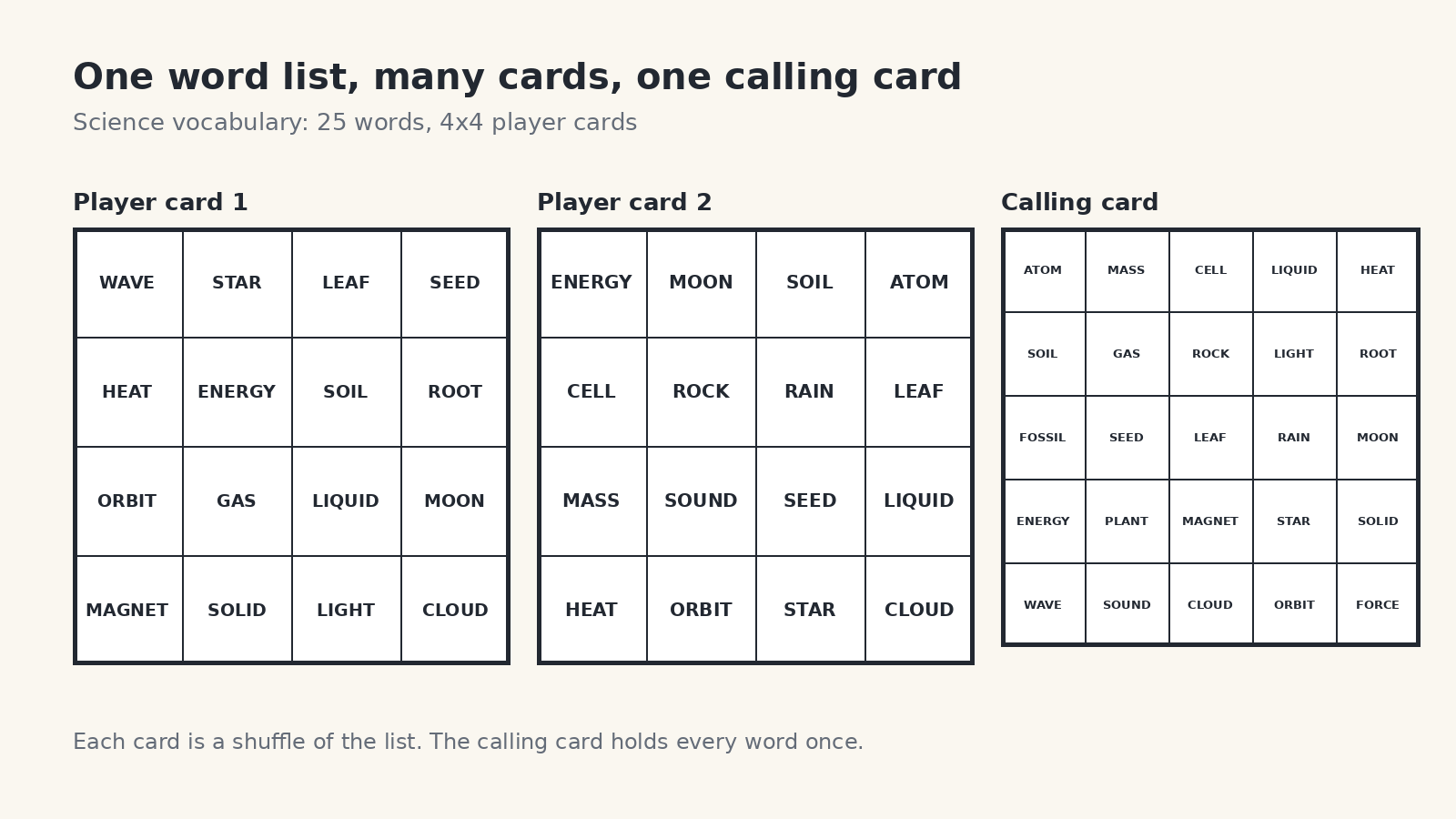
A complete set has three parts, and buyers on Teachers Pay Teachers notice when one is missing.
- One player card per seat. Each card is a shuffle of the same list, so two students rarely hold the same layout.
- A calling card. One sheet that holds the whole list, shuffled, so the caller can read items out and check a winning card against what was called.
- A stated game. The card does not print the winning pattern. The teacher names it: any row, any column, a diagonal, four corners, or the full card.
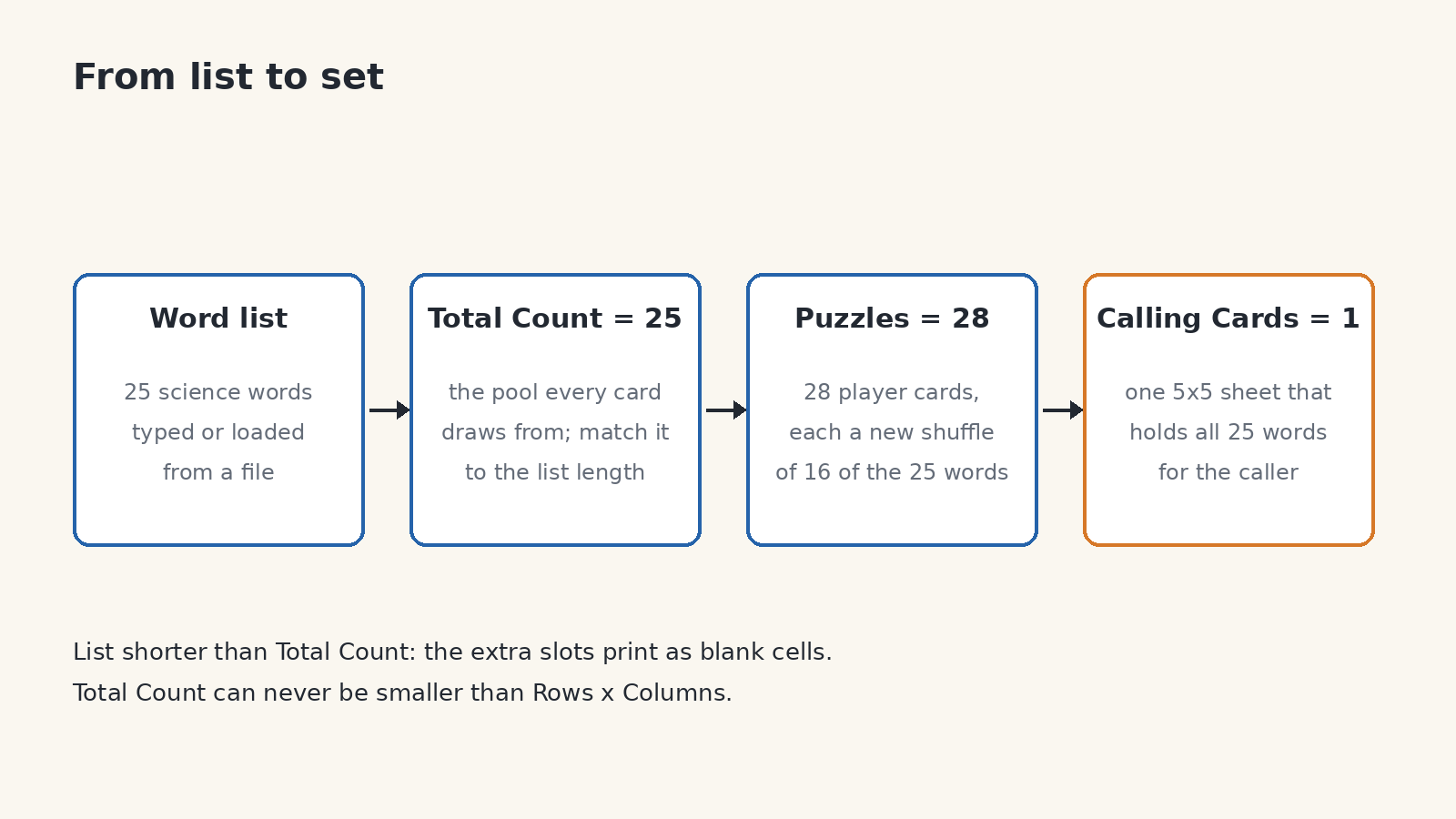
In Bingo, the Puzzles setting is the number of player cards a run writes, from 1 to 1000. Calling Cards sets how many calling cards come with them, and it starts at 0. Set it to 1 before you create the set, or the run writes player cards only. Files come out as JPG, PNG or transparent PNG.
Classic Bingo is there too, for the hall game everyone knows. It locks the card at 5×5 with BINGO across the top and the usual column bands (B 1-15 up to O 61-75), and its calling card prints each call as letter plus number, such as B12.
Word lists vs picture lists
Set Content to the kind of set you are making: Classic Bingo, Text, Images, Images + Text, Numbers or Roman Numerals.
Word lists suit vocabulary review. Choose Text, then type the unit list or load it from a file. One setting matters more than any other here: Total Count, the size of the pool the cards draw from. Match it to the number of words in your list. If the list is shorter than Total Count, the missing slots print as blank cells. If it is longer, only the first words up to Total Count are used. Total Count can never be smaller than Rows times Columns, so a 5×5 card needs at least 25 words.
Picture lists suit younger students and pre-readers. Choose Images and load JPG or PNG files. Images + Text adds a caption under each picture, taken from the file name without the extension, so a file named apple.png prints “apple”. Name the files carefully and the same set teaches the word along with the picture. Image Size (20 to 200%) sets how much of each cell the picture fills.
The art and the words must be yours, or cleared for the store you sell in.
How many unique cards a set needs
The first answer is simple: one card per player. For a class of 28, set Puzzles to 28. Each card is a fresh shuffle. The program does not compare cards with each other, but with a list bigger than the grid, two identical cards are so unlikely that you will not see one. Flip through the set before you print anyway.
The real question is how much the cards overlap. When the list is the same size as the grid, every card holds every word in a different order, so many students reach a line at almost the same moment. Everyone finishes the full card on the very last call.
We simulated 4,000 games for each list size: 28 players on 4×4 cards, with the first completed row, column or diagonal winning. With 16 words (exactly the grid), the first line came after about 5 calls, and 42% of games ended with two or more students winning on the same call. With 32 words (twice the grid), the first line took about 9 calls and ties fell to 23%. With 48 words, the first line took about 12 calls and ties fell to 15%. A longer list costs a few extra calls per game; it buys fewer shared wins.
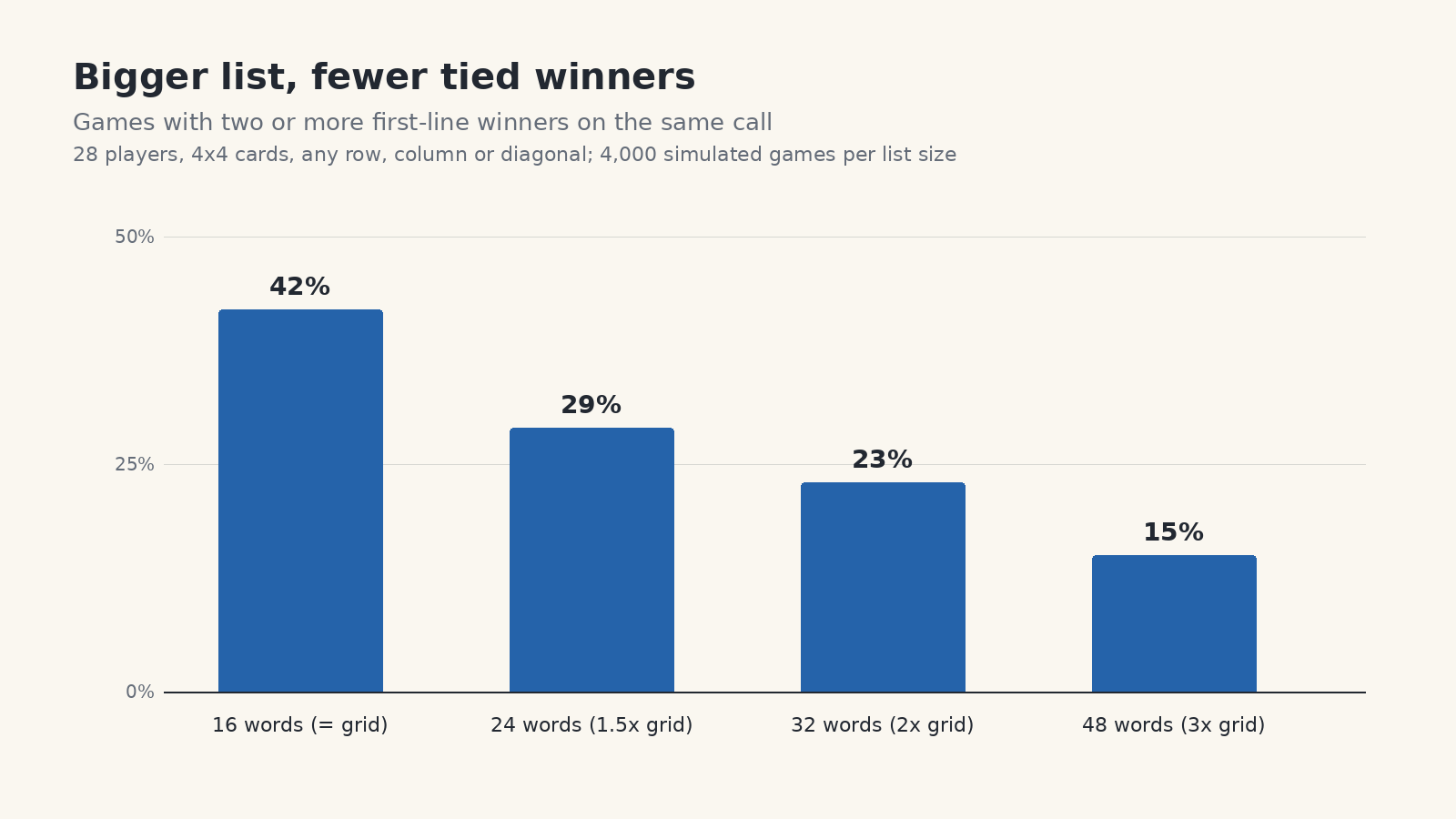
So a list about twice the size of the grid is a good default. It gives a calmer game and a reason to use more of the unit. You can also add a square that counts as already marked, set up on its own tab with your own text in it. It sits in the centre of the card, or in any cell if you choose Random. It covers one cell of each card, but the list still needs at least Rows times Columns entries.
Large-print sets for activity rooms
Activity coordinators ask for large-print bingo cards for seniors. Small print is the complaint to design against. One buyer’s review of a large-print word search book, quoted on a review-mirror site, put it plainly: “Pages and print too small for my 81 yrs husband to work on comfortably.”
There is no single large-print switch. Large print comes from fewer, bigger cells. Rows and Columns each run from 2 to 7. The longer side of the card stays the same length whatever the grid, so on a square card a 3×3 cell is more than twice as wide as a 7×7 cell. A header row (Enable Top Row) adds one more row and makes the cells smaller. A 4×4 or 3×3 card with short words prints with large cells and large type.
Classic Bingo is locked at 5×5 with its BINGO header, so it cannot shrink to fewer cells. For a number game with bigger cells, choose Numbers on a 3×3 or 4×4 card with a short Total Count, such as 20 (the numbers 1 to 20).
Then set the type. With Text, One Size keeps every word at the same size, so one long word shrinks them all. Best Fit sizes each word to its cell. For pictures, raise Image Size. Heavier Border Line and Inner Lines help the grid read at arm’s length.
In your listing, describe the set as large print and easy to see, not as therapy or a health benefit. Printable puzzle packets for senior activity coordinators covers the weekly packet routine, and large print puzzle books for KDP covers the retail book.
Calling cards and packaging
The calling card is a square grid sized by the list: 25 words make a 5×5 sheet, and 75 Classic numbers make a 9×9 sheet. A big list means small type on the caller’s sheet, which is one more reason to keep large-print lists short. For Classic Bingo, open the Top Row tab and tick Enable Top Row in the Calling Card group. The header then gets its own row, the sheet becomes 10 rows by 9 columns, and all 75 calls fit.
For a TPT listing, show one player card and the calling card in the preview, and state the count in the title, for example “28 cards plus calling card”. The unit and grade sell the set; the listing advice in TPT vocabulary word search worksheets applies here too. Bingo also works as the game day at the end of a unit, after the review sheets in the vocabulary worksheet maker guide.
For a PDF pack or a bound book, Instant Puzzle Books (the book builder included with every paid edition) turns a run of cards into a print-ready book interior at your trim size.
Bingo lets you sell the finished books, worksheets and packs you make to your own readers and customers, on Teachers Pay Teachers, Etsy, KDP or your own store. Bingo Productivity includes that, plus the right to sell or supply the puzzles you generate to other publishers and sellers. It also adds Time Saver: pick several saved Bingo presets and it runs them in one batch, writing the same number of player cards and calling cards for each preset, with every file in one output folder. A seller with a vocabulary set per unit can run a term’s worth of sets in one pass. You can move up to any higher edition at any time after you buy.
The demo makes watermarked cards, so you can check the grid, the type and the calling card before you buy. Start with your next unit’s list.
Get the free Puzzle Maker Pro demo now
Other puzzles you might like
Bingo: classic 1-75 cards or cards from your own words and pictures, with a calling card.
Word ladder worksheets: spelling ladders with clues and answer keys for TPT.
TPT vocabulary word search worksheets: unit word lists as grids with a separate answer key.
How Bingo works: the rules, the calling card and the centre square, step by step.