

A word ladder looks simple on the page: a word at the top, a word at the bottom, and a few empty rungs between them. Change one letter per rung, make a real word each time, and you reach the bottom. Teachers like it because it practises spelling and word meaning in the same few minutes, whether they print it for their own class or buy a pack on Teachers Pay Teachers. A weak one is easy to spot, though: odd words in the middle, end words with nothing in common, or a key that does not match what a student wrote.
Puzzle Maker Pro is Windows desktop software for making puzzle worksheets and books. Its Word Ladder maker builds the ladders, writes a clue for every rung students fill, and exports each puzzle with its answer key. Here is how to turn that into worksheets a teacher will trust, for your own classroom or as a pack to list.
What makes a word ladder worksheet work
Three things decide whether a ladder sheet feels like real practice or filler.
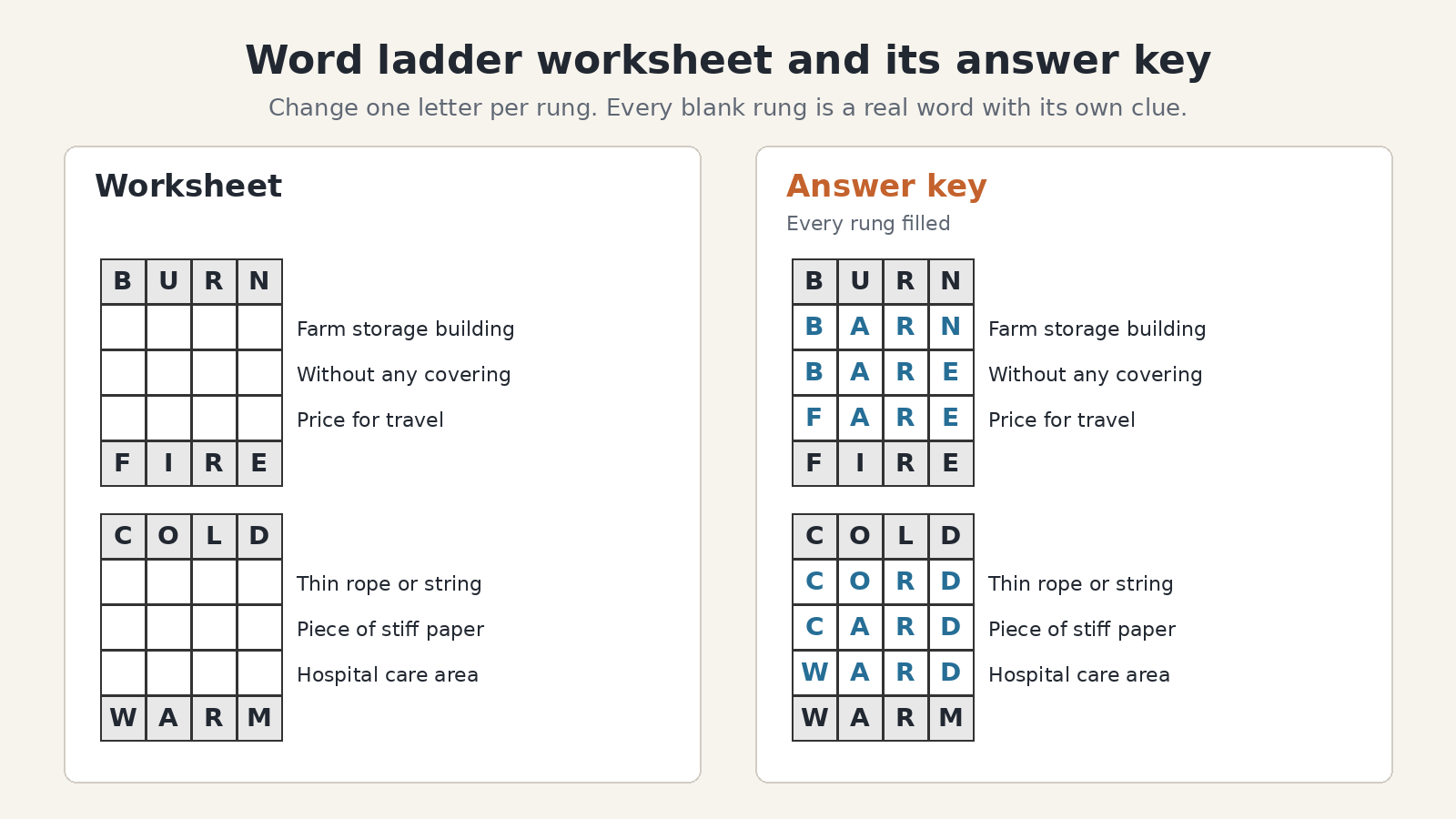
Every rung is a real word. Word Ladder builds every rung from real dictionary words and leaves out abbreviations, Roman numerals, spelled-out letter names and archaic words. At four and five letters the rungs lean on common, everyday words.
The two ends belong together. BURN to FIRE, HOGS to PIGS. By default the Related start and end words setting picks end words that go together in meaning wherever the dictionary allows.
A clue sits beside every blank rung. This is the step that turns a word game into vocabulary work. Set Page to Clued (a clue per rung) and every rung the student fills gets a short clue: “Farm storage building”, “Without any covering”, “Price for travel”. The two printed end words carry no clue. You never write these clues yourself; they come with the ladder on every edition, with no AI setup. A 20-ladder Medium pack is 60 clues you do not have to write.
Where the clue sits is up to you: Clue position offers Right of the boxes, Left of the boxes or Above the boxes. Above adds a line over each rung, so the boxes print smaller. For younger handwriting, keep the clues beside the boxes.
Ladder length and clues by grade band
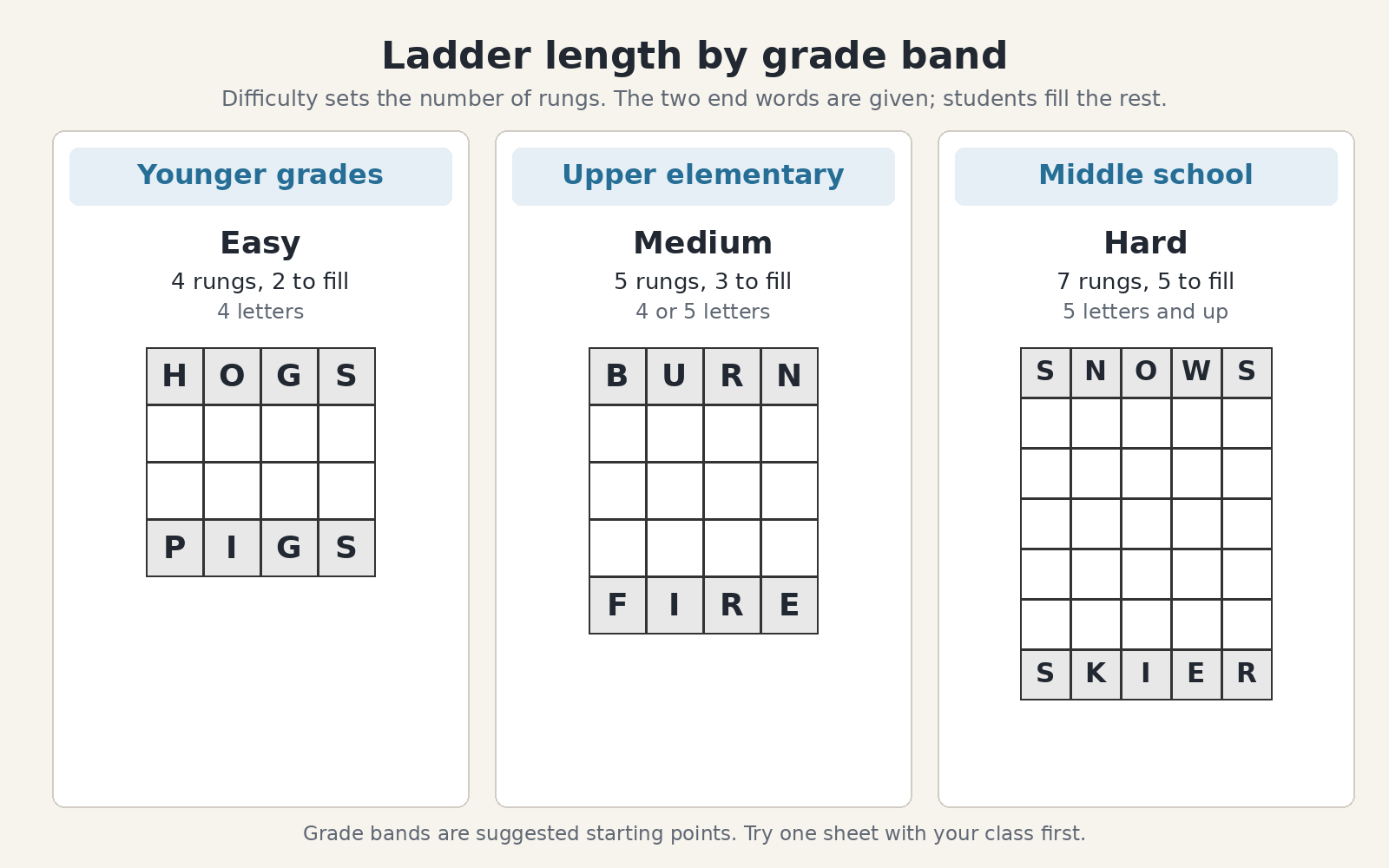
In Word Ladder, Difficulty sets the length of the ladder. It does not swap in harder words. Letters per word runs from 4 to 7.
| Difficulty | Rungs | Rungs students fill |
|---|---|---|
| Easy | 4 | 2 |
| Medium | 5 | 3 |
| Hard | 7 | 5 |
The software makes no grade claims; treat these bands as starting points and test one sheet with a class first.
- Younger grades: four-letter words at Easy, clued. Two rungs to find is a quick win.
- Upper elementary: four- or five-letter words at Medium. Three rungs ask students to plan ahead.
- Middle school: Hard ladders with five-letter words, seven rungs and five to fill. Six- and seven-letter ladders work as a stretch for older students, but they draw on a smaller pool of less everyday words, so check a sample first.
With Creative, the edition above the base Word Ladder edition, you can Prepare a whole batch, then open Fix clues… on the Clues tab and type over any clue. You can also have AI rewrite a whole set in a different voice, such as For kids or Educational, using your own OpenAI or Anthropic key or Puzzle Maker Pro AI credits.
Word ladder worksheets with answers teachers trust
Every puzzle exports with its answer key. On a clued sheet the key fills every rung and repeats the clues, so checking is quick. One TPT seller’s bundle listing puts it this way: “Answer keys streamline checking and enable self-correction.”
A plain ladder (Page set to Clueless (ends given), the default), with only the two end words printed, can sometimes be solved by more than one route. BURN to FIRE can go through BARN, BARE and FARE, or through BURS, FURS and FIRS. Both routes are correct, but a key can print only one. On a clued sheet each clue names its rung, so there is one intended answer and the key matches it.
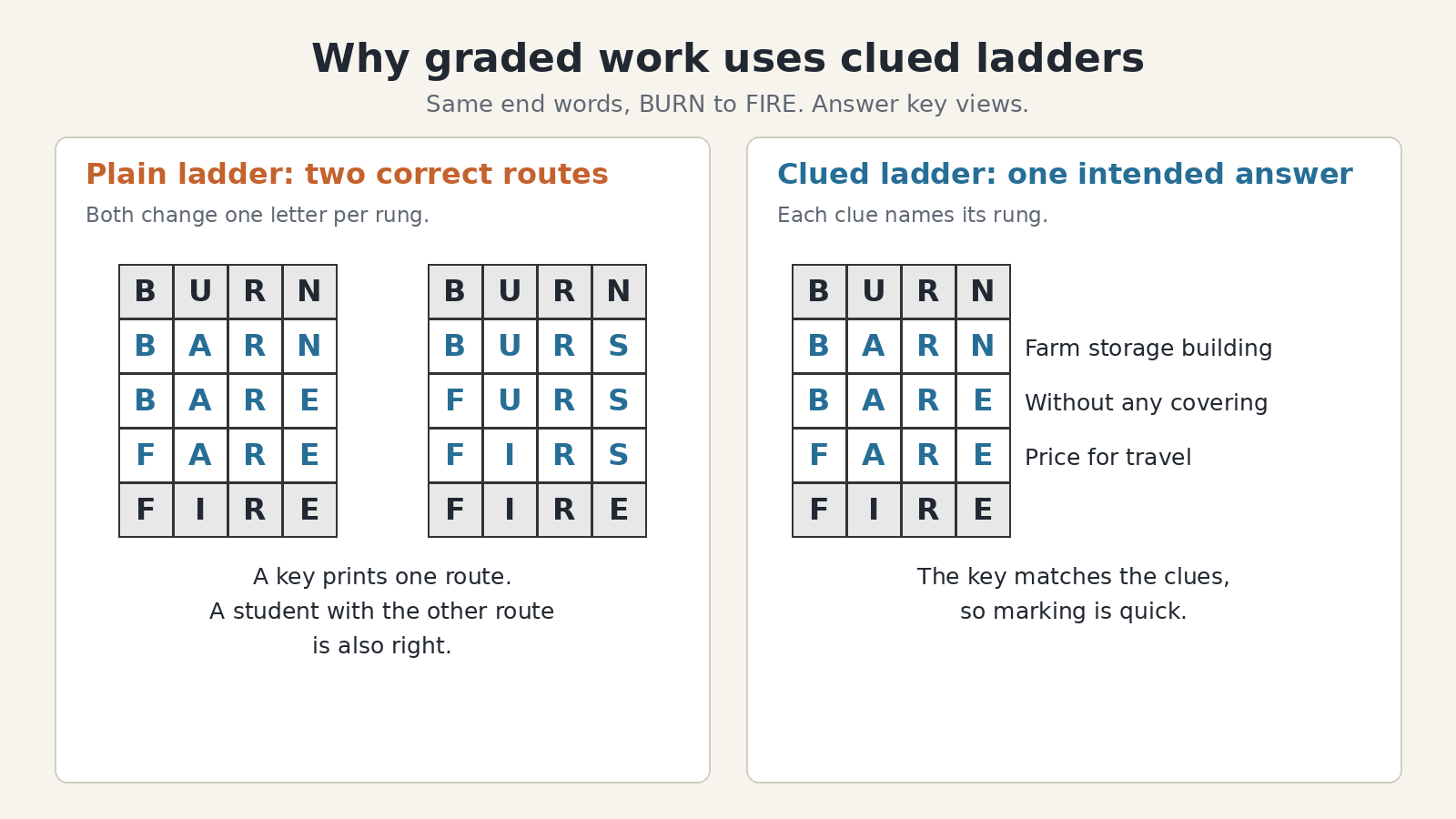
So use clued ladders for anything students hand in for marking. Keep plain ladders for early finishers and challenge pages, and say in the instructions that any correct route counts.
If you bind a set into one PDF and want all the keys at the back, choose Puzzles First, Then Solutions in the book settings. The default, Print Solutions With Puzzles, puts each solution right after its puzzle.
Starting ladders from your own spelling list
With Creative, your own words can anchor the ladders. Word Ladder works at one word length per run, from 4 to 7 letters, so your words must match the run’s Letters per word. Type single words from your spelling list, one per line, and each becomes the start or end of a ladder (Place list word at chooses which). You can also pin both ends of a ladder with two words from your list, one pair per line (COLD,WARM), and the generator fills the rungs between them with real dictionary words.
A few limits are worth knowing. The words between your ends come from the built-in dictionary, not from your list. With Validate supplied words ticked (the default), each list word is checked against the dictionary, and any word that is rejected is reported by name. And a pinned pair has to be reachable, and the right number of steps apart for the difficulty. If it is not, the run skips that pair, tells you why, and names the difficulty that fits whenever one does, so no ladder comes out the wrong length. If your list mixes word lengths, run one ladder set per length.
For pairing ladders with other sheets from the same list, see the spelling worksheet maker and vocabulary worksheet maker guides.
Packaging ladders as a TPT product
A clean ladder pack leads with the task, the work per ladder and the grade you tried it with: “Word Ladders with Clues, 3 Rungs to Solve, Grade 4, 20 Puzzles with Answer Keys”. The Quantity you set is the pack size, and the page size comes from your book settings. Show one worksheet and one key in the preview images, and list the page count with answer pages included.
Leveled sets can go out as separate listings, one level each, so a teacher buys the band that fits the class, with all three levels also offered together as a bundle. The differentiated puzzle worksheets guide covers titling and file layout for that approach.
Each puzzle exports as PNG, JPG, SVG and PDF, puzzle and key. For one printable file, Instant Puzzle Books comes with every paid edition and turns one run into a print-ready book with a title page and a table of contents. Four-letter ladders are compact, so your layout can fit several on one page.
Want Easy, Medium and Hard ladders in one PDF? With Productivity, Time Saver runs several rows (Easy, Medium and Hard, each with its own settings) in one pass and writes them all into one output folder. Leave Create Instant Puzzle Book ticked (the default) and the same run is assembled into one book. Puzzle Book Studio, the live book editor, can also combine sets, or put ladders beside other puzzle types. Either way, a book with more than one puzzle set needs Productivity, or an older Time Saver purchase, on every module whose puzzles go into it, even when every set comes from Word Ladder. In Puzzle Book Studio, a book made from one puzzle set works on every edition.
Every edition lets you sell the finished worksheets and packs you make to your own readers and customers, including teachers who buy on Teachers Pay Teachers. Productivity adds the right to sell or supply the generated puzzles to other publishers and sellers. You can start on any edition and move up to any higher edition at any time after you buy.
Next step
Make one clued ladder and its key in the demo and print it. The demo watermarks its output and makes one puzzle at a time, enough to judge the clues and the key before you buy.
Get the free Puzzle Maker Pro demo now
Other puzzles you might like
Spelling worksheet maker: one weekly list, up to four keyed sheets.
Word scramble worksheets: when a scramble pack is the whole product.
Vocabulary worksheet maker: review pages and quizzes from one unit list.
Bingo card generator for teachers: bingo sets from your own word or picture lists.