

Last checked: 19 November 2026.
A codeword is a crossword with no clues. Every white square holds a number from 1 to 26, the same number is always the same letter, and a few letters are given to start the solve. Buyers of codeword puzzle books for adults often already know the format, and their reviews say plainly what makes a book worth finishing and what makes them give up.
The examples below use Codeword, the codeword puzzle maker in Puzzle Maker Pro, our Windows puzzle generator. If you would rather build a quote-cipher book, see cryptogram puzzles for publishers, which compares the five cryptogram-style products.
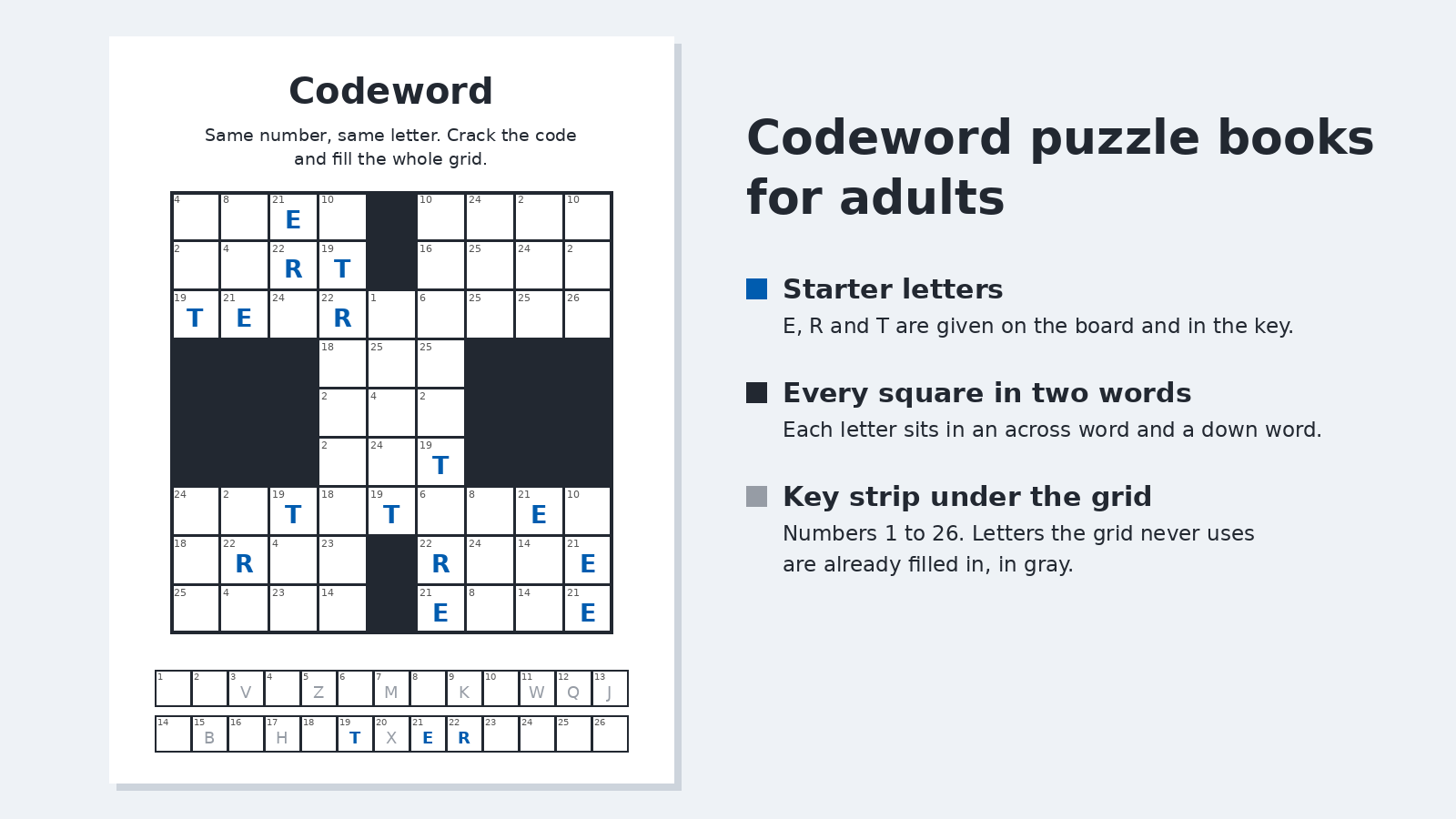
What codeword buyers ask for
Reviews of independently published codeword books on Amazon raise a few clear points:
- Starter letters that help. One Amazon reviewer complained that some puzzles “give you only ONE letter” and that many “come with two consonants and NO vowels”.
- Every letter, and words you know. Two Amazon reviewers of a 400-puzzle book praised it: “Every letter of the alphabet is used. And the words are recognizable” and “Large print. Real, every day words! Well laid out.”
- No obscure vocabulary. One Amazon reviewer of a large-print codeword book liked the format and the large type but would not recommend it, because “it has many words that are not commonly used”.
- A page that is all puzzle. One reviewer praised a book where “the puzzle fills the whole page and the strike-outs are at the bottom.”
Each point maps to a setting or a layout choice.
Starter letters that help
In Codeword, the Given letters setting on the Settings tab controls how many letters are revealed at the start, from 0 to 10. The Difficulty setting presets it: Easy gives six, Regular gives three. You can still type your own count after picking the difficulty.
The program picks the starter letters at random from letters that actually appear in the grid, so a starter is never a letter the solver cannot use. A small grid that uses few letters may reveal fewer than you asked for. The Amazon reviewer quoted above had two complaints: a single starter, and starters with no vowel. Codeword has no vowel setting, so the count is your lever. Three is the floor for an adult book; four or five makes a consonant-only start rarer. Six starters suit a relaxing book or a warm-up section.
The grid shape helps too. Codeword builds a fully interlocked, newspaper-style grid: symmetrical under a half-turn, every white square part of an across word and a down word, and no answer shorter than three letters. Each letter the solver works out lands in two words at once, so the crossing word confirms the guess or rules it out.
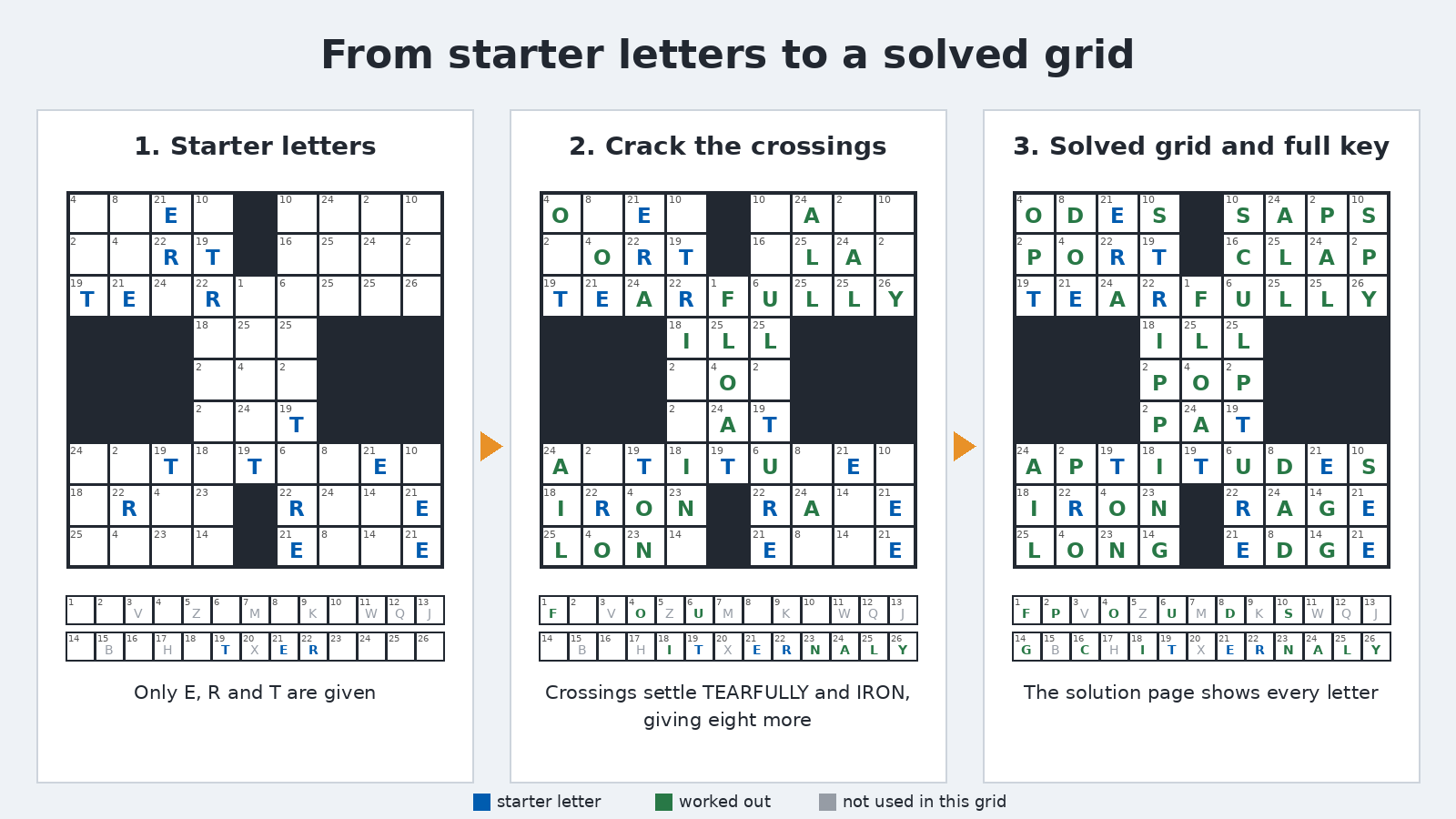
Using every letter and recognizable words
Codeword fills every grid from its built-in English list. Easy and Regular draw on the same recognizable words, so neither level reaches for harder vocabulary. At 13×13 and 15×15, Regular also uses grids with longer entries, so it takes longer to solve.
The “every letter is used” praise needs an honest answer. A grid does not always use all 26 letters, and the module does not force it to. What it does instead is print a key strip of 26 numbered boxes, in two rows of thirteen, under every grid. Letters the grid never uses are already filled in on that strip, and the starter letters are marked there too. Nobody is asked to find a letter that is not on the page. In your book description, describe what the page does, “a 1 to 26 key under every puzzle”, rather than promising all 26 letters in every grid.
The built-in list is what keeps the vocabulary recognizable. Proof a few solution pages from each section anyway: you are the editor of the book, and a few minutes on the solution pages catches the odd word you would not print.
Full-page and large-print layouts
In Codeword, the key strip does the job of those strike-outs: it is part of the puzzle image, under the grid, so it always prints on the same page as the puzzle. Instant Puzzle Books, the book export built into Puzzle Maker Pro, lays the images out at your trim and margins as a PDF or PowerPoint file. Its Grid Layout uses Rows and Columns, and one row by one column, the default, gives one codeword per page with the puzzle filling the page area.
For a large-print codeword puzzle book, the large print puzzle books guide explains why grid size, type size, trim and page count move together. For Codeword, three settings do the work:
- Grid size: Codeword runs from 9×9 to 15×15, default 13×13. A smaller grid on the same page area prints bigger squares. A 9×9 or 11×11 suits large print better than a 15×15.
- Trim Size: a larger trim, set in the book settings, gives each square more room.
- Book Typography: raise the puzzle title, description and page number fonts so the whole page matches the cover promise.
Keep the regular and large-print editions as two listings with clear titles, so the shopper knows which interior they are opening.
Keys and the key strip
Every Codeword puzzle comes with a matching solution image from the same run. The solution fills every square and every box in the key strip, so the solver can check the whole cipher, not just the grid.
Put the keys at the back. The book default is Print Solutions With Puzzles, which places each solution right after its puzzle. For a KDP codeword book, choose Puzzles First, Then Solutions so all keys sit behind all puzzles, and turn on Show page cross-references so each puzzle tells the reader which page its solution is on. Puzzle book answer keys covers why a key facing its puzzle spoils the solve.
Puzzle Book Studio is the window where you arrange puzzle sets and add pages. A book with an easy section and a regular section is two puzzle sets. The Time Saver, which comes with Codeword Productivity, generates several puzzle sets, each with its own size, difficulty and quantity, in one run. A book made from more than one puzzle set needs Productivity, or an older Time Saver purchase, on every module whose puzzles go into it. In Puzzle Book Studio, a book made from one puzzle set works on every edition. A one-level book of 100 Regular codewords, at a Quantity of 100, needs only the module. You can move up to any higher edition after you buy.
Rights in short: Codeword and Codeword Creative let you sell the finished books, worksheets and packs you make to your own readers. Codeword Productivity adds the right to sell or supply the puzzles you generate to other publishers and sellers.
Other puzzles you might like
Quote ciphers: cryptogram puzzle books for adults covers the other big decoding book, with quote length and starter letters as the difficulty levers.
Fill-ins: Word Fill and Number Fill give the solver the full entry list and a grid with a few starters filled in. See crossword and fill-in puzzles for publishers for how the clued and fill-in products compare.
Rebuild puzzles: Block Fill cuts a dense crossword into blocks and shuffles them, and the solver puts the grid back together. No clues there either.