

Last checked: 19 November 2026.
A cross math puzzle is a crossword made of sums. Equations run across and down a grid, they share numbers where they cross, and the solver fills the blank cells so that every row and every column is true. Buyers also call it a math crossword, and the software that builds one a math crossword puzzle maker. It works as an adult activity book on KDP and as a classroom worksheet on TPT, and the same three choices decide both: which numbers appear, how the difficulty climbs, and whether the key is right.
The examples below use Criss Cross Math, a module for Puzzle Maker Pro, our Windows puzzle generator. For where cross math sits next to other number puzzles, see math puzzles for publishers.
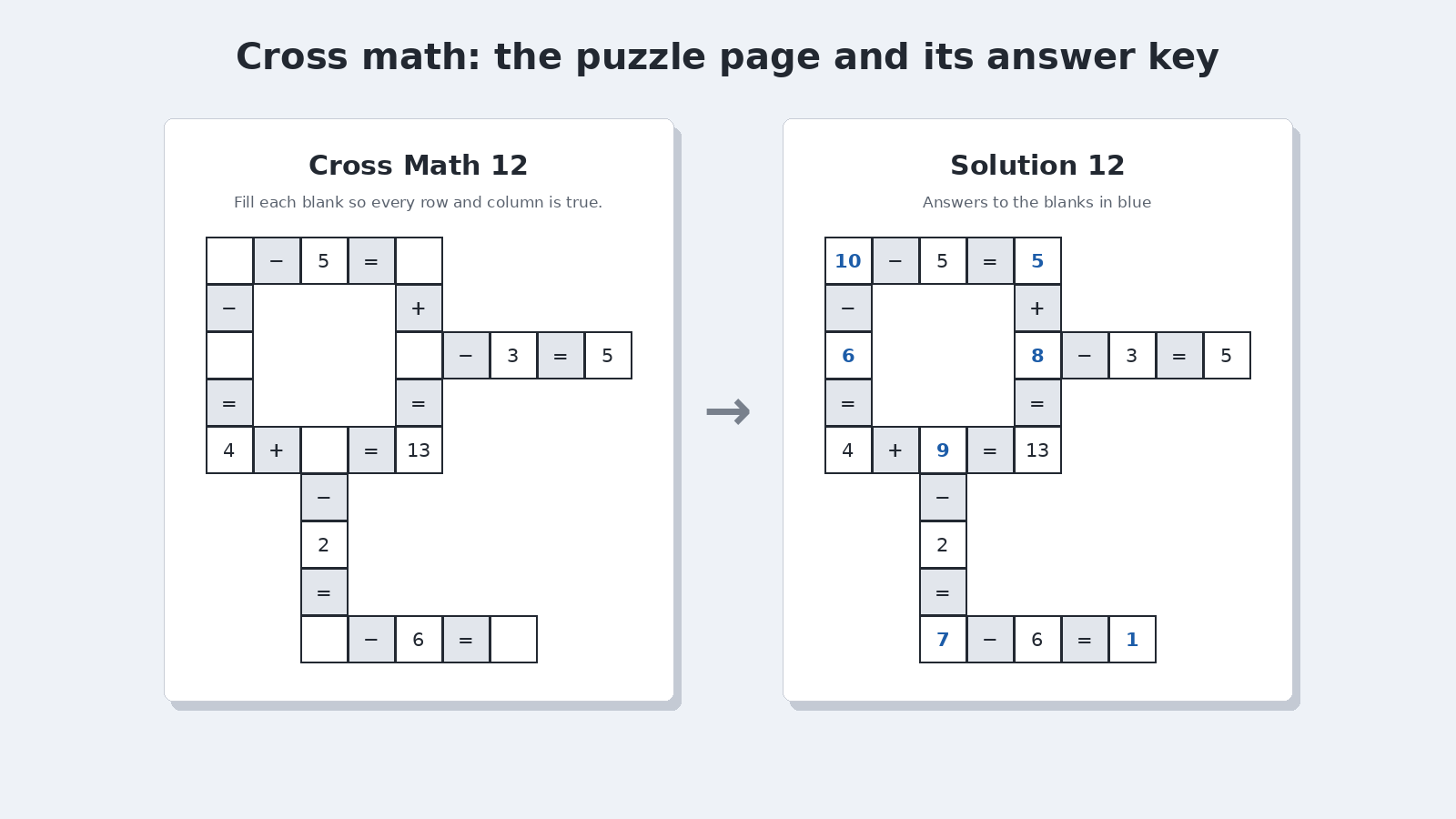
What cross math buyers expect inside
The page above shows the whole format: seven short equations, the operators and equals signs printed, and seven numbers left blank. Every equation has the shape number, operator, number, equals, result, and Criss Cross Math builds every one of them that way. The solver looks for an equation with only one blank, works it out, and that number then helps with the equation that crosses it.
Three things decide whether a buyer is happy with the book:
- The numbers suit the reader. A child working on facts within 10 and an adult who wants a longer puzzle need different ranges.
- The difficulty climbs. Early puzzles give a quick win; the last ones take real work.
- The key is right. Every blank has an answer that fits its puzzle.
Buyers notice the second and third points. One Amazon review of a sudoku book for kids said the “puzzles are too easy – even the ‘hard’ ones”. One KDP publisher, quoted in a KDP interior guide, said that a sudoku book with about five wrong solutions got them “roasted in reviews”. A cross math key is even easier for a buyer to check than a sudoku key, because each equation can be tested on its own.
Number range and operations by audience
In Criss Cross Math, the numbers come from two settings on the Settings tab: Number Range (the smallest and largest number allowed) and Number of Equations (3 to 21). The Easy, Moderate and Hard buttons under Difficulty Level Defaults fill in a starting point for both, plus the grid size.
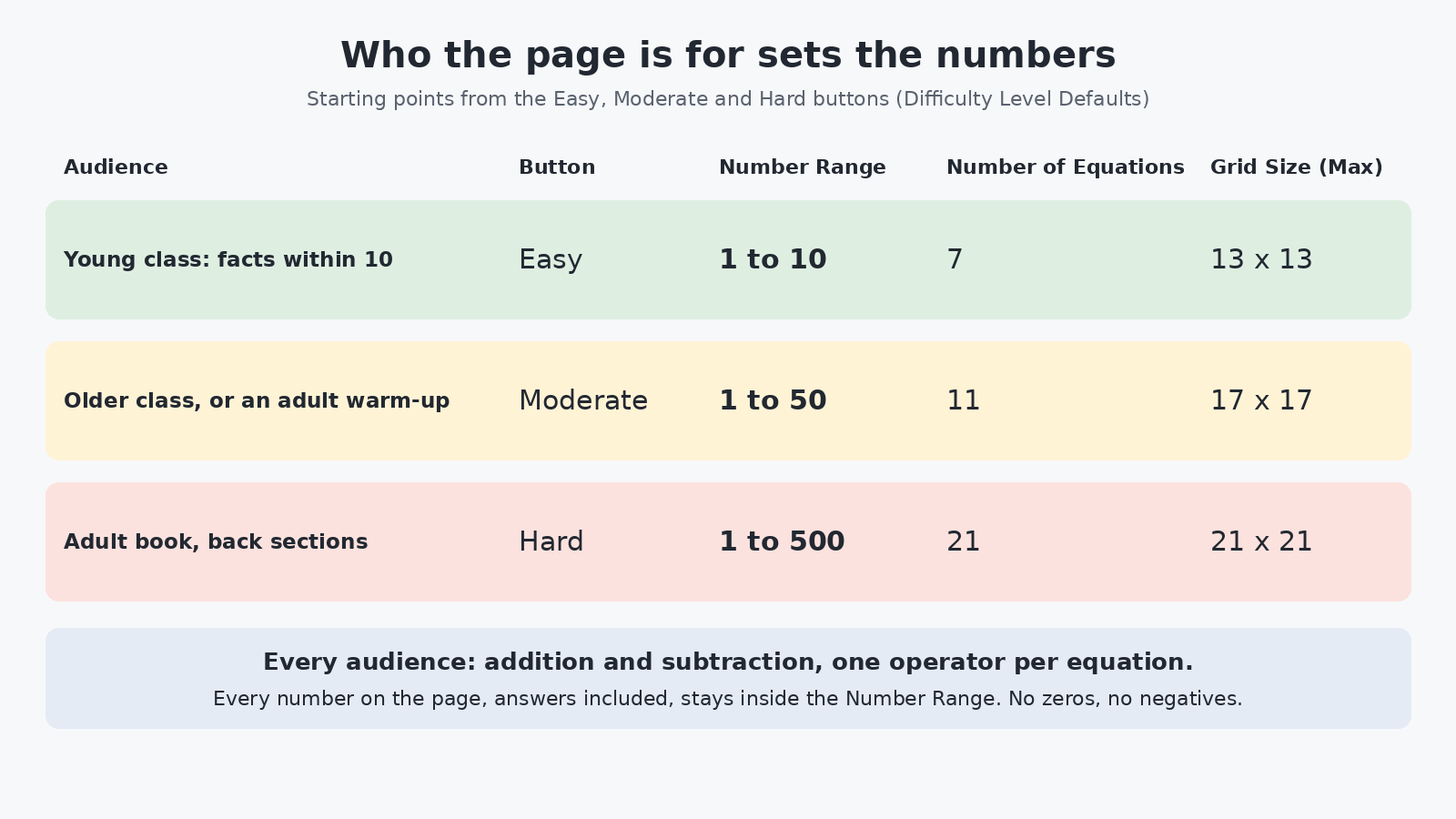
The range limits every number on the page, answers included, so a 1 to 10 sheet never asks a child for 14. There are no zeros and no negative numbers. The range can go up to 1000. You can also raise the lowest number: set the range to 10 to 99 and every number on the page has two digits, which makes an adult page harder without a bigger grid.
Operations: every equation is addition or subtraction. If your adult buyer expects multiplication and division, this module does not make that book today; Cross Sum is the compact 3×3 math cross that can include multiplication. For a Criss Cross Math book, give adults more equations and a wider range, and say “addition and subtraction” in the listing so the buyer knows what they are getting.
Equations per page: seven equations make a short worksheet. Twenty-one equations on a 21 by 21 grid is a much longer puzzle, with longer chains where one answer unlocks the next, and it needs room on the page. Before you generate the whole book, print one Hard puzzle at your trim size and check that three-digit numbers still fit in the cells; if they do not, lower Number of Equations or use Dynamic Grid Size so the cells print larger.
Building a difficulty ramp across a book
The difficulty progression guide explains why a book should climb section by section instead of mixing levels at random. For cross math, each section is one puzzle set at one setting. For example:
- Warm-up: Easy, 1 to 10, 7 equations.
- Middle: Moderate, 1 to 50, 11 equations.
- Challenge: Moderate settings with the range changed to 10 to 99.
- Hard warm-up: Hard settings with Number of Equations lowered to 15 and the range changed to 1 to 200.
- Hard: Hard, 1 to 500, 21 equations.
Keep each step small. Going straight from the Easy settings to the Hard settings triples the equations and multiplies the range by fifty: that is a cliff, not a ramp. The third section above changes only the range, a small step, and the fourth sits between it and the full Hard settings.
Generating five sets in one pass is the job of the Time Saver (it comes with the bundle below), which runs one row per section. All rows write to one output folder, and nothing is sorted into subfolders for you, so keep a note of which files belong to which section. You then put the five sets in order in Puzzle Book Studio, the window where you arrange puzzle sets, add pages such as a rules page, and export the finished book.
A book made from more than one puzzle set needs Productivity, or an older Time Saver purchase, on every module whose puzzles go into it. For Criss Cross Math, that is the Criss Cross Math bundle: the module plus its Time Saver add-on. In Puzzle Book Studio, a book made from one puzzle set works on every edition, so a single-level book is fine on the module alone. You can move up to any higher edition after you buy.
Classroom worksheet version from the same settings
A TPT cross math product is shorter than a book. The TPT math puzzle worksheets guide covers the listing itself: one named skill, a page that photocopies well, and a separate key. Name the skill in the title, for example “Add and subtract within 10, cross math”, and put the keys on their own pages.
Use the same settings as a book section at a smaller Quantity. Click Easy, set Quantity to 10, and you have ten worksheets with facts within 10, each with its own solution image. Fixed Grid Size keeps every sheet the same size, so a class set looks consistent. Dynamic Grid Size shrinks the grid to the equations, and Crop Image trims the empty space around it, when you want the puzzle to fill a half-sheet. The Titles tab can print the range on each puzzle (“1 to 10”), so a teacher can tell at a glance which sheet is which.
The shop page lists JPG, PDF and SVG export at 300 DPI. For a single PDF with answer pages, use Instant Puzzle Books, the book export built into Puzzle Maker Pro. It lays out puzzle pages and solution pages at the trim size and margins you set, as a PDF or PowerPoint file. For an adult printable, export the set as one PDF with the answer pages at the back.
Keys that match every page
Criss Cross Math writes the puzzle image and its solution image in the same run, from the same grid. Every given number on the puzzle page appears in the same cell in the key, and every blank is filled in. You never type an answer by hand.
What can still go wrong is the assembly. Puzzles get reordered, a section gets dropped, and the keys keep the old numbers. The answer keys guide explains how Puzzle Book Studio keeps each solution paired with its puzzle when you reorder, and where keys go for KDP and TPT. Before you publish, do two quick checks:
- Solve one puzzle per section with a pencil and compare it with its key.
- Check the last page of each section to make sure the solution number matches the puzzle number after any reordering.
For KDP, put the keys at the back and say in the contents and the description that every puzzle has a solution. Number puzzle books for KDP covers what keys do to your page count.
Rights in short: the module covers selling the books and worksheets you make to your own buyers, including worksheets sold on TPT. The bundle adds the right to sell or supply the puzzles you generate to other publishers, businesses and sellers.
Other puzzles you might like
Cross Sum is a 3×3 math cross: the solver places nine numbers so that three row and three column equations hold, read left to right. Ikura is a small 3×3 addition puzzle for quick classroom work. Math Maze hides the arithmetic inside a route. For the listing itself, see how to write a listing title that names the pencil job, and how to keep one design system across puzzle niches, so a math series and your other titles share one look.