

Short answer: one-line ciphers and short number sequences make the best exit ticket puzzles, because they finish on time and check at a glance. Word searches, short ciphers, easy sudoku and mazes suit a warm-up, which can run long while the room settles.
An exit ticket is a short page handed out in the last minutes and collected at the door, so it has to be finished before the bell and checked against a key. A warm-up only has to run itself while students arrive. The rest of this guide shows why each type lands where it does, and what one sellable TPT page looks like for each.
Five minutes at the start vs five minutes at the end
Start of the lesson (warm-up, bell ringer or morning work). Students arrive over a minute or two, so the page has to make sense with nothing said from the front. A rule the class already knows works best: find the words, fill the grid, or decode with a code they have used before. Early arrivals start first, and nobody waits. Finishing time can vary, because the lesson starts when the teacher says so, not when the last grid is done.
End of the lesson. Everyone stops at the same moment, so the page has to be short enough that most of the class finishes before the bell. It also comes back to the teacher. That makes the answer format the deciding factor: a missing number or one decoded line checks at a glance against the key. A full grid of blanks does not.
Open finish at the start, fixed finish and a quick check at the end. That one difference sorts most puzzle types.
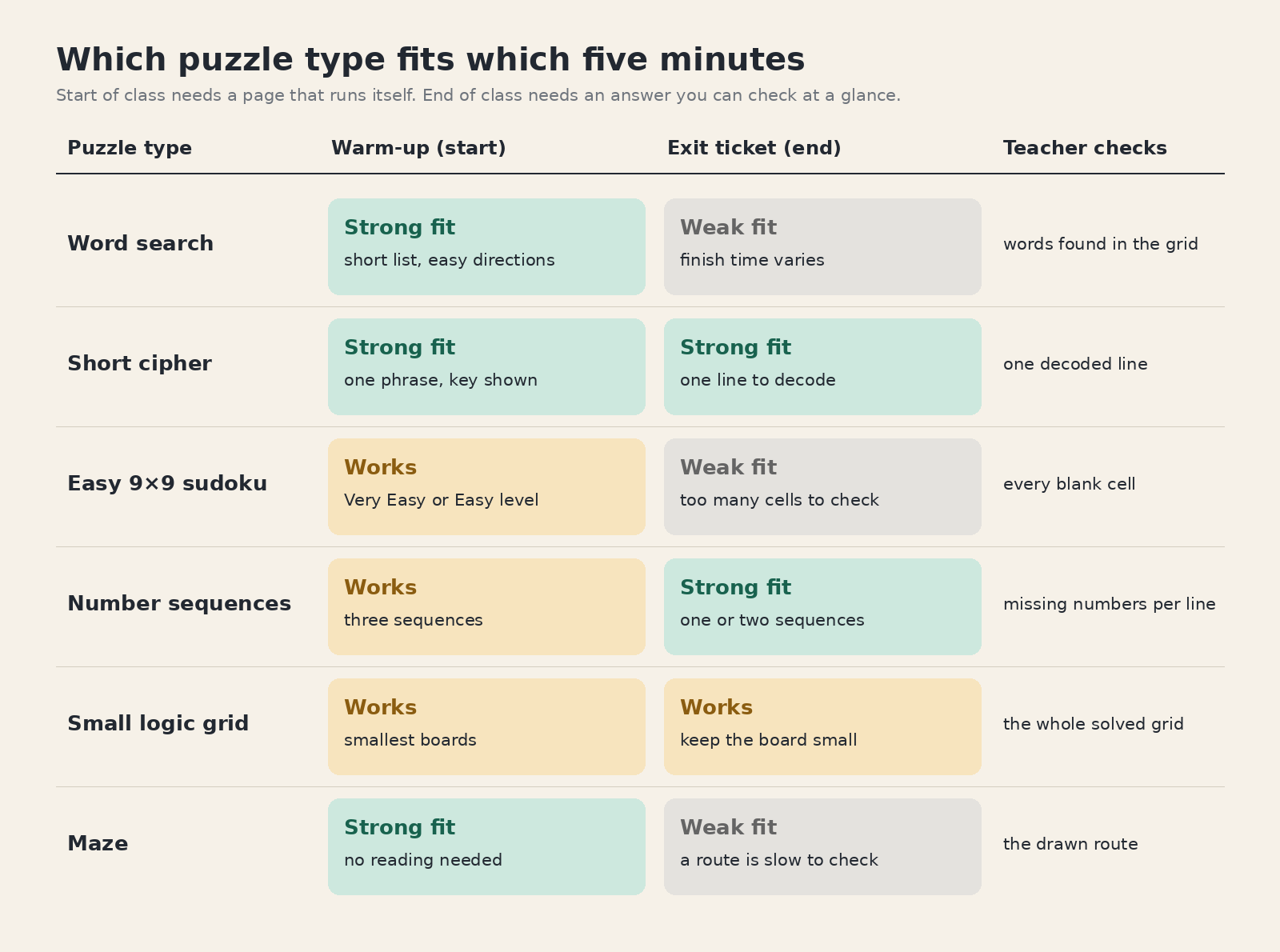
| Puzzle type | As a warm-up | As an exit ticket | What the teacher checks |
|---|---|---|---|
| Word search | Strong fit: short list, easy directions | Weak fit: finishing time varies | Words found in the grid |
| Short cipher | Strong fit: one phrase, key shown | Strong fit: one line to decode | One decoded line |
| Easy 9×9 sudoku | Works at Very Easy or Easy | Weak fit: too many cells to check | Every blank cell |
| Number sequences | Works with three sequences | Strong fit: one or two sequences | The missing numbers in each line |
| Small logic grid | Works on the smallest boards | Works if the board stays small | The whole solved grid |
| Maze | Strong fit: no reading needed | Weak fit: a route is slow to check | The drawn route |
Choosing between one page and a longer packet is a separate decision, covered in classroom warm-up vs homework packet.
Puzzle types that work as warm-ups
Word search. Standard Word Search defaults to a 10×10 grid, a comfortable size for a start-of-class page. Load this week’s words, turn Unlimited Words off and set a low Max Words (1 to 50), and leave Diagonals and Backwards off so the page starts easy. Teachers on TPT describe fixed slots such as “Word Search Wednesday” for morning work or “Mind-Bender Mondays” in a warm-up rotation, and a fixed day is easy to turn into a month of pages. Word lists and grade bands for these listings are in TPT word search worksheets.
Short ciphers. Box Code writes a phrase as coordinate pairs that the student traces back to a letter legend. Words Per Puzzle runs from 1 to 5, and each entry is a phrase. One phrase on a page makes a warm-up; five (the default) makes a sit-down sheet. Set it to 1 and each page decodes one line from your list. The blank-legend mode (Display Encoding off, so the student rebuilds the key) is a bigger job. Save it for the sit-down sheet. For other cipher types, see TPT secret code and cryptogram worksheets.
Easy sudoku. Sudoku 9×9 Creative makes the classic 9×9 at seven levels, from Very Easy to Extreme. For the start of class, use Very Easy or Easy. The Standard edition prints digits; the Creative edition swaps them for nine letters or nine pictures you pick, with the same rule. This product makes the classic 9×9, and how long a Very Easy grid takes depends on the class, so time one with a real group before you put “five-minute” in a title.
Mazes. A maze needs no reading at all, which suits a room that is still unpacking. Keep mazes for the start: a drawn route is slow to check from a stack of slips. Sizes and keys for maze pages are in TPT maze worksheets.
Puzzle types that work as exit tickets
Short number sequences. Smart Numbers prints number sequences with a hidden term. The student finds the rule and fills the gap. Set Formulas per Puzzle to 1 or 2 (the setting runs 1 to 5, default 3) and pick Easy from the four levels: Easy, Medium, Hard and Expert. The page holds one or two lines, and each line has a short answer to check: the missing number or numbers. At the default three sequences, the same setup makes a start-of-class page instead. Other short math boards are compared in TPT math puzzle worksheets.
One-line ciphers. The one-phrase Box Code page works at the end of class too. Use a phrase from the day’s topic, and the check is one line per slip.
Tie the puzzle to the day’s objective. An exit ticket should show what the class learned, so make the content carry the lesson: the hidden phrase in the cipher is the key idea from the lesson (“PHOTOSYNTHESIS NEEDS LIGHT”), the sequence uses the rule you just taught (add 7, or double each time), or a five-word search uses only today’s vocabulary. The puzzle is the format; the answer checks the learning.
Small logic grids. A logic key is the whole solved grid, so only the smallest boards check quickly. TPT logic puzzle worksheets covers the logic types and which of them are checked for a single solution.
One page, one grid, one key
Each product named above writes the puzzle and its solution image in one run. To turn that pair into a page a teacher will buy:
- One grid per page, with the rule in one line above it.
- A name line on exit tickets, because they come back. If the grid image fills the page, place it on your own worksheet template with room for a name.
- Half sheets if you want them. Exit tickets are often half a page. Place the image twice on one US Letter page in your own layout and add a cut line.
- The key on its own page. For a single warm-up, it sits directly behind the puzzle.
- A preview that shows the page and the key, so the buyer sees both before paying.
- The slot, type and level in the title, for example “Easy Number Sequence Exit Ticket, 1 page + key”.
List the warm-up page and the exit-ticket page separately, so each title names its slot and the buyer knows when to hand it out. Levels split the same way, as shown in differentiated TPT packs.
Bundling a month of warm-ups as one TPT product
A single page sells as a single listing. A month of warm-ups is a different product: one PDF, not a TPT bundle of separate listings, with one page for each school day, keys together at the back, and a title and preview that say how many pages are inside, for example “20 Cipher Warm-Ups + Answer Keys”.
- One type, one run. Sudoku 9×9 Creative makes 1 to 5000 puzzle-and-solution pairs from one setup and one level. Set Box Code to one phrase per puzzle and Quantity to 20, and each page takes the next line of your twenty-phrase list. Smart Numbers sets the count with Puzzles to Create.
- Word search: one list or one list per page. One word list with Quantity set to 20 (and Use Words Only Once or a low Max Words) makes a month of grids in one collection, on any paid edition. For a different list on every page, Time Saver (Productivity, or an older Time Saver purchase) takes many word lists in one batch and makes one puzzle per list; Standard Word Search’s Time Saver runs on its own and writes every row into one output folder, so sorting the files is your step before you zip.
- One PDF with keys at the back. Instant Puzzle Books, on every paid edition, stacks the puzzle pages and adds a title page and a table of contents. Its default prints each solution right after its puzzle, so open Project Settings, then Book Settings, and choose Puzzles First, Then Solutions; the keys then land together at the end. The teacher prints the front and keeps the back.
- A mixed month (word search on Wednesdays, a cipher on Fridays) means combining collections from several products in Puzzle Book Studio. That needs Productivity, or an older Time Saver purchase, on each product whose puzzles go into the book. A book from a single collection works on any paid edition, and you can move up to any higher edition anytime after you buy.
A standard TPT purchase covers one teacher and their own classroom, so a month of warm-ups is more pages for that one classroom, not a school-wide license. Selling your finished pages on TPT is covered by every paid edition (editions and rights).
To see how one run turns into a page and its key, try a short warm-up on your own computer first.
Get the free Puzzle Maker Pro demo now
Other puzzles you might like
- Classroom warm-up vs homework packet: one page plus a key, or a sequenced packet.
- Sub day and early-finisher puzzle packets: a grab-and-go packet with keys at the back.
- Differentiated TPT packs: one puzzle type as easy, mid and challenge listings.
- TPT word search worksheets: topical lists and grade bands.
- TPT secret code and cryptogram worksheets: cipher pages and their keys.
- TPT math puzzle worksheets: short reasoning boards that are not drill sheets.
- TPT logic puzzle worksheets: shading, loops, regions and paths.
- TPT maze worksheets: maze listings for the classroom.