

A spelling worksheet is worth buying only when the words on the page are the words the teacher assigned this week. Teachers won’t pay for a scramble of someone else’s words. What sells is narrower: this week’s list in, a short run of different practice sheets out, and an answer key for every sheet so grading stays quick.
Puzzle Maker Pro is Windows desktop software that builds those sheets from a list you type or load. Three modules give you the core of a weekly pack (Word Guess, Word Scramble and Word Search), and Word Ladder adds a fourth sheet when your words fit it. Every sheet exports with its own key, ready to print or list on Teachers Pay Teachers.
A week of spelling practice from one list
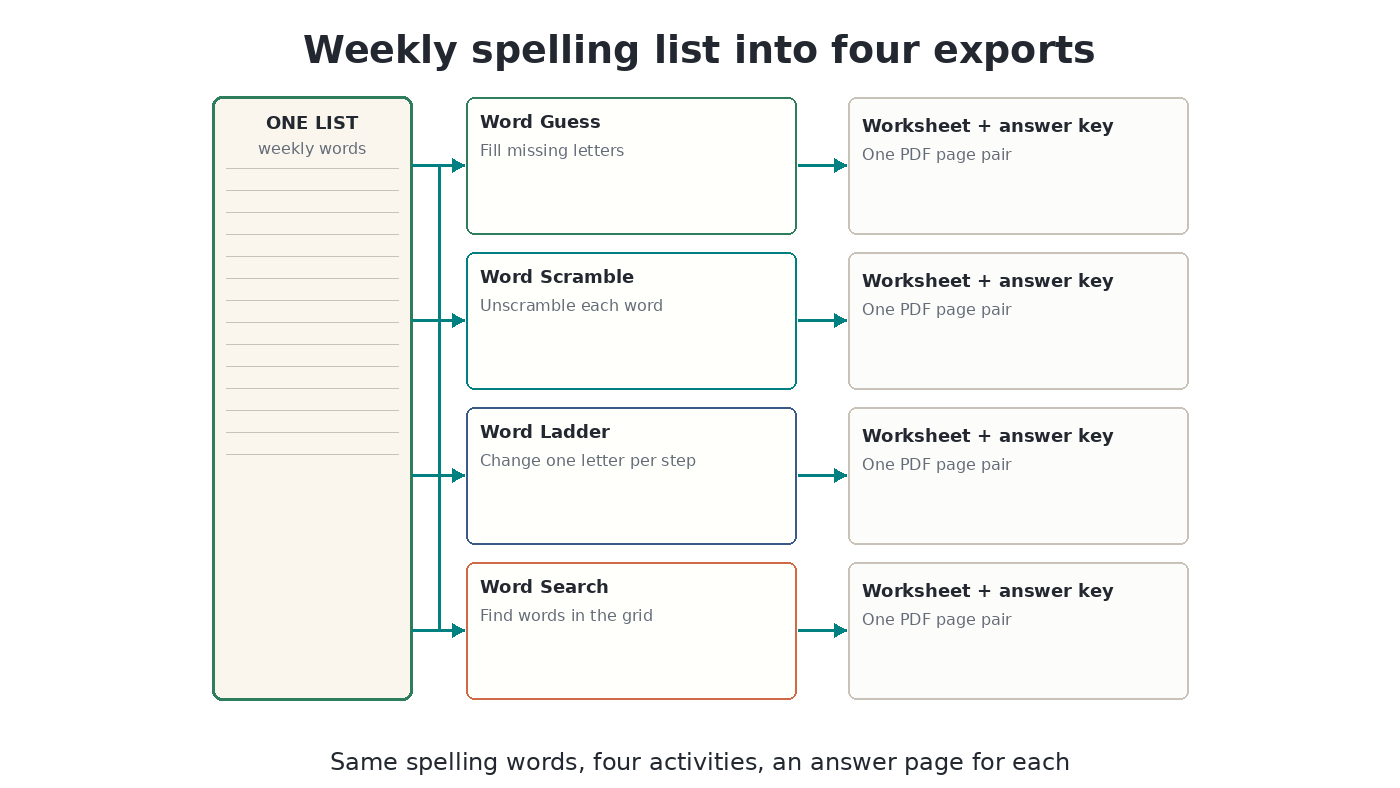
Spelling practice works best as a progression: produce the word, rebuild it, then spot it. A good weekly pack moves through those steps instead of printing the same grid four times.
| Sheet | Module | What the student does |
|---|---|---|
| Produce the spelling | Word Guess | Fill in missing letters while clue letters stay in place |
| Rebuild the spelling | Word Scramble | Restore each jumbled word on its answer line |
| Recognize the spelling | Standard Word Search | Find each listed word in a letter grid |
| Bridge two spellings (optional) | Word Ladder | Change one letter per rung between two words of the same length |
Same words, four different things for the student’s pencil to do. That is what makes a pack feel like a week of work rather than one sheet copied four times.
Word Guess: where the student writes the word
Word Guess is the sheet that makes students produce the spelling. Some letters stay on the line as clues; the rest are blanks. The Creator’s difficulty radios run from 1/2 (about half the letters shown, the easiest) to 1/6 (roughly one letter in six). You can also tick Do Not Show Vowels as Clues, so students fill in the vowels themselves later in the week.
Print the same list at Easy and at Tough and you have two difficulty levels without keeping two word lists. The keys show the full words, which is exactly what you grade against.
Name each sheet for what it asks. “Fill in the missing letters” and “Unscramble the word” are different tasks, and the preview should make that obvious.
Word Scramble and Word Ladder: the middle of the week
Word Scramble sits between clue-guided spelling and finding words in a grid. Each word appears jumbled on its own row with room to write the answer. Optional length hints and the number of words per page are covered in word scramble worksheets.
Word Ladder works at one word length per run, from 4 to 7 letters. You can pin both ends of a ladder with two words from your list, one pair per line (COLD,WARM), and the generator fills the rungs between them with real dictionary words. Pick Clued to print a short clue for each rung, or Clueless to give only the two end words. Choose the ladder when your list has same-length pairs you would like students to bridge, and run one ladder per word length if the list mixes lengths.
Word Search: recognition at the end of the week
Standard Word Search closes the week. Students find the whole words they practised on the Guess and Scramble pages. For an extra spelling step, Hide Vowels blanks the vowels in the grid, so students have to know the spelling to spot the word. The answer key still shows every letter.
Keep classroom grids readable: a rectangular grid, a word bank that matches the list, and search directions that suit the grade on the cover. For review weeks built around a word bank rather than a spelling list, see TPT vocabulary word search worksheets.
Packaging a weekly spelling listing
Put the week in the title: grade, unit, or list number. Show each sheet type in the preview images, and say up front whether the pack has three sheets or four. Give the page count, answer pages included, so a buyer knows what prints.
Keep it letter size and to the point. A spelling pack needs one skill progression, the week’s words, and keys that match those exact words. Skip book-style front matter and puzzle types that are not part of the week.
Easy and Tough versions can ship as two files in one product or as two listings. Either works, as long as the preview shows which is which.
When the weeks add up to a book
After a term of lists, the same words can become a KDP word-search book or an Etsy printable. See one word list, multiple puzzle products for how to cut a list for each marketplace.
Instant Puzzle Books comes with every paid edition and binds those weeks into a print-ready book. Mixing puzzle types in one book takes Productivity on each module you mix. You can start on Creative and move up to any higher edition at any time after you buy.
Commercial rights for the worksheets and packs you sell on Teachers Pay Teachers are part of the Puzzle Maker Pro license, as stated on the homepage. The word list itself needs to be yours or licensed for where you sell.
Next step
Type this week’s list into the free demo and print the Word Guess, Scramble and Search sheets with their keys. The demo watermarks its output, so you can see every page before you buy.
Get the free Puzzle Maker Pro demo now
Other puzzles you might like
Word scramble worksheets for teachers and sellers: when a scramble pack is the whole product.
TPT word search worksheets: word search listings for any classroom theme.
One word list, multiple puzzle products: turn one curated list into KDP, Etsy and classroom products.