

Last checked: 17 November 2026.
Publishing a color by number book for adults? Start with what the buyer expects, because adult titles sit in a different corner of the store than kids’ books. The buyer already knows the activity. They want pictures with enough detail to feel worth an evening, a color legend they can read without a magnifier, and a keyed answer when a swatch is ambiguous. That keyed answer is the finished colored image at the back, numbered to match the puzzle page.
Below: what goes inside an adult volume, which print settings change the page, and how to assemble the KDP interior. For turning your own image into a page, see the Color by Number product page. For where color-by-number pages sit beside other low-reading visuals, start with visual puzzles for KDP and Etsy books and the broader visual and matching puzzles for publishers guide.
What adult buyers expect on the page
A credible adult volume usually delivers four things on every puzzle spread.
Art with real edges. Faces, buildings, and landscapes need enough cells that shading reads as shape, not noise. A toddler page with five big blocks will feel like the wrong product in an adult title.
Numbered cells tied to a palette. Each printed code maps to one swatch. The solver should never wonder whether two numbers share a color.
A color legend on the puzzle page. Top, side, or bottom placement is a design choice, but the legend belongs where the buyer can see it while coloring. Hiding the swatches on another page turns a relaxing book into a bookmark shuffle.
A keyed solution at the back. The colored solution image is the answer key adults search for. Number it to match the puzzle (“Solution 12” for puzzle 12) and keep it off the facing page so the spread does not spoil itself.
Label difficulty yourself in the title and back-cover copy. Difficulty in an adult book comes mostly from the source art, how many cells carry detail, and how many colors sit in the palette. Say that plainly on the cover so a buyer who wanted a calm evening is not staring at a 24-color cathedral facade.
Settings that change the printed page
The production levers named on the Color by Number product page are the ones worth matching to this buyer.
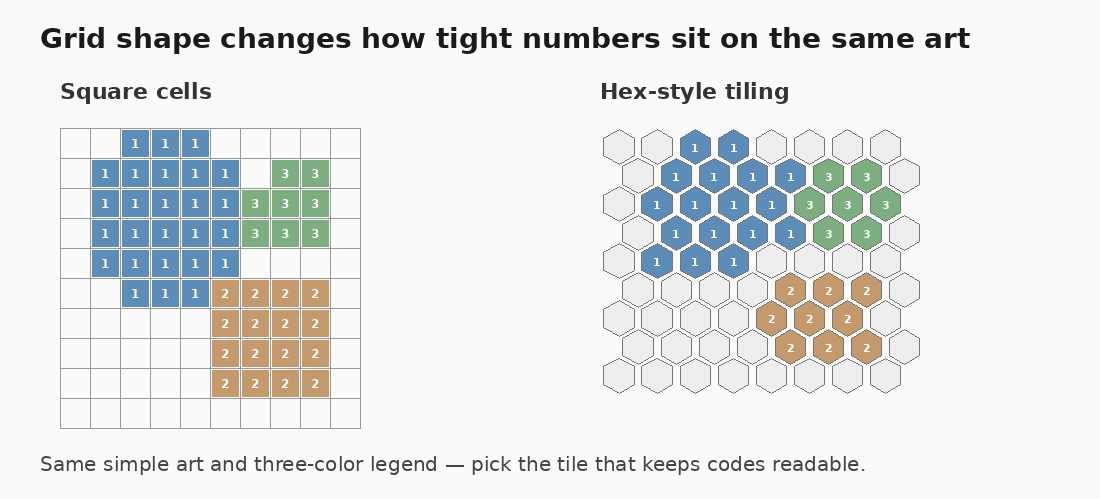
Grid style. Squares, circles, hexagons, triangles and other tile shapes change how tight numbers sit in each cell. Circles and staggered tiles can look softer in a thumbnail; squares give the clearest digit box on an 8.5 × 11 inch page. Pick the shape that still reads at the trim size you plan to publish.
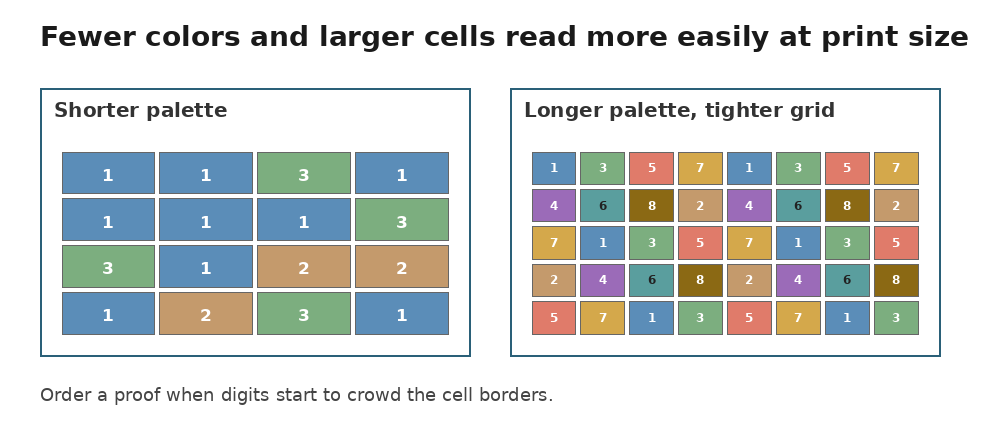
Palette size. Auto mode reads the palette from your image; Custom mode lets you set the colors yourself, from 2 up to 30. A shorter palette on larger cells keeps the printed codes readable. Long palette on a tight grid? Print one page at true size before you commit the series.
Numbered puzzle and colored solution files. Each run produces the page the solver colors and a separate filled-color image. That solution file is what you key at the back. Keep puzzle and solution numbering in sync across the book.
300 DPI PNG and JPG export, and PDF through book assembly. The shop page lists PNG, JPG, and PDF at 300 DPI. In practice, page PDFs for KDP usually come from Instant Puzzle Books (included with every paid Puzzle Maker Pro edition) after you stack puzzle pages and solution pages. Puzzle Book Studio handles titles, numbering, and layout when you want more control than a quick stack.
For answer-key habits that apply across puzzle types, puzzle book answer keys covers placement and numbering. For Look Inside and trim habits on visual books, the visual puzzles for KDP and Etsy books article walks through preview slices.
Building the KDP interior as a system
One strong page is not yet a book. The workflow that scales is: rights-safe art in, consistent palette rules across the set, numbered puzzle exports, matching solution exports, then book PDF out.
Single-collection books assemble in Instant Puzzle Books or Puzzle Book Studio from one module run. That fits a first adult title or a themed mini series.
Several image sets in one volume need batch generation. The Color by Number Business Bundle adds the Time Saver to the core module, so you can queue several presets or quantities in one pass and feed each set into its own book section.
You can sell the finished books, worksheets, and packs you make on KDP, Etsy, Teachers Pay Teachers, or your own store. The Color by Number overview compares the core module and the bundle.
Rights stay yours to verify. Use photos, illustrations, or patterns you created or licensed for commercial print. Adult buyers assume original interiors; recognizable characters or stock art with the wrong licence are return triggers unrelated to the puzzle mechanics.
How this sits beside other adult puzzle books
Adult buyers often compare a color-by-number volume to quote books or connect-the-dot books on the same account. The promise is different: here the payoff is pigment matching, not decoding text or following a trail. If you publish more than one visual type, keep titles explicit so Look Inside shows numbered cells and a legend, not a dot field or cipher grid.
For cryptogram quote books aimed at the same KDP shopper, see cryptogram puzzle books for adults. For hard connect-the-dot interiors with long trails and a keyed line drawing, see dot to dot books for adults.
Other puzzles you might like
Mosaic and picture-reveal logic grids suit buyers who want shading from clues instead of a printed palette. Connect the Dots fits the shopper who wants one continuous numbered path. Turn puzzle printables into a KDP book explains channel steps when you already have page files and need a paperback interior.