

Summary: Tilepaint puzzles are created in Puzzle Maker Pro by choosing a grid size, a difficulty and a tile color mode, then exporting each printable puzzle with its matching solution as PNG, JPG, SVG or PDF. This tutorial covers the settings, the Mosaic and Tinted tile colors, setting a Smart Title, exporting, and scaling one puzzle up to a finished book.
Overview
The Tilepaint module generates complete Tilepaint puzzles: it cuts the grid into tiles of many shapes, decides which tiles are shaded, and prints the row and column counts. Every puzzle has exactly one solution that can be reached by logic alone, and it is graded Easy, Medium or Hard by the solving techniques it needs. The Creator has three tabs: Main, Style and Layout. New to the puzzle itself? Read How Tilepaint Puzzles Work first.
Required Modules
- Tilepaint — pick your edition on the product page.
Tilepaint Classic makes Tilepaint puzzles at every grid size and difficulty, with the full Style tab and all three tile color modes (Single colour, Mosaic and Tinted), and exports PNG, JPG, SVG and PDF with a matching solution. It includes Instant Puzzle Books, a book PDF assembled straight from your current settings, and Puzzle Book Studio for designing a book page by page from one puzzle collection. Tilepaint Productivity includes everything in Tilepaint Classic and adds Time Saver for saved multi-row runs, Puzzle Book Studio Productivity for books built from several collections, and JSON export. Add Interactive to either edition — Tilepaint Classic + Interactive or Tilepaint Productivity + Interactive — for online play, so the same puzzles can be solved in the browser on your own site.
A simple rule for choosing: if each of your books uses one size and difficulty, choose Tilepaint Classic. If you want one book that mixes sizes or difficulties, or many sets at once, choose Tilepaint Productivity. Add Interactive to either one if your readers will solve the puzzles in the browser.
You can upgrade later, to Productivity or by adding Interactive, so start with the edition that fits what you are making today. See Puzzle Maker Pro Editions Explained.
Commercial rights: Tilepaint Classic lets you sell the finished puzzle products you make, such as books, worksheets and printable packs, to your own readers and customers, including on KDP, Etsy and Teachers Pay Teachers. Tilepaint Productivity adds the right to sell or supply the puzzles themselves to other publishers and sellers.
Want to see it first? The free demo makes one watermarked puzzle at a time in a single shading color, so you can check the settings and the output before buying.
Preparation
Decide who the puzzles are for and where they will be printed. Tilepaint needs no word lists or pictures: everything comes from the generator. Then decide on color, because it settles the tile color mode:
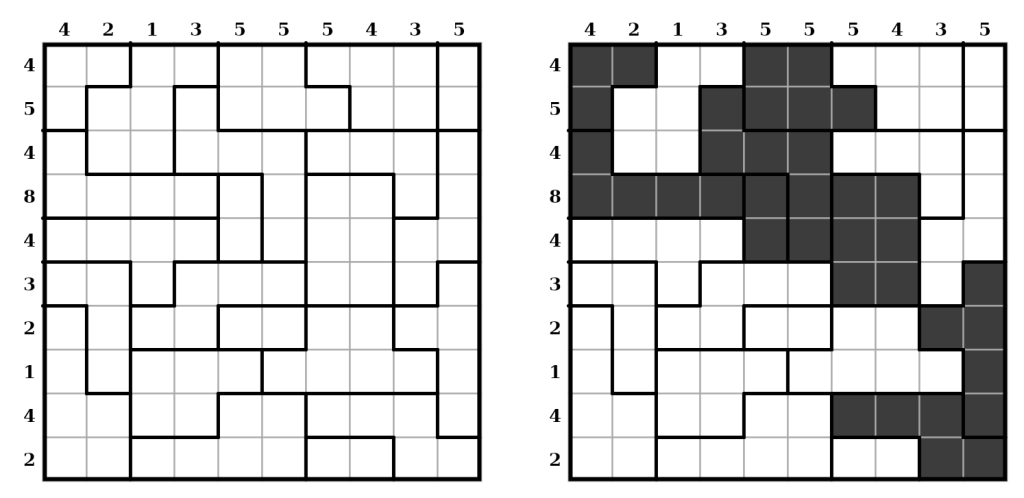
- Black-and-white interior: use Single colour. The puzzle pages are black, white and light gray, and the answer key shades the tiles in dark gray, so every page prints clearly in grayscale.
- Color interior, printable PDF or classroom handout: Mosaic and Tinted turn the pages into stained-glass and pastel-quilt designs (see Choose the Tile colours Setting below).
Choose the Main Settings

On the Main tab:
- Width and Height: the grid, each from 5 to 15 cells, default 6 × 6. They are independent, so wide or tall boards are fine. A 5 × 5 or 6 × 6 Easy board suits beginners and upper-primary pupils, with few tiles and only full-line and zero-line checks; 8 × 8 to 10 × 10 fills a page in a 6 × 9 or 8.5 × 11 book comfortably; 12 × 12 to 15 × 15 gives a long solve for experienced solvers.
- Difficulty: Easy (the default), Medium or Hard. Difficulty is graded by the techniques a board needs, and the generator reaches each tier through tile size: Easy boards have a few large tiles and need only lines that are finished or need every cell they can get; Medium boards have more, smaller tiles and add line arithmetic (a tile too big to fit a count, or one a line cannot reach its count without); Hard boards have the smallest tiles and add testing one tile against the counts. Grid size and difficulty work together: a Hard 6 × 6 is a quick but sharp puzzle, and an Easy 15 × 15 is long but gentle.
- Tile colours: Single colour (the default), Mosaic (solution) or Tinted tiles. See the next section.
Then set the number of puzzles in the Quantity box above the tabs. Every puzzle in a run is different: no board repeats within one Create run.
Choose the Tile colours Setting
The Tile colours setting on the Main tab decides how the printed pages look:
- Single colour — the classic look. The answer key shades tiles in one color, the Shading color on the Style tab (dark gray by default).
- Mosaic (solution) — the puzzle page stays plain, and the answer key paints every shaded tile in its own color from the palette, like stained glass. Neighboring tiles never share a color, so each tile stands out.
- Tinted tiles — every tile is tinted in a soft palette color on both the puzzle and the answer key, so the tile shapes are easy to see before the solve starts. On the answer key, the shading is laid over the tint as a darker shade.
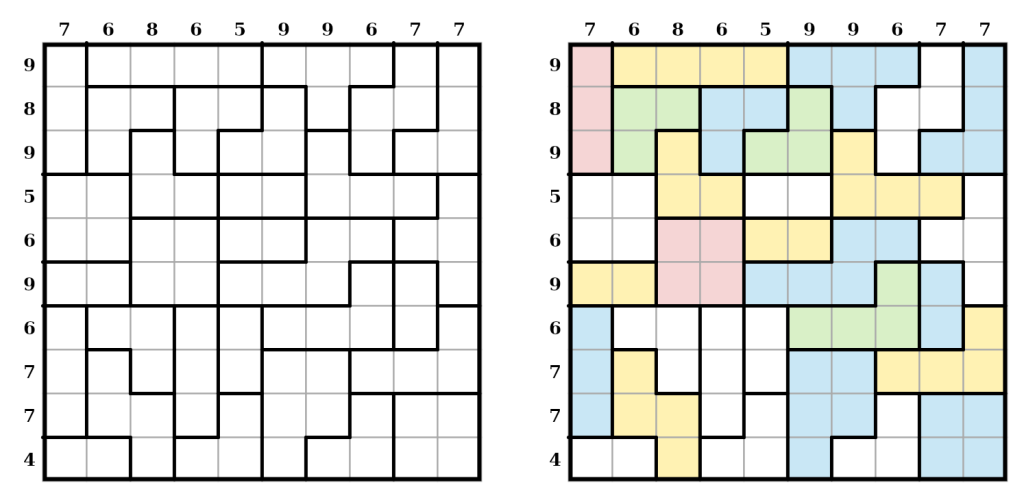
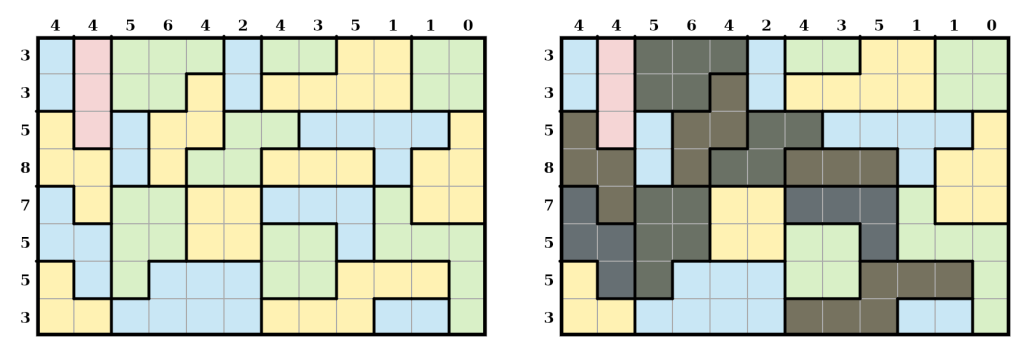
The palette itself is on the Style tab (next section). The tile colors are for your printed and exported pages; online play uses the plain shaded look.
Style the Puzzle

On the Style tab you set the Font for the counts, the Background Color and Cell Fill Color, and, in the Lines group, the width and color of the cell border (the thin grid lines). The Shading color is in the Colors group and sets the color of the shaded tiles in Single colour mode. Pick a color that fits your book, or keep the dark gray for a black-and-white interior.
The Tile colours group holds the six palette colors that Mosaic and Tinted use, in soft pastels by default. Click a swatch to change one color, or click Randomize for a fresh pastel set. The mode itself is always chosen on the Main tab.
Full styling options are covered in How to Customize Puzzle Designs.
Set the Title

On the Layout tab, choose a Smart Title. A Smart Title fills in each puzzle’s details automatically, so every page in a batch is labelled correctly. Tilepaint offers these options; the examples are for a 6 × 6 Medium puzzle:
- Tilepaint Grid Size (the default) — e.g. “Tilepaint 6 × 6”
- Tilepaint — e.g. “Tilepaint”
- Tilepaint Difficulty — e.g. “Tilepaint Medium”
- Tilepaint Grid Size Difficulty — e.g. “Tilepaint 6 × 6 Medium”
- Grid Size — e.g. “6 × 6”
- Difficulty — e.g. “Medium”
- Grid Size Difficulty — e.g. “6 × 6 Medium”
- Custom — your own text, used exactly as typed
The difficulty options print the grade each puzzle was built at, so the label on the page always matches the puzzle. The same options are available for the puzzle Description. Its default is Custom, with the one-line rules reminder “Shade whole tiles. The numbers count the shaded cells in each row and column.”, which is a good line to print under every puzzle in a book. The Layout tab also has Crop Output Image, which trims the outer margin. See the Smart Titles tutorial for how the control works.
Generate and Export
The preview on the right updates as you change settings. Click Next Preview to make a new puzzle, and use Show Preview to see the Puzzle, the Solution or Both side by side. When the look is right, choose your formats on the Output Settings tab at the top of the main window (it is shared by every puzzle type): PNG, JPG, SVG or PDF for worksheets and books on every edition, plus:
- JSON (Productivity) — the puzzle data, for your own apps and workflows.
- HTML (with Interactive) — an HTML batch folder for online play, plus a ZIP ready for the BookPublisherTools WordPress plugin. In the browser, one click shades a whole tile, and the player warns when a row or column has too many shaded cells or can no longer reach its count.
Then click Create. Puzzle and solution files are saved to your output folder, one pair per puzzle.
Scale to a Book
Once one puzzle looks right, the same settings make the whole book. On every edition, Instant Puzzle Books turns the set you just created into a ready-to-print book PDF from your current settings, with a title page, table of contents and a footer on every puzzle that tells your reader which page its solution is on. Puzzle Book Studio lets you open that set and design the book page by page.
With Tilepaint Productivity, build a graded book that mixes difficulties in one pass:
- For each chapter, set the size and difficulty, then click the Save button on the presets toolbar at the top of the panel and give the preset a name, for example
Tilepaint-Easy-6x6,Tilepaint-Medium-8x8andTilepaint-Hard-10x10. Each Time Saver row starts from a preset. - In Time Saver, add one Tilepaint row per chapter from those presets, each with its own quantity.
- Generate the set. Every puzzle keeps its matching solution, and no board repeats within a row.
- Open Puzzle Book Studio Productivity with the generated set to lay out the puzzle and answer-key pages and combine it with your other puzzle collections, then render the book PDF.
Time Saver and Puzzle Book Studio each have their own tutorial. See Further Reading.
Outcome
You can now create Tilepaint puzzles at any size from 5 × 5 to 15 × 15, square or rectangular, at three difficulties, give them a classic, Mosaic or Tinted look, title them automatically, export them with their answer keys, and scale them up to a finished puzzle book — with Tilepaint Productivity, one that gets harder chapter by chapter.
FAQ
What grid sizes can I make?
Any width and any height from 5 to 15 cells, set separately, so square, wide and tall boards are all possible.
How is the difficulty decided?
By the techniques a solver needs. Easy boards need only lines that are finished or need every cell they can get, Medium boards add line arithmetic (“too big to fit” and “needed to reach the count”), and Hard boards add testing a single tile. The generator gets there through tile size: harder boards have more, smaller tiles. Larger grids also take longer to solve.
Will every puzzle have exactly one solution?
Yes. Every Tilepaint puzzle is checked so that logic alone leads to its single solution, at every size and difficulty.
Which edition has the Mosaic and Tinted colors?
Every paid edition: Tilepaint Classic already includes Single colour, Mosaic and Tinted, with the six-color palette on the Style tab.
Will the colored pages work in a black-and-white book?
Use Single colour for a black-and-white interior; its pages print cleanly in grayscale. Mosaic and Tinted are made for color interiors, printable PDFs and handouts.
How do I make a book that gets harder as it goes?
Use Tilepaint Productivity: add one Time Saver row per difficulty or size, then combine the rows into one book in Puzzle Book Studio Productivity. Tilepaint Classic builds each book from one set, so every book has a single size and difficulty.