

Summary: Statue Park puzzles are created in Puzzle Maker Pro by choosing a board size and difficulty, generating, and exporting the puzzle with its matching solution as PNG, JPG, SVG or PDF. This tutorial shows how to make your first puzzle, choose the shape set and how the statues look in the answer key, set a Smart Title, and turn one puzzle into a whole book.
Overview
Statue Park (also published as Pentomino Park) is a shape-placement logic puzzle: place every shape in the bank so none touch along an edge, black dots are covered, white dots stay empty and the empty cells connect. This tutorial walks through making one in Puzzle Maker Pro, from opening the module to a print-ready puzzle and solution. New to the puzzle itself? Read How Statue Park Puzzles Work first.
Required Modules
- Statue Park — pick your edition on the product page.
Statue Park Classic makes the complete puzzle: every board size from 7×7 to 14×14, every difficulty, the 12 pentominoes, shaded statues, the shape bank options, full styling and Smart Titles. It exports PNG, JPG, SVG and PDF with a matching solution and includes Instant Puzzle Books and Puzzle Book Studio for one puzzle collection. Statue Park Creative adds the other shape sets (tetrominoes, double tetrominoes, pentominoes and tetrominoes together, or your own pick of pentominoes) and coloured or picture statues in the answer key. Statue Park Productivity includes everything in Creative and adds Time Saver for multi-row batch runs, Puzzle Book Studio Productivity for books that combine several collections, and JSON export. Statue Park Creative + Interactive and Statue Park Productivity + Interactive add online play, so your puzzles can be solved in the browser on your own site.
You can move up to any higher edition later: Classic to Creative or Productivity, Creative to Productivity, and Interactive on top of either. So start with the edition that fits what you are making today. See Puzzle Maker Pro Editions Explained.
Commercial rights: Statue Park Classic and Statue Park Creative both carry the licence to sell the finished puzzle products you make — books, worksheets and printable packs — to your own readers and customers, including on KDP, Etsy and Teachers Pay Teachers. Productivity adds the right to sell or supply the puzzles themselves to other publishers and sellers.
A free demo makes one watermarked puzzle at a time, so you can check the settings and the look before buying.
Preparation
Nothing to prepare: the generator makes everything. If you plan to put pictures on the statues (Creative and up), pick a built-in picture set or have a few square images ready. For your first puzzle, an 8×8 board at Easy is a comfortable start: six pentominoes and plenty of dots, a good length for one worksheet or one lesson.
Choose the Main Settings
On the Main tab, set the options that define the puzzle:
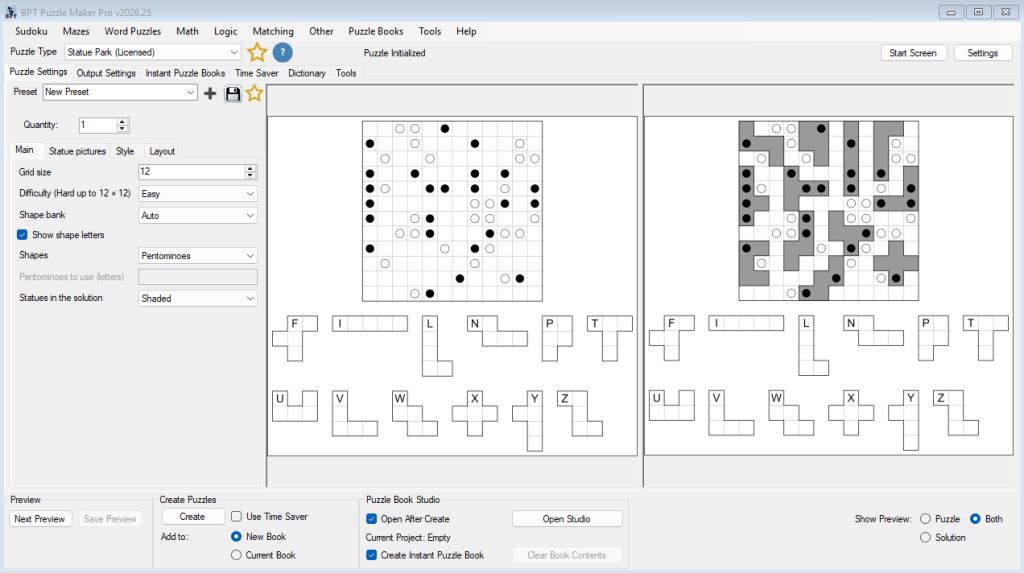
- Grid size: a square board from 7×7 to 14×14, default 12×12. With the 12 pentominoes, the board decides how many shapes the puzzle uses: 4 on 7×7, 6 on 8×8, 8 on 9×9, 9 on 10×10, 11 on 11×11, and all 12 from 12×12 up. Below 12×12 each puzzle draws its own random selection, so pages in a book differ. As a guide: 7×7 or 8×8 for a first taste, 10×10 for a worksheet, 12×12 to 14×14 for the traditional full-set park.
- Difficulty (Hard up to 12 × 12): Easy, Medium or Hard. Easy solves with placement logic alone, Medium also needs the connected-park rule, and Hard adds a one-step logical check: follow what a placement would force, and rule it out if a rule breaks. Hard runs on boards up to 12×12; if you pick Hard on 13×13 or 14×14, the puzzles are made (and titled) at Medium, so build a Hard section on 12×12 or smaller. Every level has exactly one solution and needs no guessing.
- Shape bank: where the shapes to place are printed: Auto (Puzzle Maker Pro picks the side that fits the page), Below or Beside the board. For tall book trims such as 6×9 or 8.5×11, Below keeps the board as wide as the page; Beside suits landscape or square pages.
- Show shape letters: prints each shape’s letter (F, I, L…) in the bank. Leave it on so solvers can refer to the shapes by name; switch it off for a cleaner bank.
Generate and Preview
Click Next Preview in the main window to render one puzzle while you dial in the settings. Puzzle Maker Pro builds the matching solution in the same pass.


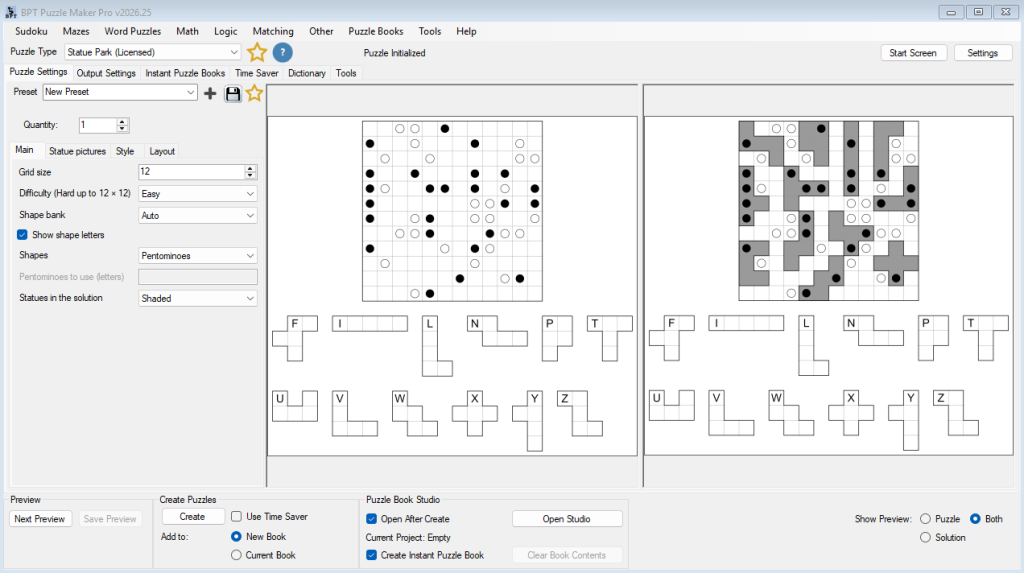
You should now see a board like this one, with the shape bank beside or below it, plus its completed answer key with the statues shaded. When the look is right, enter the number of puzzles you need in the Quantity box and click Create. For a classroom worksheet, keep the Description on its default: its text is the five rules, so each puzzle page can carry them, and the solution files are your separate answer key. The puzzle and solution files land in your output folder, one pair per puzzle, and no board repeats within one Create run. Hard puzzles on the larger boards take a few seconds each, so a large Hard batch runs while you get on with something else.
Choose the Shapes (Creative and Up)
The Main tab also shows Shapes, Pentominoes to use (letters) and Statues in the solution. They are yours to change from Creative up; on Classic they stay greyed out on their defaults, and the Statue pictures tab shows its controls locked with a caption naming the edition that unlocks them. Shapes offers:
- Pentominoes — the traditional set, sized to the board as above.
- Tetrominoes — the five four-square shapes (I, L, O, S, T), on any board from 7×7. The friendliest start for younger solvers, which makes Creative the edition to pick for a primary classroom.
- Double tetrominoes — each tetromino twice, ten shapes, on 10×10 and up.
- Pentominoes + tetrominoes — all 17 shapes on a 14×14 board, the longest park to solve.
- Pick pentominoes — type the letters of the pentominoes you want in Pentominoes to use (letters), for example
FILPTX. Type at least one letter and no more than the board holds (6 on 8×8, 9 on 10×10, all 12 from 12×12); otherwise the puzzle is not made and a message tells you the allowed number.
Double tetrominoes and Pentominoes + tetrominoes need a bigger board; if your grid size is smaller, it is raised to fit.
Choose How the Statues Look (Creative and Up)
Statues in the solution changes how the placed shapes are drawn in the answer key, and how the shapes in the bank are drawn. The board on the puzzle page stays the same, and online play always shows plain statues:
- Shaded — one stone grey, the traditional look.
- Coloured — every shape type in its own colour, in the solution and in the bank.

- Pictures — a picture on each statue, which young solvers love. Open the Statue pictures tab, tick Use these pictures, and add pictures from a built-in set or from your own files. The statues take the pictures in order; if there are more statues than pictures, the list repeats.

Style the Puzzle
On the Style tab you control the canvas, the cell fill and grid lines, the board border, the shape outlines, the statue fill, the black and white dots, and the font of the shape letters. The Layout tab has a crop option that trims the outer margin, and a Use branding toggle (off unless you turn it on) that paints your branding template onto this collection’s puzzle images. Full styling options are covered in How to Customize Puzzle Designs.
Set the Title
On the Layout tab, choose a Smart Title. It fills in the puzzle’s own details, so every page in a batch is labelled correctly without retyping. Statue Park offers these options; the examples are for a 10×10 Medium puzzle:
- Statue Park — e.g. “Statue Park”
- Statue Park Grid Size — e.g. “Statue Park 10 × 10” (the default)
- Statue Park Difficulty — e.g. “Statue Park Medium”
- Statue Park Grid Size Difficulty — e.g. “Statue Park 10 × 10 Medium”
- Grid Size — e.g. “10 × 10”
- Difficulty — e.g. “Medium”
- Grid Size Difficulty — e.g. “10 × 10 Medium”
- Custom — your own title text, used exactly as typed
The same options are available for the puzzle Description, which defaults to the rules: “Place every shape in the grid. Shapes may not touch along an edge. Black dots are covered by a shape, white dots stay empty, and all empty cells must connect.” See the Smart Titles tutorial for how the control works.
Export Your Puzzle
Export the puzzle and its solution as PNG, JPG, SVG or PDF for worksheets and books. Depending on your edition you can also export:
- JSON (Productivity) — the puzzle data for your own apps and workflows.
- HTML output (Interactive editions) — the files that drive online play, exported as HTML plus a ZIP for the BookPublisherTools WordPress plugin. In the browser, solvers click cells to shade statues or mark open park, drag to shade several cells at once, see the placed shapes grey out in the bank, and press Check when they are done.
Scale to a Book
Once one puzzle looks right, the same settings make the whole book. On every edition, set the Quantity, click Create, and use Instant Puzzle Books for a ready-to-print book PDF with a title page, contents and solution cross-references, built from your current settings; or open the set in Puzzle Book Studio to design the book yourself. On Productivity, a graded book comes from several rows at once:
- Save the settings as a preset from the toolbar at the top of the panel, named for the section, for example
Park-Easy-10x10. Each Time Saver row starts from a preset. - In Time Saver, add one Statue Park row per section, each with its own quantity. A graded 100-puzzle book could be 30 Easy 8×8, 40 Medium 10×10 and 30 Hard 12×12.
- Generate the set. Every puzzle keeps its matching solution.
- Open Puzzle Book Studio Productivity with the generated set. Lay out each row as its own section (Easy, Medium, Hard) with the answers at the back, mix in your other puzzle types, and produce the book PDF.
Time Saver and Puzzle Book Studio each have their own tutorial; see Further Reading.
Outcome
You can now create Statue Park puzzles with matching solutions, choose the board, difficulty and shape set, decide how the statues look in the answer key, title and style them, export them for print or screen, and scale one puzzle up to a finished book.
FAQ
What board sizes can I make?
Square boards from 7×7 to 14×14, default 12×12. With the pentominoes, smaller boards use fewer shapes (4 on 7×7, 9 on 10×10) and 12×12 and up use all twelve.
Which difficulty should I choose?
Easy for newcomers and children, Medium once solvers know the rules, Hard for experienced puzzlers. For a class, start younger students on 7×7 Easy (four shapes), use 8×8 Easy for older students, and keep 10×10 Medium and Hard for those who have solved a few. Hard runs on boards up to 12×12. Every level has exactly one solution and needs no guessing.
Can I use shapes other than pentominoes?
Yes, from Creative: tetrominoes, double tetrominoes, all 17 pentominoes and tetrominoes on 14×14, or your own pick of pentominoes.
Can I put pictures on the statues?
Yes, from Creative. Set Statues in the solution to Pictures and add pictures on the Statue pictures tab, from a built-in set or your own files. They appear in the answer key and the shape bank.
Do I need Productivity to make a lot of puzzles?
No. Setting the Quantity and generating a batch works in every edition. Productivity adds Time Saver, which saves multi-row setups so a whole graded book regenerates in one run, plus Puzzle Book Studio Productivity for books that combine several collections, and JSON export.
What formats can I export?
PNG, JPG, SVG and PDF for the puzzle and its solution in every edition. Productivity adds JSON, and the Interactive editions add HTML output for online play.