

Shoppers who search for a queens puzzle book, queens logic puzzles, or star battle logic puzzles are not asking for chess. They want a square grid split into irregular regions, exactly one marker in every row, column, and region, and no two markers touching, diagonals included. Publishing one? The KDP job is to turn that rule set into a finished interior: clear grid sizes, regions that still read after print, and one answer key per board without spoiling the puzzle page.
Still choosing a mechanic? Logic puzzle books for KDP maps Queens beside Slitherlink, Numberlink, Shikaku, and the rest. Rules and settings walkthroughs are in the Queens tutorials and Getting Started with Puzzle Maker Pro: Queens.
What Look Inside must prove
A queens logic puzzle book sells on the first interior spread. The puzzle page shows coloured or shaded regions and an empty grid. The buyer should see three promises immediately:
- One board per page. Cramming two region maps on one 6×9 sheet shrinks the cells and blurs the borders that carry the puzzle.
- Regions before markers. The puzzle export hides the queens. If Look Inside shows glyphs on the puzzle page, the listing lies about the job.
- Keys exist and match numbering. Every Queens book needs a numbered solution section. A key that uses lighter lines than the region map is hard to read at paperback size.
The comparison trio Galaxies vs Shikaku vs Queens explains why Queens needs its own title: the preview is regions only, not dots or area numbers. Mix that look under a generic logic title and the buyer opens the wrong book.
Grid sizes by band
Queens builds 5×5 through 8×8 boards in the grid size control. That range gives you three clean difficulty bands; treat them as bands, not random variety.
5×5 is the starter band. Five regions and five markers fit a gift-sized sit and read well in teen collections; see puzzle books for teens for how harder logic types stay age-appropriate without a juvenile cover.
6×6 and 7×7 are the middle band. Region count rises; forced cells appear less often. Section front matter that labels “Standard” or “Intermediate” beats a single undifferentiated stack.
8×8 is the hard band. The same rules apply, but the region map is denser and the solve runs longer. Name that band on the contents page so Look Inside matches the back-cover difficulty claim.
A series can run Easy 5×5 Vol. 1 beside Hard 8×8 Vol. 2: two books, two promises, not one interior that silently changes size on page forty.
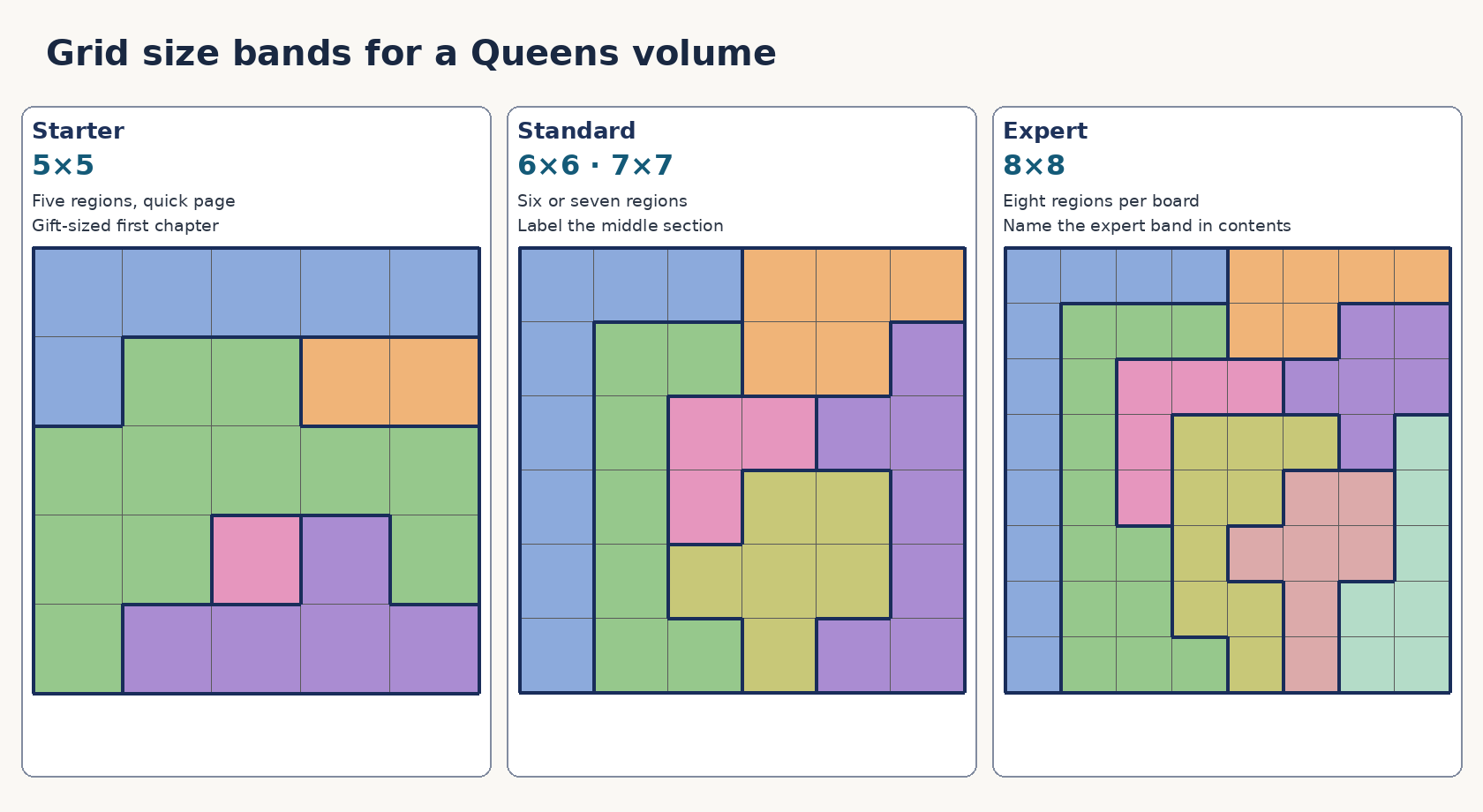
Generate one export batch per band with fixed grid size and style, then assemble sections in order. Label each size section so a jump in difficulty never surprises the solver.
Region shading that survives black-and-white print
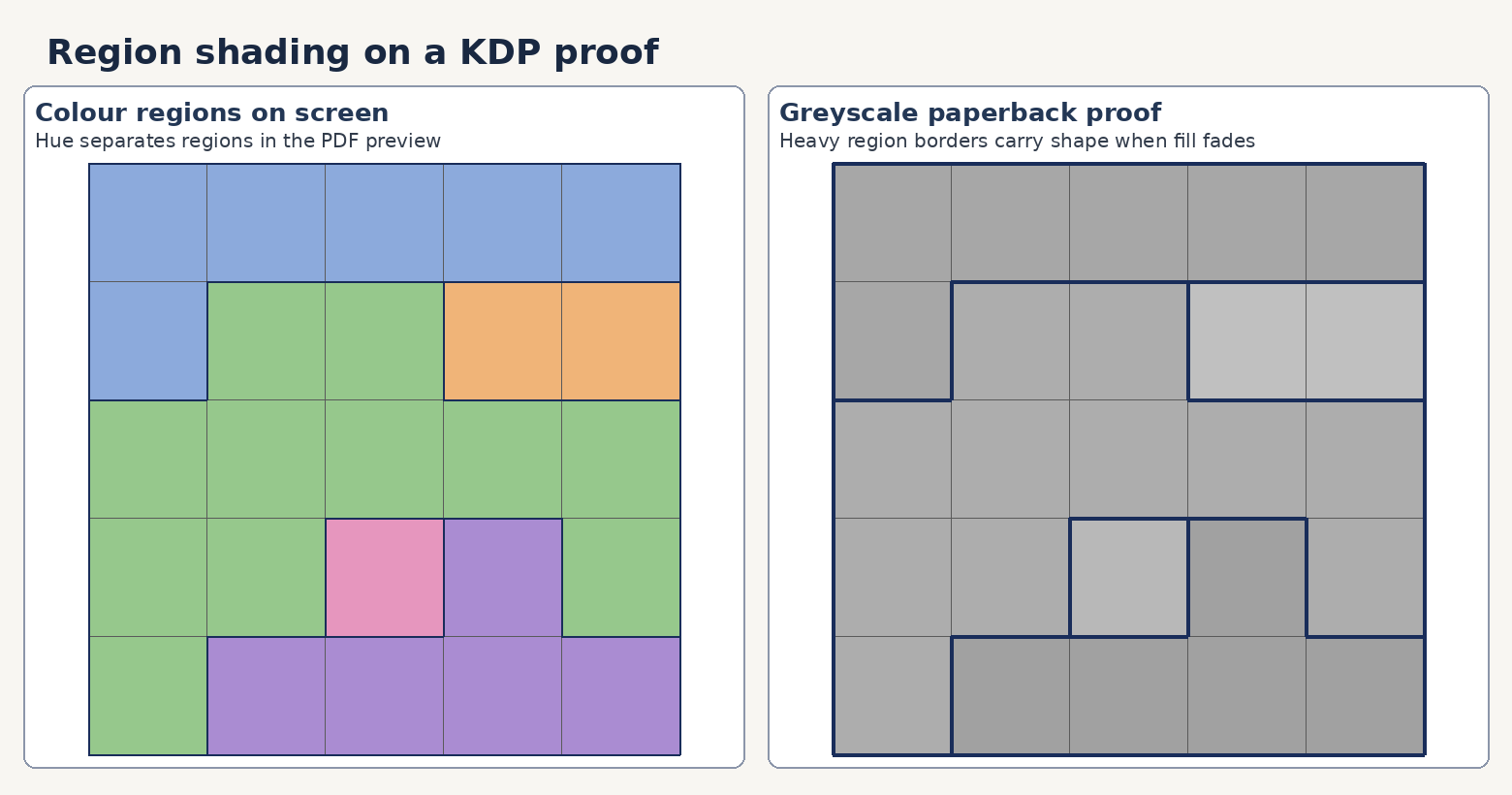
Colour sells the screen proof. KDP paper does not. Region fills that look distinct on a monitor can collapse into the same grey on an inside page, and the solver loses the third constraint: one marker per region.
The production fix is layered:
- Turn region fills on in the Queens style tab so each region has its own swatch on the puzzle page.
- Keep region borders heavy relative to cell lines. A thick region outline still separates territories when fill values merge in greyscale.
- Proof a monochrome PDF before you lock the listing. If two regions vanish together, lighten one fill, darken a border, or widen the region line before you export the full batch.
Letters as the solution marker (Q or another single letter) stay readable when fills wash out; picture markers need extra proof at print DPI. The Queens product page describes symbol choices; pick one marker style per book so puzzle and key pages match.
One key per board
Queens keys are placements, not filled digits. Export pairs one puzzle image with one solution image per index. Number titles consistently (“Queens 1” to “Queens 100”) and list the solution section in the table of contents.
Facing-page keys spoil the solve. The KDP convention is a solutions block past the puzzles, with a stated start page in front matter, the same discipline as puzzle book answer keys describes for other types, except every answer is a drawn marker on the region map.
Drawn keys need visible weight. A hairline queen glyph on top of a pale region fill fails in paperback. Match or exceed the puzzle page border weight on the solution export. Budget page count realistically: a hundred Queens puzzles plus a hundred small placement keys is a real book, not a pamphlet with four grids tucked in the corner.
Queens books vs Star Battle books
Star Battle is the older magazine cousin. Classic Star Battle usually places two stars in every row, column, and outlined region on a 10×10 board, stars never touching. A Queens book uses one queen per row, column, and region, no eight-neighbor contact, long diagonals allowed when cells are not adjacent. One-star Star Battle exists, and it plays like Queens.
So the rules overlap but are not identical. Star Battle titles signal magazine solvers who may expect two stars per unit; Queens titles signal the newer logic-puzzle wave. Do not mix terminology on one cover (“Star Battle” pages inside a “Queens” title). Pick one noun, state the grid sizes, and show a region-only puzzle page in Look Inside.
This is not classic chess n-Queens. Region shapes and the no-touch rule replace unlimited diagonal attacks. The Queens tutorials cover the rules in full.
Assembling the interior
Two layers sit on the Queens batches:
- Puzzle and solution images from Queens at one setting per section: grid size, region style, marker symbol frozen across the band.
- Book layout in Instant Puzzle Books for a fast single-type PDF, or Puzzle Book Studio when you need section pages, continuous numbering, and a second large-type PDF from a regenerated image batch.
Separate Easy and Hard sections in one project, or Queens plus another logic type, takes Productivity on each module you mix. Start on Creative and move up to any higher edition anytime after you buy.
State the book shape on page one: total puzzle count, how grid sizes run by section, where solutions start. Commercial rights for the finished KDP interior are part of the Puzzle Maker Pro license as stated on the homepage.
Other puzzles you might like
Teen logic collections: harder grids without a juvenile cover promise. See puzzle books for teens.
Region-split logic chooser: when you are still picking Galaxies, Shikaku, or Queens for the next title. See Galaxies vs Shikaku vs Queens.
Cryptogram and cipher volumes: quote-driven interiors instead of placement maps. See cryptogram puzzle books for adults.