

Summary: A Block Views puzzle is a spatial-reasoning puzzle: it shows a small 3D building made of toy blocks and asks what it looks like from directly above, from the front or from the side — or shows the view and asks which building it belongs to. This guide explains what each view shows and what it hides, walks through four real puzzles, and gives you a checklist that cracks the hard ones.
Want to make your own? Block Views generates top-view puzzles and matching worksheets with answer keys, ready for print — and, on Creative and up, front, side and mixed views too.
The Goal: Match a Building to Its Top View
Every Block Views puzzle is a question about one building seen two ways: drawn in 3D, as you would see it on a table, and as a flat top view — the picture you would get by looking straight down on it. Some sheets ask for the front view or the side view instead; they follow the same ideas and have their own section below.
There are three kinds of sheet:
- Building to view: the building is drawn at the top of the page. Below it are several lettered top views — usually three or four. Pick the one that is really what the building looks like from above.
- View to building: a top view is shown at the top. Below it are lettered buildings. Pick the one that has exactly that top view.
- Matching worksheet: several buildings and their top views are shuffled on one page — side by side in two columns, or mixed together in one numbered grid — and you pair each one with its match.
Every question has exactly one right answer, and every puzzle comes with an answer key so you can check yourself.
What a Top View Shows (and What It Hides)
First, how to read the drawing: the front of the building faces you, and depth runs up and to the right, so the blocks further back are drawn higher and further right.
Now imagine hovering over the building and looking straight down. In each square you see the top of whatever is highest there, and nothing else. Three things follow from that, and they are the whole puzzle:
- Height disappears. A tall tower and a flat plank look exactly the same size from above if they cover the same squares. A top view tells you where blocks are, never how tall they are.
- Only the top shows. Wherever one block rests on another, you see only the top block in that square, in its own colour. A block that is covered all over disappears from the view completely. The one exception is a cylinder: its circle sits on the block underneath, so you see the circle with the lower block’s colour around it.
- The picture keeps its direction. The back of the building is at the top of the view and the front is at the bottom, with left and right just as you see them in the drawing. So a block standing at the front of the building appears at the bottom of the top view.
The blocks also leave marks you can read from above:
- Cubes, bricks and planks show as plain squares and rectangles — a brick and a plank of the same length look identical from above.
- Cylinders show as a circle.
- Roofs show as a rectangle with a dashed line along the ridge, so you can tell which way a roof runs.
Worked Example 1: Find the Top View
Here is a gentle one. A green cylinder stands on a yellow plank that runs from front to back.

Work through it the way the three rules above suggest:
- Shape first. The plank covers two squares, one behind the other, so the top view is a tall rectangle. All three options pass this test — which is why you never stop at the outline.
- Marks next. The cylinder stands on top of the plank, so from above you see a green circle sitting on the yellow. Option B has no circle at all, so the cylinder is missing. B is out.
- Direction last. The cylinder stands on the front end of the plank, and the front is at the bottom of a top view. So the circle belongs at the bottom. Option C has it at the top — that is the building turned around. C is out.
That leaves A, and the answer key agrees.

Worked Example 2: The Block That Disappears
This one uses the rule that trips most people up: covered blocks vanish.

The building is a red brick lying across two cubes — a green one and a blue one — with a yellow cylinder standing on the floor to the right. From the front you can see four blocks. From above you can see only two: the red brick, which covers both cubes completely, and the circle of the yellow cylinder. The green and the blue are gone.
Now the options:
- A shows the right shapes in the wrong colours: the rectangle is yellow and the circle is red. Two colours have been swapped.
- B puts the circle on the red rectangle — the cylinder has moved on top of the brick.
- D has the circle on the left. The cylinder has jumped to the other side: that is the building turned around.
- C has a red rectangle with a yellow circle beside it on the right. That is the building.

Notice what the wrong answers are. Every one of them is a real building — the answer changed in one small way: a block moved, turned, recoloured or taken away. That is how Block Views makes its trick answers, and it is why the best way to solve is to ask “what was changed?” rather than “which one looks nice?”
The Other Way Round: Find the Building
In a view to building puzzle the top view is the clue and the buildings are the options. The same rules apply in reverse: for each building, picture it from above, then compare.

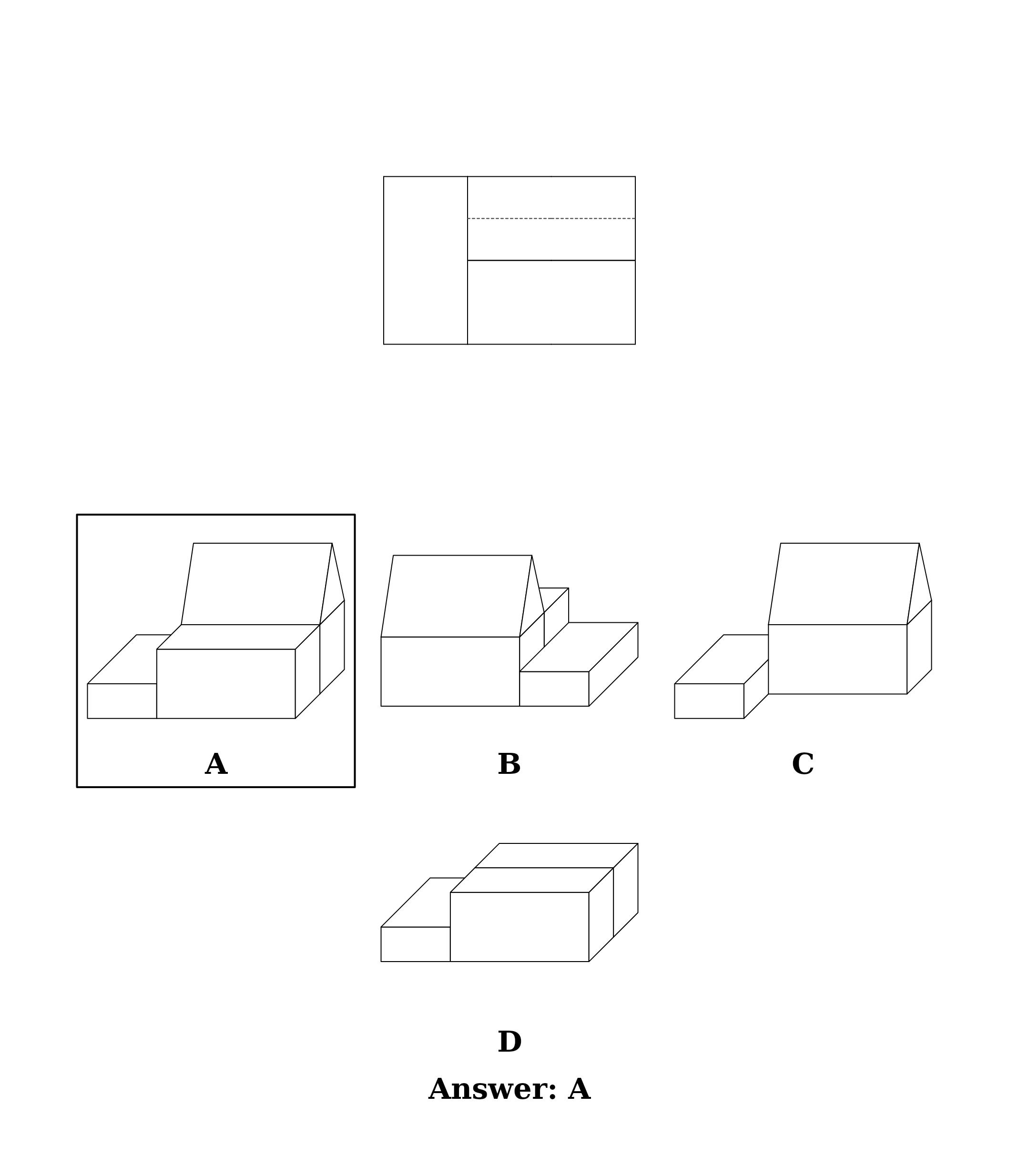
This sheet is a colorable one: the blocks are drawn in outline only, so the page can be coloured in after it is solved. With no colours to compare, the marks do the work. The dashed line in the top view says there is a roof at the back on the right, with its ridge running from left to right. D has no roof at all, and B‘s roof is on the left, so both are out at once. That leaves A and C, which both have a roof on the right — so compare their right-hand squares with the view, back and front. Only A has the roof at the back with a flat block standing in front of it.
Front and Side Views
Some sheets ask for the front view or the side view instead, and the question printed on the sheet names the view. Now picture standing in front of the building, or beside it on the right, and looking straight at it:
- Depth disappears. A block at the back and a block at the front look exactly the same if they are the same size. A front view tells you how wide and how tall things are, never how far back they stand — just as a top view never tells you how tall.
- Nearer blocks cover farther ones. A block standing behind a taller one vanishes from the front view, the same way a covered block vanishes from above. Anything that peeks out above or beside the blocks in front still shows.
- The side view is from the right. It is the side you can see in the 3D drawing, so the front of the building is on the left of a side view and the back is on the right.
The blocks leave marks here too:
- Cubes, bricks and planks show as rectangles. A plank is half as tall as a cube.
- Cylinders show as a rectangle with a dashed line down the middle.
- Roofs show as a triangle when you look at the end of the roof, and as a plain rectangle when you look at its long side.
Worked Example 3: Find the Front View

From the front this building is three blocks wide. On the left, a yellow roof sits on a low red plank; in the middle, a yellow cylinder stands on a red cube; on the right, a red roof stands on the floor. Both roofs face you end-on, so both are triangles. Before looking at the options, say what the front view must have, left to right: a yellow triangle on a short red rectangle, a dashed-line rectangle on a red square, and a red triangle. Then check each option against that list:
- A has no dashed line anywhere — the cylinder is missing.
- B has the two triangles in each other’s colours: red on the left, yellow on the right. The roofs have swapped colours.
- C has only a red rectangle on the left — the yellow roof on the plank is missing.
- D has a yellow triangle on the low plank, the cylinder on the cube, and a red triangle on the right. That is the building.

Worked Example 4: Find the Building from Its Side View

The side view shows a long green shape one cube tall, with a yellow cylinder poking up above its left half. Left in a side view means the front of the building, so the answer has a cylinder standing in the front row, tall enough to rise above the green block at the right-hand end of the building.
- C has no cylinder at all, so it is out at once.
- A has the cylinder standing on the back end of the green brick at the right-hand end. From the right it would rise over the right half of the view, not the left.
- D is the building turned around: its cylinder stands at the back, so it too would show on the right.
- B has the cylinder standing on the low plank in the front row, next to the green brick at the right-hand end. Seen from the right, that brick is in front of it, and the cylinder peeks over the brick’s front half — exactly the view.

A pack can also mix the views, so one page asks for a top view and the next for a side view. Read the question first, every time.
Matching Worksheets
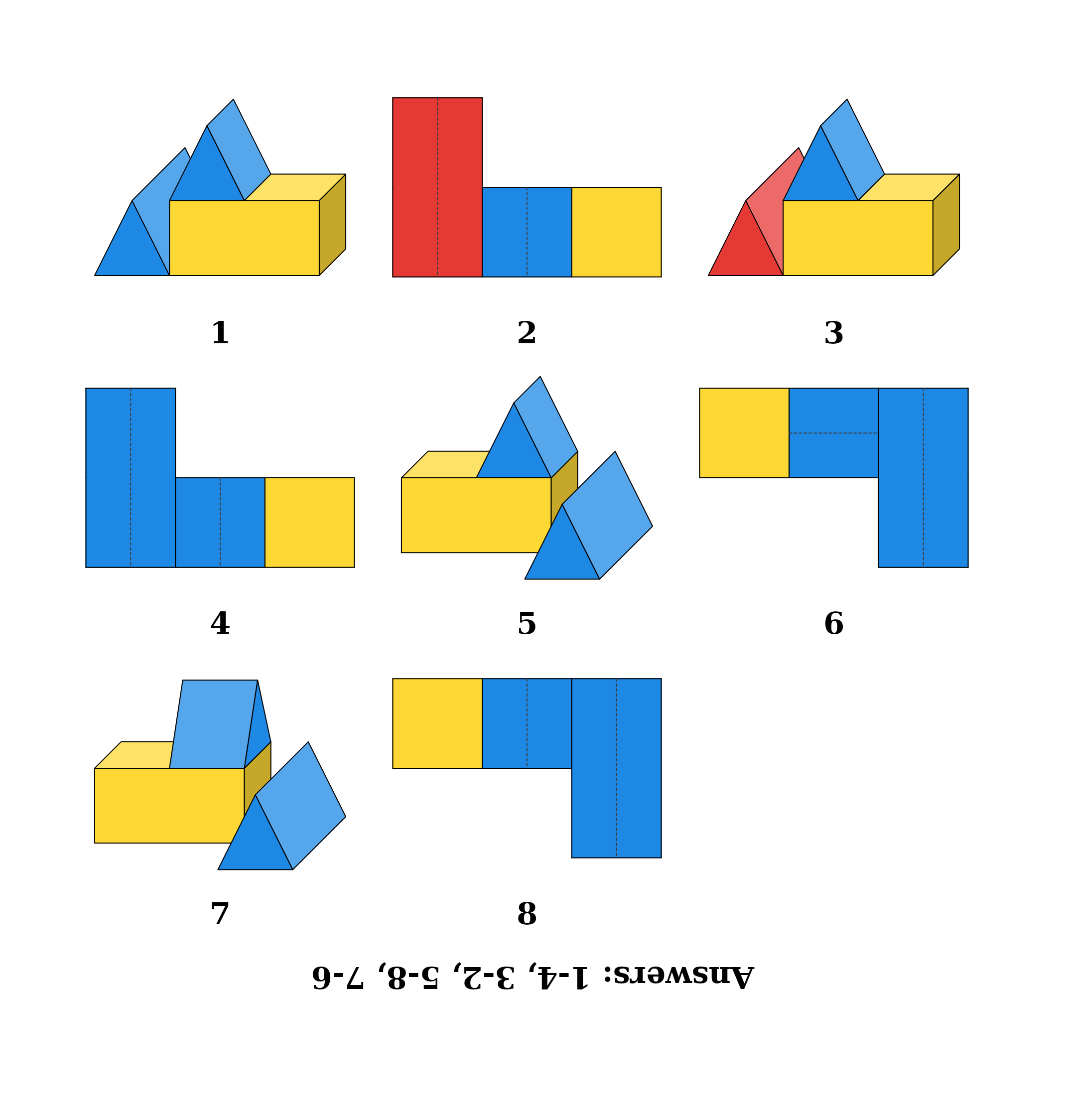
A matching worksheet is a whole page of these questions at once. Each building has its view somewhere on the page, and you pair them up — by drawing a line from each number to its letter on a two-column sheet, or by writing down the pairs of numbers in a mixed grid like the one below. In this grid, start with the most distinctive picture: building 3 is the only building with a red block, and picture 2 is the only top view with any red in it — so 3 pairs with 2.
Two things make a matching page harder than it looks:
- The buildings are related. They are variations of each other, so the views are close cousins. Check every picture the full way — shape, marks and direction — before you commit.
- There can be extra answers. Some worksheets include one or two pictures that match nothing. If you have a picture left over at the end, that is not necessarily a mistake.
Some sheets print the answers upside down at the bottom of the page, like this one, so a solver can check without the answer jumping out at them.
How to Solve Any Block Views Puzzle
When a puzzle is hard, work through the same checklist every time:
- Check the outline. How wide is the view, and how deep or how tall? From above, count the squares the building covers; from the front or side, count how wide it is and how high each part stands. This rules out the options with the wrong shape.
- Find what is hidden. From above, only the top block in each square shows, so blocks underneath drop out. From the front or side, only the nearest block shows, so blocks behind a bigger one drop out — but anything taller still peeks over.
- Read the marks. From above, circles are cylinders and dashed lines are roof ridges; from the front or side, a dashed line down a block is a cylinder and a triangle is a roof seen end-on. A circle drawn on a coloured square is a cylinder standing on a block; a circle on its own is a cylinder on the floor. Check that each mark is in the right square and, for a roof, running the right way.
- Check the direction. In a top view: back at the top, front at the bottom, left and right as drawn. In a front view: left and right as drawn, top at the top. In a side view: front on the left, back on the right. A picture that is right but backwards is the building turned around — or its mirror image, with left and right swapped.
- Check the colours on a colour sheet: each part of the view should show the colour of the block you see first from that side — the top block from above, the nearest block from the front or side.
On a harder puzzle, expect the trick answers to differ in only one of these ways — so go through all five, even when an option looks right at a glance.
Difficulty Levels: Easy, Medium and Hard
The difficulty changes the buildings and the tricks:
- Easy buildings have two or three blocks and three answer options. The tricks are bold: a block missing, the building turned around, a cylinder moved or a roof turned, and — on colour sheets — a block in another colour.
- Medium buildings have four or five blocks and four options, and add two subtler tricks: a quarter turn (on square buildings) and, on colour sheets, two colours swapped.
- Hard buildings have six to eight blocks, stand up to three cubes tall, and always have blocks stacked on other blocks — so more is hidden from above. They add the mirror image and, on colour top-view sheets, a block shown in the colour of the block underneath it.
Try It Online
Block Views is a satisfying puzzle to solve on screen: tap the option you think is right — on the drawing or its letter below — and see whether you got it. On a matching sheet, tap a picture and then its partner, or drag one onto the other; on a two-column sheet a line joins each pair as you make it. Play a Block Views puzzle in your browser. The general player controls, including checking your answer and resetting, are covered once in How to Play Puzzles Online.
FAQ
What is a top view?
It is what an object looks like when you look straight down on it from above. In a top view you see where things are and what is on top, but not how tall anything is.
Why can’t I see some of the blocks in the top view?
Because they are underneath other blocks. In every square, only the top block shows, so a block that is covered all over drops out of the view.
Which way round is a top view drawn?
The back of the building is at the top of the view and the front is at the bottom, with left and right as in the drawing — as if you stood where you are now, in front of the building, and leaned over it to look straight down.
Can a Block Views puzzle have two right answers?
No. Every wrong option is checked to look different from the answer, and in a building puzzle every block is visible in the drawing, so there is always exactly one answer.
What do the circle and the dashed line mean?
In a top view, a circle is the top of a cylinder, and a dashed line is the ridge of a roof, showing which way the roof runs. In a front or side view, a dashed line down the middle of a block marks a cylinder.
Which side is the side view?
The right-hand side — the side you can see in the 3D drawing. So the front of the building is on the left of a side view, and the back is on the right.
What age is this puzzle for?
Easy sheets suit young children who are just learning to picture objects from different sides; Hard sheets, with tall stacked buildings and subtle tricks, challenge older children and adults. A good teaching order is top views first, then front views, then side views (where left and right turn into front and back), and finally a mixed pack. Colorable sheets double as colouring pages once they are solved.
Further Reading
Make Your Own Block Views Puzzles
Now that you know how the views work, make your own — from gentle two-block warm-ups to tall, tricky buildings, each with its answer key, ready for a worksheet pack, a classroom or a puzzle book.
Create your own Block Views puzzles with Block Views
Not ready yet? Try the free demo first — it covers every module.