


Pentomino Puzzle Generator: Printable Puzzles With the Twelve Classic Shapes and One Answer per Board
Hand a puzzle fan the twelve pentominoes and an empty rectangle ten squares wide and six tall, and the table goes quiet. The X goes down early, because a plus sign only fits in so many places. The I lies flat along an edge. Then three pieces fight over one stubborn gap until somebody flips the F, and the rectangle closes.
That is a pentomino puzzle. A board, a bank of five-square pieces printed with it, and one rule: cover every square of the board using every piece exactly once. There is no arithmetic and nothing to read. Just shapes, and a brain working out where they go.
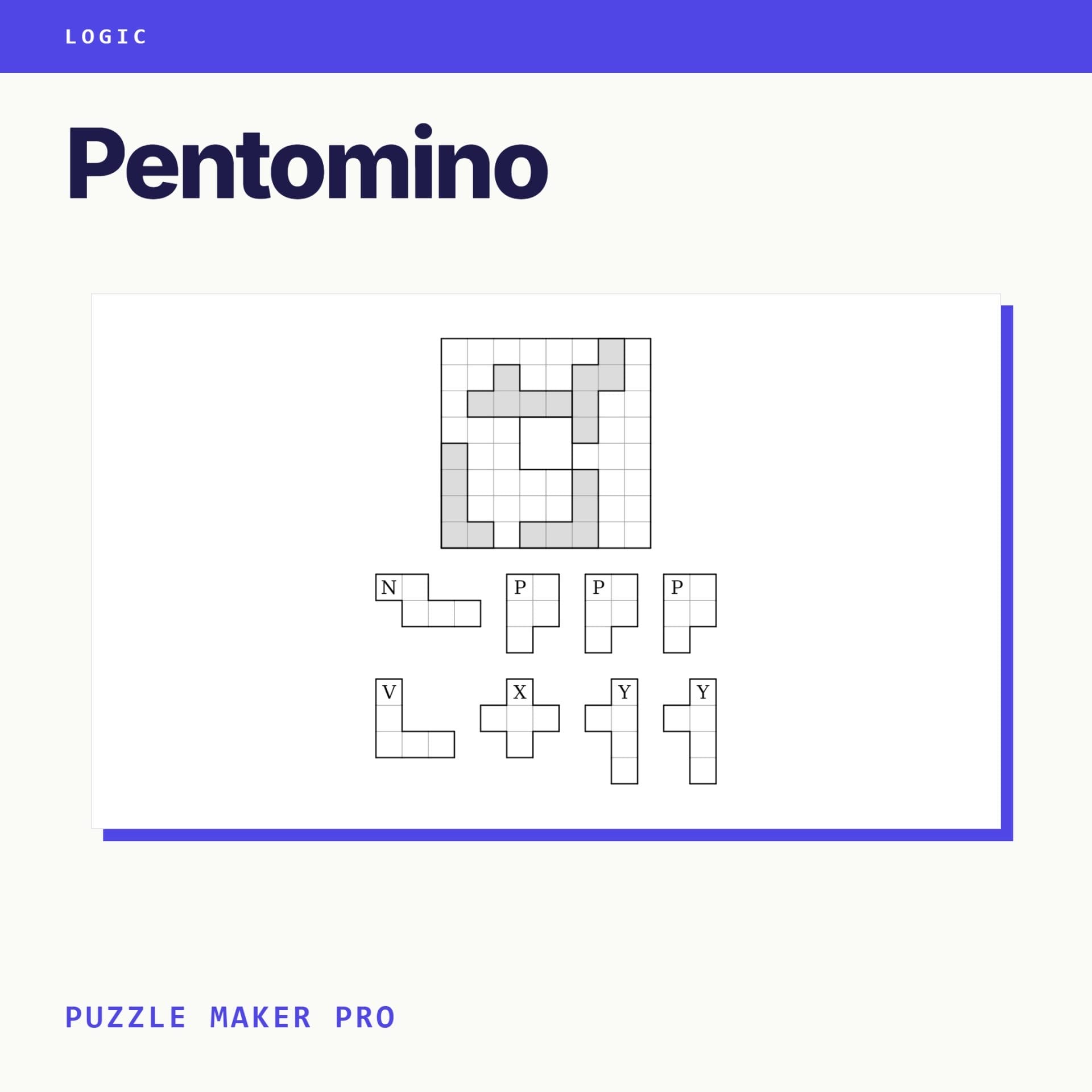
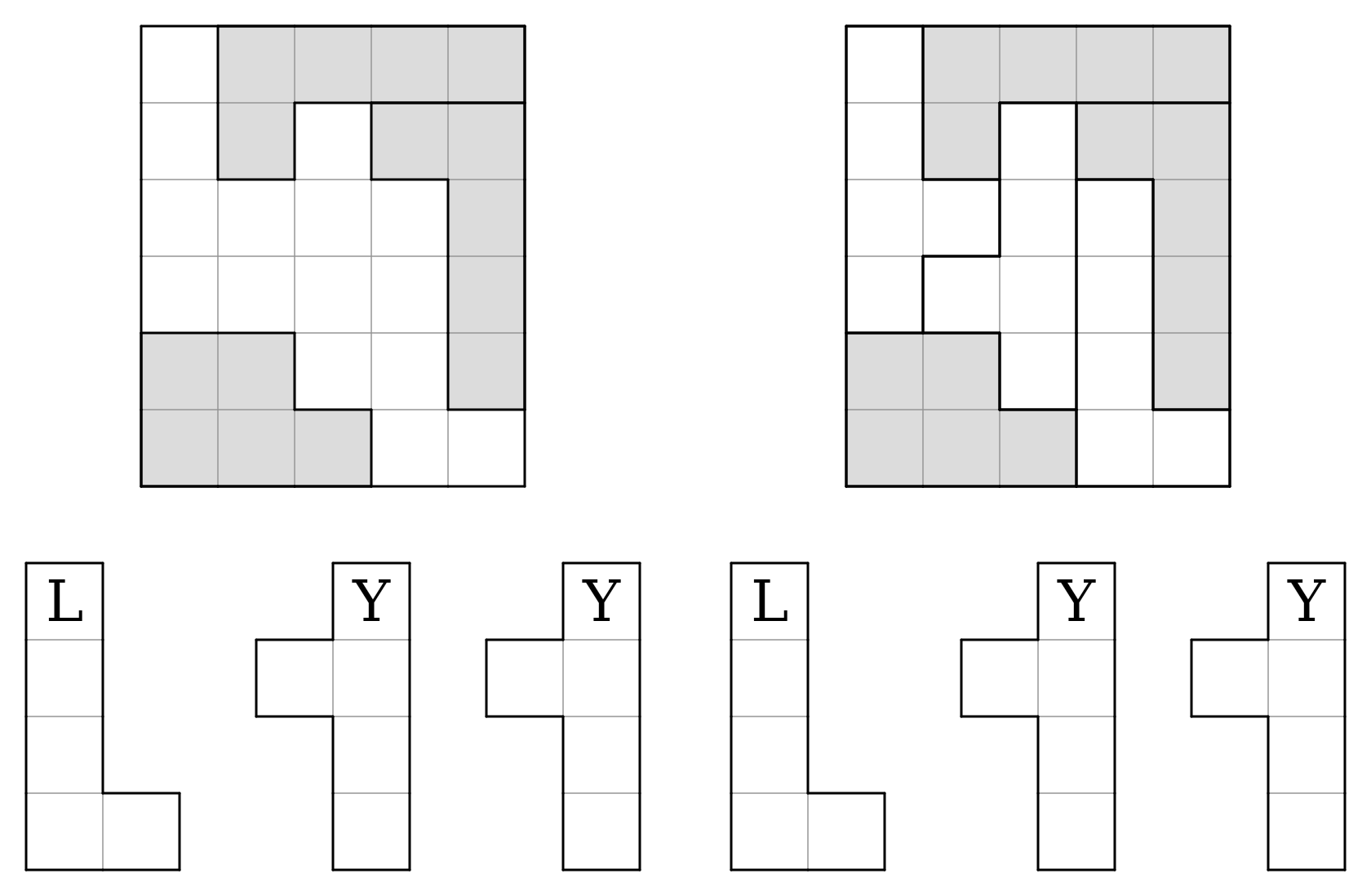
Making one by hand means drawing the board, the pieces and the answer, then checking that no second covering sneaks through. Pentomino builds those pages for you. It is a pentomino puzzle generator inside Puzzle Maker Pro for Windows, and every puzzle it makes arrives as a full kit: the puzzle page, its answer, a board-only copy of each, and a cut-out sheet with the pieces printed at exactly the board’s square size. Leave Exactly one solution switched on, as it starts, and the answer key in the back of your book is the only answer there is. Start readers on a 5×6 warm-up like the one below and build them up to the full twelve-piece rectangle with Creative.
Quick edition guide: Pentomino (Standard) makes pages on rectangular boards, with answers, cut-out sheets and finished books. Drawn board shapes, the classic 10×6 twelve-piece rectangle, picture pieces and Puzzle Slides come with Creative. Whole chapters in one run come with Productivity. Add Interactive to Creative or Productivity to put playable puzzles on your own website. Try a pentomino page free before you pick.
 A first page: the board, three starters already in place, and the exact pieces the solver must fit, printed underneath.
What a Pentomino Page Asks of the Solver
Most puzzle pages test what a reader knows. A pentomino page tests how they see, and that is why a pentomino page stands out in a book full of word searches.
Pentominoes are the twelve shapes you can build by joining five squares edge to edge, and each one is named for the letter it looks like: F, I, L, N, P, T, U, V, W, X, Y and Z. Your page prints a board and, below or beside it, the bank: the pieces this board needs, each with its letter in one square so a P never gets mistaken for a Y. Our guide How Pentomino Puzzles Work walks through a full example you can point readers to.
The solver covers every square, uses every piece in the bank once, and builds around the grey starter pieces already on the board. A shape can turn up in the bank more than once (up to three copies by default), and some shapes may not appear at all. That is why page forty still asks something new.
Readers can be told to turn and flip the pieces freely, to turn them but never flip them, or to place them exactly as printed. The presets write the instruction line for you, and it is yours to edit: on [Hard], add “Pieces may be turned but not flipped.” so the rule is in plain words before anyone picks up a piece.
Put it in front of a class and it turns into a maths lesson nobody notices. Before anyone touches a piece, ask how many pieces a 5×6 board needs: thirty squares divided by five is six. Then switch a puzzle to turned only and talk about which pieces would only fit if they were flipped. Area, rotation and reflection, learned with the hands. And because the puzzle itself needs no reading, one interior travels to other language markets once you translate the title and the single instruction line.
One Board, One Answer, Proven Before It Prints
A solver finishes the board, flips to the back of the book, and finds a different answer printed there. Did they get it wrong? Did you?
With Exactly one solution switched on, which is how Pentomino starts, nobody has to wonder. Before a page prints, Pentomino tests every way the board could be finished and keeps placing grey starters until a single answer survives.
The result is a key you can trust and a page a solver can reason through: if a piece fits in only one place, that is where it goes. Making an open activity sheet where any complete covering counts? Untick the box and the generator keeps the starters at exactly the number you asked for.
 The page and its answer, generated together. With the default setting on, that answer is the only one that fits.
Try the free demo and solve one yourself before you spend a cent.
Scissors-Ready: Pieces Printed at the Board’s Exact Size
A cut-and-place activity lives or dies on one detail. If the pieces print a millimetre too big, nothing fits, and the solver decides the puzzle is broken.
So every run writes five files for each puzzle: the puzzle page with board and bank, the answer, a board-only copy, a board-only answer, and the cut-out sheet. The cut-out sheet is drawn at the same square size as the board, so a printed piece lies flat on its printed squares. Print the board-only copy on card, cut the pieces from the sheet, and the page turns into a table activity.
Printing for a classroom table or a library session? Set Smallest printed square to a size that is easy to cut and handle. If a board and its pieces would print any smaller on your page size, the run stops and tells you, rather than quietly shrinking the squares behind your back.
Everything exports as JPG, PNG, SVG or print-ready PDF, so the same set feeds a KDP interior, an Etsy download and a classroom photocopier. By default the starters are grey and the piece outlines black, so the pages need no colour and suit a black-and-white interior.
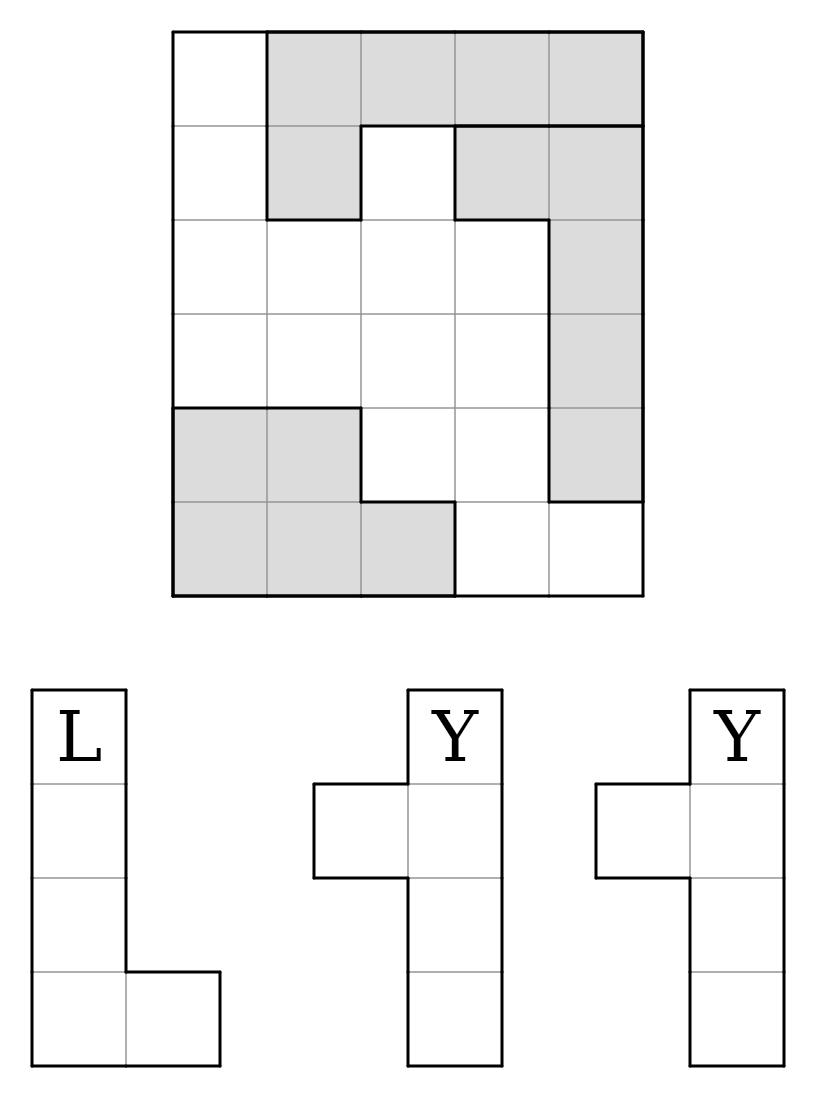
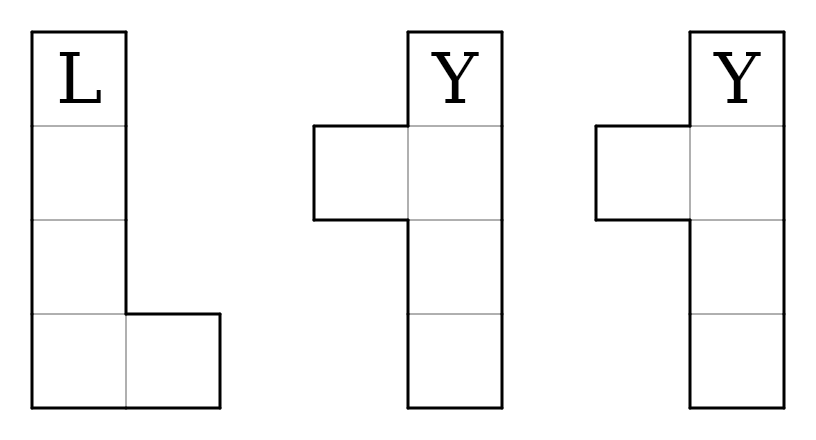
 The cut-out sheet for the page at the top. Same square size as the board, so every piece fits where it belongs.
Bigger Board, Stricter Rule, Fewer Starters: Three Dials for Difficulty
A first-time solver and a puzzle-club regular can both enjoy a pentomino page, just not the same one. Difficulty here is something you set with three plain dials, not a label stamped on afterwards.
Board size. Boards run from 1 to 30 squares a side, holding 10 to 120 squares, and the piece count follows the board: area divided by five. A 5×6 board takes six pieces; a 10×10 board takes twenty.
The move rule. Turned and flipped is the friendliest. Turned only takes the mirror images away, so the F, L, N, P, Y and Z can no longer become their backwards twins. Kept as printed turns every placement into careful fitting.
Starter pieces. Grey pieces already on the board make any puzzle easier. Pieces already placed sets the minimum, and the one-solution setting may add more.
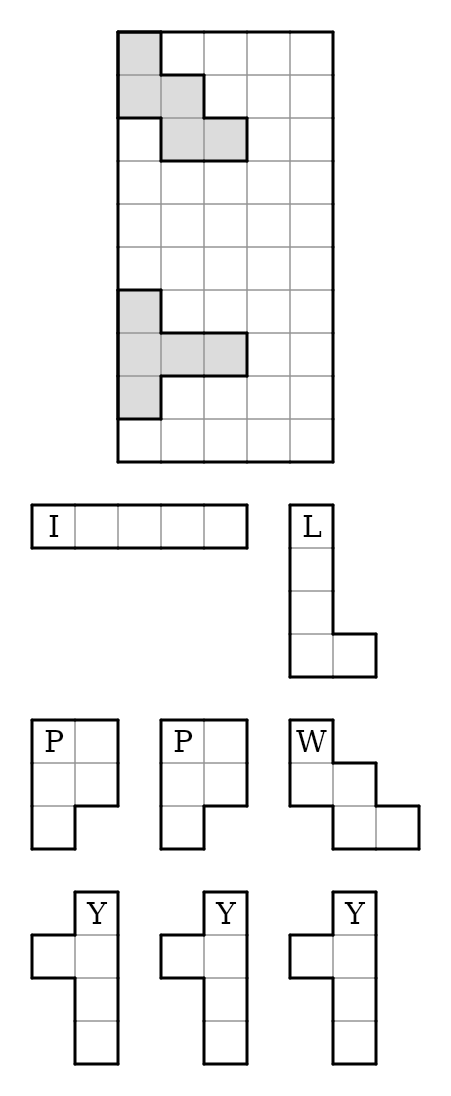
Or let the presets turn all three dials at once. [Easy] is a 5×6 board with six pieces and at least three starters. [Medium] is 5×8 with eight pieces and at least two starters. [Hard] is 5×10 with ten pieces turned only, and with one solution guaranteed it typically arrives with one to four starters to anchor the solve. Set the level once and a run of sixty comes back with sixty answers and sixty cut-out sheets: one setup instead of a stack of graph paper. The step-by-step guide Create Pentomino Puzzles walks through every setting.
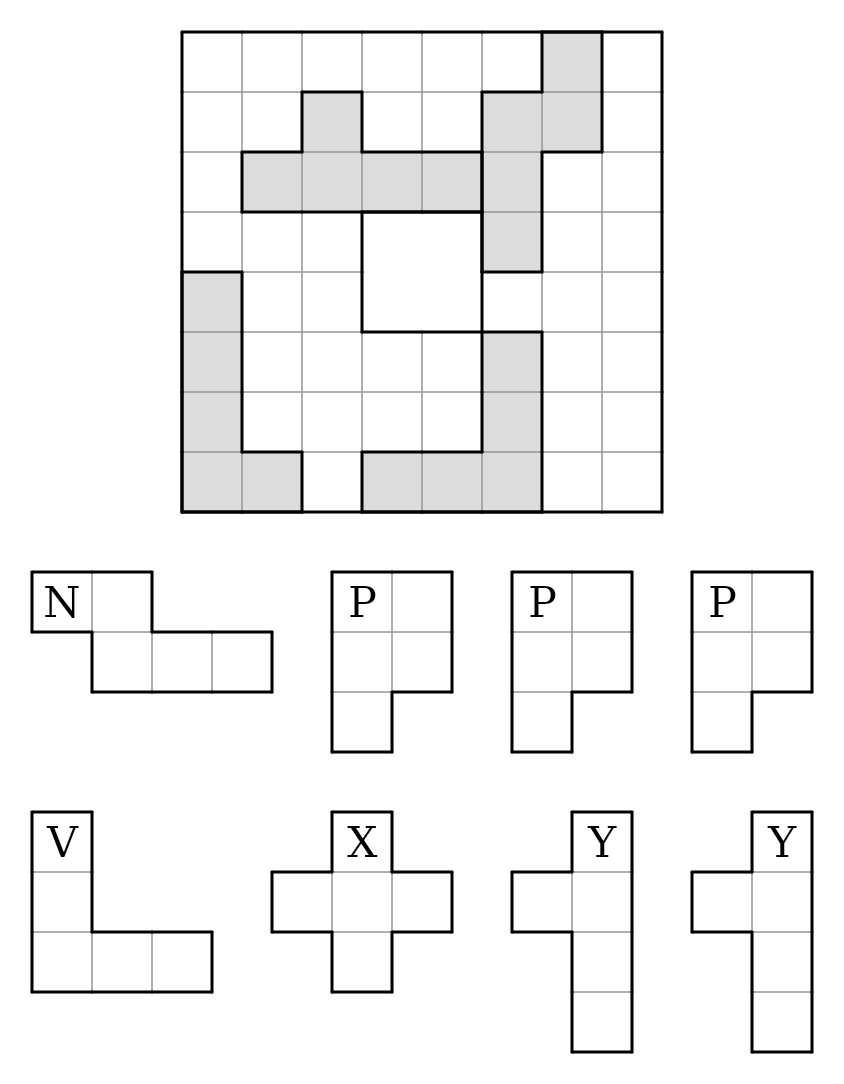
 The [Hard] preset: a longer board, ten pieces, and no mirror images allowed.
One Cut-Out Set for a Whole Class of Cards
Hands-on puzzles carry one classroom cost nobody writes into the lesson plan: the pieces. A fresh sheet per student per puzzle means scissors at the start of every lesson and paper confetti at the end.
Choose Same pieces in every puzzle, or start from the [Reusable Classroom Set] preset, and every card in the run uses the same pieces at the same square size while posing a different challenge. Each card is a pentomino worksheet with its own answer page for checking. Cut one set per table, laminate it once, and the next card is ready the moment your fastest student is: a tech-free early-finisher job that runs all term. On Standard the set reuses the pieces the first card picks; with Creative you choose them yourself, the classic twelve included.
Two other batch modes cover the rest of the year. Different pieces in each puzzle (the default) gives every page its own bank. Same pieces, different starters keeps the bank and moves the grey pieces. Whichever you pick, no two puzzles in one run pose the same challenge.
Differentiated packs are three runs: [Easy], [Medium] and [Hard], one after another on any edition, or three Time Saver rows made in a single pass with Productivity.
Paint Your Own Board, Pick the Pieces, Change Their Faces (Creative)
Plain rectangles are where solvers learn. A heart, a star, or a picture frame with a window cut out of the middle: those are the boards a browsing parent stops on.
Draw your own board. With Creative, Edit board shape… opens the shape editor: paint the squares that belong to the board, leave holes wherever you like, and the piece count follows your drawing. The editor keeps the square count to a multiple of five, so the area always divides into whole pieces, and the generator finds the tiling for you.
Choose the pieces. Full set puts all twelve pentominoes on a sixty-square board exactly once. Choose the classic 10×6 rectangle (pieces turned and flipped) and you have the twelve-piece challenge the pentomino set is known for. One of each shape gives a bank with no repeats. I choose lets you type a count for every letter from F to Z, so a lesson can feature the awkward X and W on purpose.
Dress the pieces. Swap the letters for numbers, other letters, colour shapes or your own pictures, and a seasonal or themed edition comes from the same settings. Same puzzle, new costume.
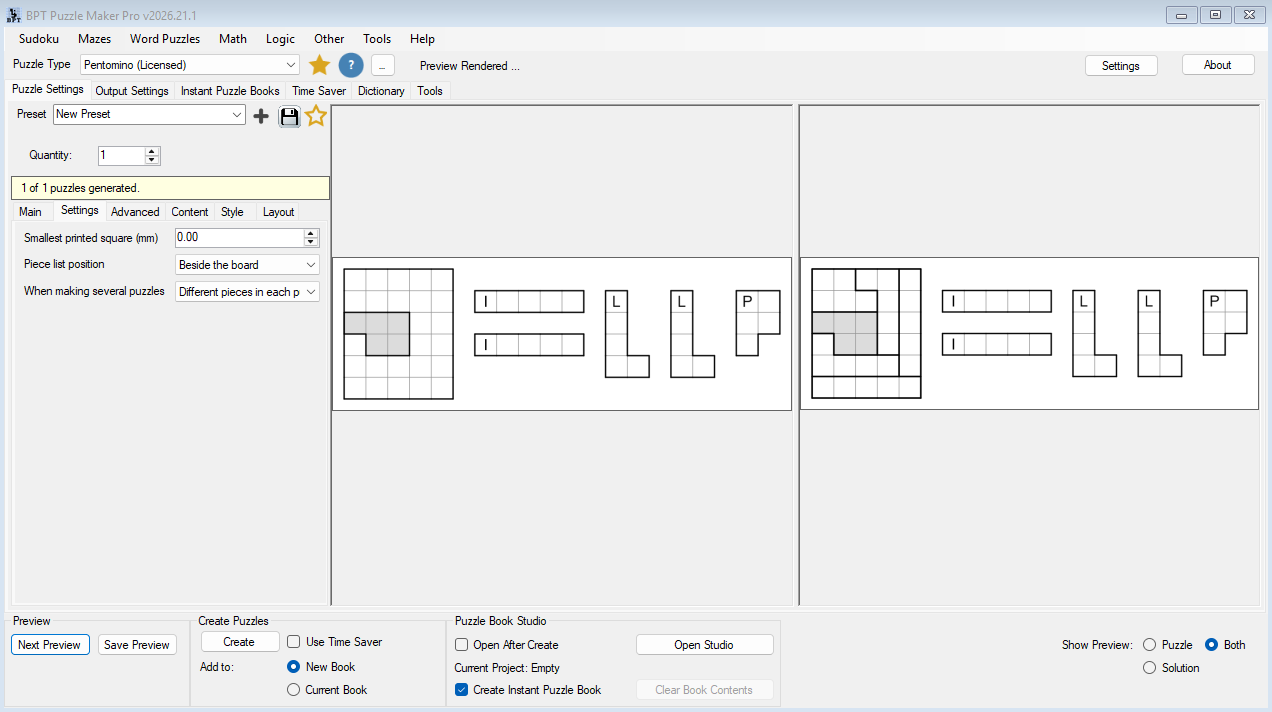
 A drawn board with a hole in the middle. Paint the outline, and the generator works out which pieces fill it.
What You Can Make From One Pentomino Run
Pick a shelf; one run fills it.
- Pentomino puzzles for kids’ activity books: a spatial spread among the word games and colouring pages
- Cut-and-place printables for Etsy, each puzzle with its page, answer and scissors-ready pieces
- Teachers Pay Teachers packs of pentomino worksheets in three levels, every card with its answer
- Reusable classroom sets: one laminated piece set, a new challenge card every week
- Puzzle-fan logic books that build from a 5×6 warm-up to the 10×6 full set, with Creative
- Themed editions with picture or colour-shape pieces on silhouette boards, with Creative
- Live lessons where the class moves the pieces on screen, with Creative
- Playable pentomino pages on your own website, with the Interactive editions
From One Pentomino Page to a Whole Puzzle Book
One pentomino page is a treat. Sixty of them, ordered from easy to hard with every answer in the back, is a book someone pays for.
Every edition, Pentomino (Standard) included, comes with Instant Puzzle Books. It takes your current page settings, margins and trim size and assembles the run into a ready-to-print book PDF, complete with a title page, a table of contents, and a footer on every puzzle that tells your reader exactly which page its solution is on.
The book itself holds the puzzle and answer pages. Publishing a bound paperback? Sell the cut-out sheets beside it as a printable download, or use the draw-the-boundaries presets ([Easy], [Medium], [Hard] and [Activity Book]) so every page works with a pencil.
Want to move a page, retitle a section or change the trim and watch the book change? That is Puzzle Book Studio, and Creative gives you full editing for one puzzle collection. The Productivity editions combine several collections into one book, so your pentomino chapter can sit beside a sudoku chapter and a maze chapter in a single title.
Time Saver, in the Productivity editions, is where chapters come from. Set up one row for [Easy], one for [Medium], one for [Hard], give each its own quantity, and run the lot in one pass, every level with its answers and cut-out sheets.
Teach It Live with Puzzle Slides (Creative)
A pentomino puzzle on paper belongs to whoever holds the pencil. Put it on the classroom screen and it belongs to everyone.
Export your set as Puzzle Slides and every puzzle becomes a slide with the clean board on one side and each remaining piece beside it as its own picture, cut to the board’s exact scale. With the deck open in PowerPoint, you or a student move a piece by hand, turn it or flip it, and line it up over its five squares while the class calls out corrections. The class decides whether a move keeps to the rule, and the solution slide has the final word.
One printed run, and you also have Monday’s maths starter, a tutoring warm-up, a puzzle-club challenge round, or the hands-on moment in an online lesson.
Play Pentomino on the Web (Interactive editions)
Plenty of your shoppers will never have solved a pentomino puzzle. The quickest way to sell them a book of them is to let them solve one on your site first, for free, before the word “pentomino” has had time to sound difficult.
Export the set and upload the ZIP to the free BookPublisherTools WordPress plugin, or host the HTML yourself. Visitors pull pieces out of the tray and onto the board, where they snap to the squares. Prefer tapping? Tap a piece, tap a square, or steer it with the arrow keys. The Rotate and Flip buttons follow the rule you chose, so on a “turned only” puzzle Flip stays switched off. A misplaced piece goes back with To tray or comes off with Undo. Cover the board, press Check, and the game confirms the solve; a leveled game can also check it the moment the last piece lands.
Pick the presentation that suits your site:
A puzzle list. Visitors pick a board from a dropdown and start playing. It is the fastest way to put a pentomino sample on a page.
A leveled game. The same set becomes a path of levels that unlock in order, with stars and progress saved in each visitor’s browser. Clear the last level and a completion screen shows your own message and button, “Enjoyed these? Get the full book,” pointing wherever you like.
For a class, call each stop a “Lesson” instead of a “Level”, start the path on a 5×6 board with plenty of starters, and let the boards grow from there: practice students work through at their own pace, with your workbook as the reward at the end. Three free boards on your site will explain the puzzle better than any paragraph.
Who This Is For
Activity-book publishers. Your interiors need variety, and a spread of pentomino pages, answers in the back, is the one a parent remembers. If you have skipped spatial puzzles because drawing and checking them by hand takes all day, one setup now makes the whole chapter, answers and cut-out sheets included.
Teachers, tutors and Teachers Pay Teachers sellers. Area, rotation and reflection without a worksheet full of sums, plus an answer for every card and one reusable piece set for the whole class. A free pentomino sheet gives you one puzzle; this gives you a new one-answer board for every card, cut-out pieces printed at the board’s scale, three levels to ramp through, and pages with your own name on them, yours to sell. Pentomino (Standard) already makes the classroom set and three-level packs; Creative adds drawn boards, the classic full set of twelve, and Puzzle Slides for the projector.
Puzzle fans and logic-book publishers. Longer boards, the turned-only and kept-as-printed rules, and with Creative the classic twelve-piece rectangle: a back section that keeps a seasoned solver at the table.
Existing Puzzle Maker Pro customers. A Pentomino licence unlocks it inside the Puzzle Maker Pro app you already run, presets and all. Every edition builds books through Instant Puzzle Books; Puzzle Book Studio takes it from Creative, and Productivity adds Pentomino rows to your Time Saver grid beside your other puzzle types.
Site owners and course creators. A playable pentomino path gives visitors something to do on your page, and the completion screen hands them your book at the moment they are enjoying it most.
Which Edition Should You Choose?
Pick the edition for the book you are making next. Every one of them makes real pentomino puzzles with matching answers and scissors-ready cut-out sheets; what changes is the shape of the board, the choice of pieces, and how many you make at once.
Pentomino (Standard). Best when you want pentomino pages in your books now. Random mix pieces on rectangular boards up to 120 squares, all three move rules, exactly one solution by default, starter pieces, every batch mode including the reusable classroom set, full control of lines, colours and labels, all five files per puzzle, and Instant Puzzle Books.
Creative. Best when the look or the lesson matters. Drawn board shapes with holes, every way of choosing pieces (one of each shape, the full set of twelve, or your own counts), numbers, letters, colour shapes or pictures on the pieces, Puzzle Book Studio Creative, and Puzzle Slides.
Productivity. Best when you are filling books by the chapter. Time Saver batch runs, Puzzle Book Studio Productivity for books with several collections, and JSON export of the puzzle data. Its licence also lets you supply the puzzles to other publishers.
| What you want to do | Standard | Creative | Productivity |
|---|---|---|---|
| Pentomino puzzles with matching answers and cut-out sheets | ✓ | ✓ | ✓ |
| Rectangular boards from 10 to 120 squares, Random mix pieces | ✓ | ✓ | ✓ |
| Turned and flipped, turned only, or kept as printed | ✓ | ✓ | ✓ |
| Exactly one solution, starter pieces, reusable classroom sets | ✓ | ✓ | ✓ |
| Export JPG, PNG, SVG and print PDF | ✓ | ✓ | ✓ |
| Instant Puzzle Books with title page, table of contents and solution cross-references | ✓ | ✓ | ✓ |
| Style lines, colours and labels | ✓ | ✓ | ✓ |
| Drawn board shapes, holes included | ✓ | ✓ | |
| One of each shape, the full set of twelve, or your own piece counts | ✓ | ✓ | |
| Numbers, letters, colour shapes or pictures on the pieces | ✓ | ✓ | |
| Puzzle Slides, an interactive PowerPoint for classrooms and live sessions | ✓ | ✓ | |
| Puzzle Book Studio Creative, full book design for one puzzle collection | ✓ | ✓ | |
| Time Saver, batch runs from saved rows | ✓ | ||
| Puzzle Book Studio Productivity, books from several collections | ✓ | ||
| JSON export of the puzzle data for your own apps and workflows | ✓ | ||
| Licence to sell finished books, worksheets and packs to your own readers and customers | ✓ | ✓ | ✓ |
| Licence to sell or supply the generated puzzles to other publishers and sellers | ✓ |
Add Interactive to Creative or Productivity for web play on your own site: publish the puzzles as a list or a leveled game that visitors play in the browser.
Standard, Creative and Productivity each include everything in the rung below, and none of them is a dead end: after you buy, you can move up the ladder for more production power, add Interactive once you are on Creative or Productivity, or do both. Start with the edition that matches the book or pack you are making now, in the switcher at the top of this page.
Want Tetromino too? The Pentomino Bundle gives you Pentomino and Tetromino together, at Creative or at Productivity, so your book can open on four-square warm-ups and close on the twelve-piece rectangle.
Try It Before You Buy
Print one, cut it out, and decide with the pieces in your hand. Generate a real puzzle in the free demo, look at the bank and the starters, and check the answer against the board before you choose an edition. The demo stamps a watermark on its output and makes a single puzzle per run; every paid edition removes both limits.
Get the free demo, make one pentomino page, and come back up to the edition switcher when the pieces fit.
Licensing and Commercial Use
Pentomino and Pentomino Creative both let you sell the finished books, worksheets and packs you make to your own readers and customers, on KDP, Etsy, Teachers Pay Teachers, or your own store. It is a one-time commercial-use licence, and nothing you make carries a watermark.
Pentomino Productivity includes that, plus you may sell or supply the generated puzzles to other publishers and sellers.
The editions differ in what you can make, not in permission to sell. Delivery is immediate: your download and licence appear in your member area the moment your order completes.
Product Details
| Product | Puzzle Maker Pro – Pentomino |
| Editions | Pentomino (Standard); Creative; Creative + Interactive; Productivity; Productivity + Interactive |
| Platform | Windows desktop |
| Internet required | No (creation is offline; web publishing optional) |
| Puzzle rule | Cover every square of the board using every piece in the bank exactly once |
| Pieces | The twelve pentominoes F, I, L, N, P, T, U, V, W, X, Y, Z, five squares each; 2 to 24 pieces per puzzle |
| Boards | Rectangles 1 to 30 squares a side, 10 to 120 squares in all; drawn shapes with holes in Creative and up |
| Move rules | Turned and flipped; turned only; kept as printed |
| Solution | Exactly one solution by default (starter pieces are added until one remains); can be switched off for open activities |
| Difficulty | Set by board size, move rule and starter pieces; [Easy], [Medium] and [Hard] presets included |
| Files per puzzle | Puzzle page, answer, board-only copy, board-only answer, cut-out sheet at the board’s square size |
| Output formats | JPG, PNG, SVG, PDF |
| Batch modes | Different pieces in each puzzle; same pieces, different starters; same pieces in every puzzle (reusable classroom set) |
| Piece faces | Letters by default; numbers, other letters, colour shapes or pictures in Creative and up |
| Puzzle books | Instant Puzzle Books (all editions); Puzzle Book Studio (Creative and up); title page, table of contents and solution cross-references on every edition; cut-out sheets print as separate files |
| Batch creation | Time Saver (Productivity editions) |
| JSON export | Productivity editions |
| Puzzle Slides | Clean board plus every remaining piece as a movable picture at board scale (Creative and up) |
| Web play | Drag-and-snap play on your own site via HTML output and the WordPress plugin, as a list or a leveled game (Interactive editions) |
| Upgrades | Move up to any higher edition after you buy |
| Commercial licence | Sell finished books, worksheets and packs to your own readers and customers (Standard and Creative); Productivity adds selling or supplying the generated puzzles to other publishers and sellers |
| Free demo | Yes |
| Delivery | Immediate, in your member area |
Questions Before You Buy
Is there a free demo?
Yes. Get the free Puzzle Maker Pro demo, generate a pentomino puzzle, print its cut-out sheet and check its answer before you buy. Its output carries a watermark, one puzzle per run.
Which edition do I need?
Pentomino (Standard) if rectangular boards with a random mix of pieces cover what you make: it includes every move rule, the one-solution setting, starter pieces, the classroom set and Instant Puzzle Books. Creative if you want drawn boards, the full set of twelve, your own piece counts, picture pieces or Puzzle Slides. Productivity if you make books by the chapter with Time Saver. Add Interactive to either of those two for play on your own website. The whole ladder is explained on Puzzle Maker Pro Editions Explained.
Can I sell what I make?
Yes. Pentomino and Pentomino Creative both let you sell the finished books, worksheets and printable packs you make to your own readers and customers. Productivity adds the right to sell or supply the generated puzzles themselves to other publishers and sellers.
Does every puzzle have only one solution?
By default, yes. With Exactly one solution switched on, which is how the module starts, the generator places starter pieces until a single answer is left. Switch it off for open activity sheets where any complete covering counts.
Will the cut-out pieces really fit the printed board?
Yes. The cut-out sheet is drawn at the same square size as the board, and you can set a minimum printed square size so pieces stay big enough to handle. If they would print smaller than that, the run stops and tells you.
Can I put the cut-out pieces inside a printed book?
Books carry the puzzle and answer pages, and the cut-out sheets come out of every run as their own files. Sell or hand them out as a printable companion pack, or build a bound book from the draw-the-boundaries presets so readers need only a pencil.
How do I make puzzles easier or harder?
Three settings do it: a bigger board with more pieces, a stricter move rule (turned only, or kept as printed), and fewer starter pieces. The [Easy], [Medium] and [Hard] presets combine all three for you; on [Hard], add “Pieces may be turned but not flipped.” to the instruction line. With one solution guaranteed, even a [Hard] puzzle usually shows a few starters.
Can one set of cut-out pieces serve a whole class?
Yes. Choose Same pieces in every puzzle, or start from the [Reusable Classroom Set] preset, and every card in the run uses the same pieces at the same size while posing a different challenge.
My readers have never seen a pentomino puzzle. Will they know what to do?
The rule fits in one sentence, and you write the instruction line under each title (the presets fill one in). For a gentle start, the [Easy] preset uses a small board with several pieces already placed, and you can send new solvers to How Pentomino Puzzles Work for a full worked example.
Can I make the classic 10×6 rectangle with all twelve pieces?
Yes, with Creative and up. Start from the [Full set] preset, or choose Full set on a 10×6 board, and the generator lays all twelve pentominoes into the rectangle (pieces turned and flipped), with its answer and cut-out sheet like any other puzzle.
Pentomino or Tetromino?
Tetromino uses five shapes of four squares each: gentler boards for younger and first-time solvers. Pentomino brings twelve shapes of five squares and the classic 10×6 challenge. They are separate products that open in the same Puzzle Maker Pro app with the same Creator layout, matching presets and cut-out sheets, so owning the pair gives you an easy-to-hard ramp from a first shape puzzle to the full twelve.
Can I upgrade later?
Yes. You can move up to any higher edition at any time after you buy, further up the ladder when you need more production power, or add Interactive on top of Creative or Productivity. Start with the edition that fits what you are making today; you are never locked into it.
Build the Section Puzzle Fans Save for Last
Puzzle fans can tell a back section that fights back from one that only fills pages. Give them twelve shapes, a rectangle and exactly one way to close it.
Picture the next one instead. A chapter of pentomino pages that ramps from a 5×6 warm-up to a 5×10 board with no mirror images allowed, every answer in the back, and the classic 10×6 rectangle waiting as the finale with Creative. A reader turns an L over for the fourth time, finds the gap it was made for, and turns the page looking for the next one.
Choose your edition in the switcher at the top of this page. Want the pieces in your hands before you decide? Grab the free demo, make a puzzle, print the cut-out sheet, and fit an L into its corner yourself.


