

Overview
Most mazes are built from a neat square grid. A Voronoi Maze throws the grid away: the playing field is a mosaic of irregular cells grown from scattered points, so it looks like cracked glaze, a stone wall, or a giraffe’s coat rather than graph paper. You solve it the same way as any maze — find the single route from Start (S) to Finish (E) — but instead of stepping along straight corridors, you move from cell to cell wherever two of them share an open edge. Because no two cells are the same size or shape, the path is far harder to eyeball than a tidy grid, which is exactly what makes it a fresh, striking page in a maze book.
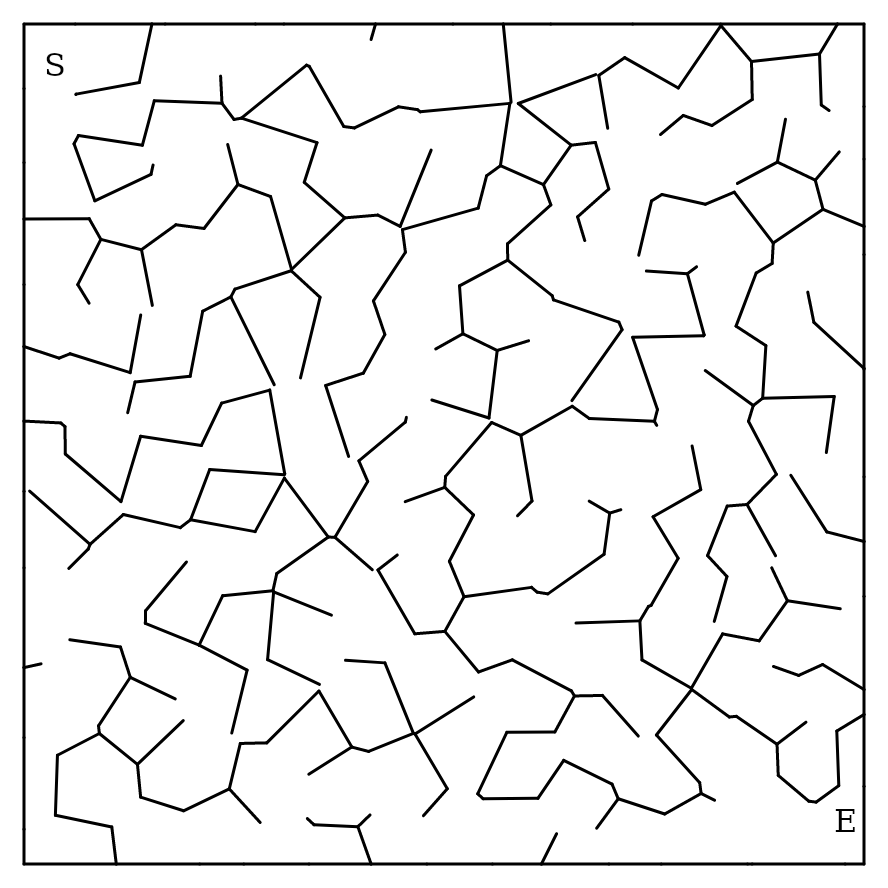
Voronoi Mazes come in two shapes, and both solve the same way.
The Goal
Find the one continuous route that connects S to E by stepping between cells that share an open edge. Every Voronoi Maze ships with its solution already drawn.
The Rules
- One path, always. Like every Puzzle Maker Pro maze, a Voronoi Maze is a perfect maze — there is exactly one route between Start and Finish, with no loops. Every other branch is a dead end.
- Move where edges are open. Two neighbouring cells share a wall that is either open (you can step between them) or closed. The maze opens just enough of those shared edges to leave a single path and walls the rest.
- Dead ends are real. A run of cells that stops going anywhere is a dead end — back up to the last junction and try another neighbour.
How to Start Solving
- Find S and E and trace from both ends. Working inward from the Finish as well as the Start meets in the middle faster.
- At each cell, try its open neighbours one at a time. Follow a chain until it reaches the other marker or dead-ends, then back up. Because there are no loops, backing up never loses progress.
- Pencil lightly. Shade the runs you have ruled out; the unbroken chain of cells from S to E is your answer.

The Two Shapes
Both shapes are built from the same scatter of points, so both are straight-edged polygon-cell mazes — only the cell shape changes.
Voronoi — each scattered point claims the region closest to it, giving irregular many-sided cells that tile the page like cracked glass or dried mud. Bigger and smaller cells sit side by side, so the corridors wander at every angle. Larger books look great with the cells shaped into a silhouette (a heart, an animal) so the whole cloud takes a form — that’s a Creative-edition trick covered in How to Make Shaped Mazes with Masking.
Triangulation — the same points, connected instead into triangular cells (a Delaunay triangulation). The look is sharper and faceted, like a low-poly render or a cut gem, and the three-sided cells give the path a crisper, more angular feel. It reads completely differently from the Voronoi shape while solving by the exact same rule.


The shape changes the look and the feel; the rule never changes — one path, cell to cell, S to E.
Play It Online
Voronoi Mazes aren’t only for print. With the Productivity edition, a set can be published to your website as an interactive game: visitors solve it right in the browser by dragging to trace the path from cell to cell — mouse or finger — with a built-in check and a timer. Both shapes play online, because both are straight-edged polygon-cell mazes the player draws directly from the cell edges. You can even gate later puzzles behind a short email sign-up, turning a free game into a lead magnet. How the player works (drawing, retracing, checking) is covered once in How to Play Puzzles Online.
Outcome
You can now solve a Voronoi Maze in either shape: trace from both ends, step between cells that share an open edge, and back up out of dead ends. Want a whole book of them — organic cells or faceted triangles, plain or shaped, each one unique — and an online version to hand out? That’s what Puzzle Maker Pro’s Voronoi Mazes module does.