
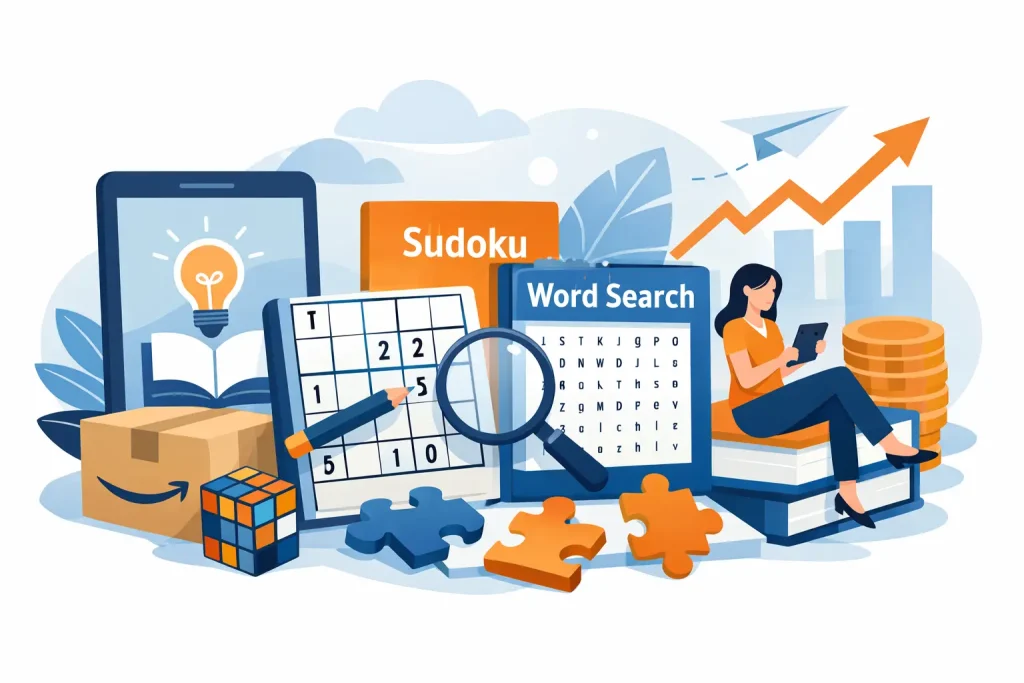
Most amazon kdp puzzle books fail for a simple reason: they look like they were assembled fast, with no clear audience and no real publishing plan. The market is still active, but easy money is gone. If you want puzzle books to work on Amazon KDP now, you need better positioning, better production systems, and a catalog strategy that does more than upload another generic word search.
That shift is good news for serious creators. It favors publishers who think in terms of assets, workflows, and repeatable output instead of one-off books. If your goal is to build a real product line rather than test random interiors, puzzle publishing can still be a strong category.
Why amazon kdp puzzle books still work
Puzzle books solve a very old publishing problem: readers want simple, useful entertainment they can understand instantly. That makes them easier to market than many low-content products, but harder to do well than they first appear.
The demand is broad. Adults buy puzzle books for travel, gifts, stress relief, hobbies, and screen-free downtime. Parents buy them for kids. Teachers and education publishers use puzzle formats for reinforcement. Niche audiences respond well when the theme is specific enough to feel made for them. A generic sudoku book competes with everything. A well-branded puzzle book for cat lovers, RV travelers, baseball fans, or classroom vocabulary practice has a clearer place in the market.
The opportunity is not just in one title. The real strength of puzzle publishing is that a single content system can support multiple books, age ranges, formats, and sales channels. That matters because KDP rewards consistency more than lucky experiments.
The biggest mistake publishers make
Many creators approach puzzle books as a cover problem. They focus on the title, subtitle, and thumbnail, then drop in an interior that is repetitive, poorly balanced, or obviously generated without editorial review. Readers notice.
A puzzle book is a user experience product. If clues feel awkward, answer placement is messy, type is too small, mazes are too easy, or the page count feels padded, the book loses trust fast. Reviews reflect that. And once reviews turn against a title, fixing the listing will not solve the underlying issue.
The better approach is to treat interior quality as the product and the cover as the packaging. That means building puzzle assets carefully, checking variation, controlling difficulty, and making sure the pages are designed for print, not just for creation speed.
How to build amazon kdp puzzle books efficiently
Efficiency matters because puzzle publishing becomes attractive when production is repeatable. If every book requires starting from zero, margins shrink and expansion slows. The publishers who last in this category create assets once, then repurpose them into different books, bundles, printables, and themed editions.
A strong workflow usually starts with puzzle generation at scale. That does not mean sacrificing quality. It means creating enough raw material to sort, edit, and organize into products with a real point of view. From there, layout becomes the second system. You need control over page order, answer placement, spacing, and consistency across an entire series.
This is where commercial puzzle tools matter. A system like BookPublisherTools can help publishers generate reusable assets and move them into finished books without rebuilding the entire project every time. For creators planning more than one or two books, that production model is a business advantage, not a convenience.
Choosing puzzle types that fit the market
Not every puzzle type performs the same way, and not every type fits every audience. Word search remains one of the easiest categories to position because it works across age groups and niches. Sudoku has enduring demand, but it is highly competitive and less flexible thematically. Crossword books can perform well when clue quality is strong, though they usually require more editorial care. Mazes, matching, and logic puzzles work especially well in children’s publishing, education, and activity books with a clearer developmental or entertainment angle.
It depends on your business model. If you want fast niche expansion, word-based puzzle formats often give you more room to create themed books. If you want a stronger perceived value product, mixed puzzle books can be effective because they feel more substantial and giftable. If you are building educational content, puzzle type should match learning goals before market trends.
The key is not choosing the most popular format. It is choosing the format you can produce well, consistently, and profitably.
What makes a puzzle book stand out on KDP
Most puzzle categories on Amazon are crowded at the top and thin in the middle. That creates a practical opening. You do not always need to beat the largest publishers. You need to avoid looking interchangeable.
The easiest way to do that is through specificity. A clear audience beats a broad promise. A puzzle book for adults is vague. A large-print word search book for camping enthusiasts over 50 is much easier to understand and market. The same principle applies to educational buyers. A general activity book competes widely. A focused math puzzle workbook for second grade with a clean progression has a more obvious use case.
Design also matters more than many KDP publishers expect. Interior readability, puzzle spacing, answer key organization, and page rhythm all affect buyer satisfaction. Covers matter, but clean formatting and sensible puzzle progression often matter more after the sale. That is what generates repeat buyers and fewer complaints.
Volume helps, but only if your catalog has logic
A larger catalog can create momentum on Amazon, but random volume is not a strategy. Ten unrelated books do less for your business than a focused series with shared branding, audience alignment, and reusable production elements.
Think in clusters. Instead of publishing one maze book, one sudoku book, and one mixed activity book with no connection, build a line around a niche, age group, or use case. That could mean seasonal word search books, teacher-friendly printable puzzle collections, or adult relaxation puzzle books with a consistent visual identity.
This approach improves efficiency and market clarity at the same time. You can reuse assets, keep your layouts consistent, and build stronger expectations across titles. That is especially useful if you plan to test covers, trim sizes, or difficulty levels without redoing the whole operation.
Quality control is where profits are protected
The production side of amazon kdp puzzle books gets attention, but quality control is where many publishers either keep margins or lose them. Duplicates, broken clues, poor answer keys, low contrast pages, and awkward margins create customer frustration fast.
That means your process should include review, not just generation. Check for repeated vocabulary in word-based books. Verify answer pages. Make sure puzzle density feels intentional. Print test copies when possible. A PDF that looks fine on screen can behave differently in print, especially with scaling and line weight.
This is also where platform fit matters. KDP is not forgiving if your layout choices create usability issues. A book that technically uploads is not necessarily a book that should be published.
Pricing and positioning depend on perceived value
Low pricing can help new titles get traction, but puzzle books are not always won through cheap pricing. Buyers often compare by page count, niche relevance, cover appeal, and whether the book feels thoughtfully made. A strong themed product can justify a higher price than a generic one, especially in giftable or specialty niches.
Perceived value also increases when books feel part of a system. Matching covers, clear difficulty labels, large-print options, and polished answer sections signal professionalism. These details do not just improve conversion. They make your catalog look like a publishing business instead of a collection of experiments.
The publishers who win think beyond one platform
KDP can be a strong sales channel, but the smartest workflow is built around reusable content, not a single storefront. The same puzzle assets can often support print books, printable packs, educational products, branded content, and digital bundles. That reduces risk and gives each puzzle you create more commercial life.
This is why production efficiency matters so much. If your process supports only one finished book, scaling becomes expensive. If your process supports multiple outputs from the same asset base, your publishing decisions get better. You can test niches faster, update books more easily, and create additional products without repeating the labor.
That is the difference between making puzzle books and building a puzzle publishing operation.
If you are serious about amazon kdp puzzle books, focus less on chasing crowded trends and more on creating a workflow that produces better books, faster. The market still rewards quality. It just rewards organized quality a lot more than guesswork.