
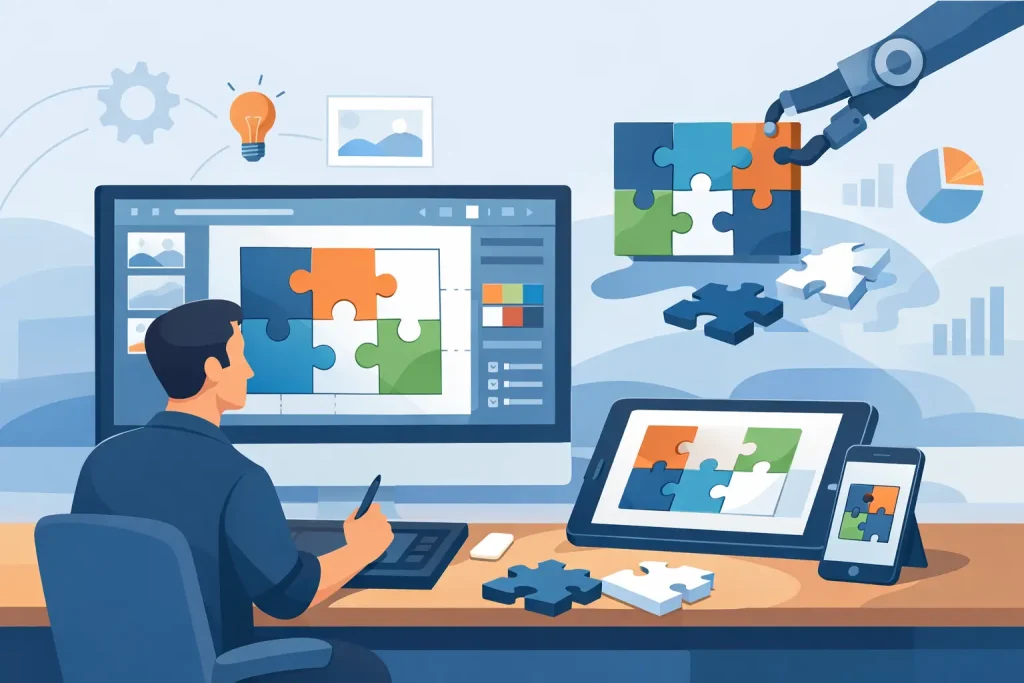
If you plan to sell puzzle books, classroom printables, branded activity pages, or digital downloads, puzzle creation software commercial use is not a small detail. It affects how fast you can produce, how consistently you can publish, and whether your workflow scales when one successful product turns into ten.
A lot of software can generate a puzzle. Far fewer tools are built for commercial publishing. That difference matters once you move beyond making a one-off worksheet and start building a catalog.
What puzzle creation software for commercial use actually needs to do
The biggest mistake publishers make is evaluating puzzle software like a hobby tool. A clean interface is helpful, but commercial work lives or dies on output, repeatability, and control.
If you are publishing for Amazon KDP, selling bundles on your own site, supplying educational content, or creating branded engagement products for clients, you need software that helps you create assets fast and reuse them across multiple formats. A single crossword or sudoku is not the product. The product is the system that lets you turn that puzzle into a book page, a printable pack, a digital file, a social graphic, or a presentation slide without rebuilding everything manually.
That is why commercial buyers should look past the first demo impression and ask a more useful question: can this software support volume without creating extra production work?
The real difference between hobby tools and publishing tools
Hobby-oriented puzzle apps usually focus on instant generation. You enter words, click a button, and get a result. That can be fine for occasional use. It becomes a bottleneck when your business depends on producing dozens or hundreds of puzzle pages with consistent formatting.
Publishing-oriented software works differently. It treats puzzle creation as the first step in a repeatable workflow. You generate reusable puzzle assets, adjust difficulty or design settings, and then move those assets into finished outputs for print or digital publishing.
This is where many creators gain back the most time. Instead of remaking content every time they want a new product variation, they adapt existing assets into multiple end products. That model is far more efficient for niche publishers, printable sellers, and content teams that need fresh inventory on a regular schedule.
Evaluate puzzle creation software commercial use by workflow, not features alone
Feature lists can be misleading. More options do not always mean more usable output. For commercial use, the strongest software usually performs well in five areas.
First, it supports bulk creation. If you are building a 120-page puzzle book, a holiday printable pack, or a series for different age groups, batch generation matters. Manual one-at-a-time production is expensive, even if the software itself is cheap.
Second, it creates reusable assets. This is one of the clearest separators between basic tools and professional systems. Reusable assets let you create once and repurpose across books, worksheets, printables, and digital products.
Third, it offers export flexibility. PDF is essential, but it should not be the only path. Many publishers also need image exports, PowerPoint output, or production-ready files for layout workflows.
Fourth, it gives you layout control. Puzzle generation is only part of the job. Commercial products also need clean page structure, answer key placement, branding consistency, and a polished final presentation.
Fifth, it fits your publishing model. Some users need crosswords and word searches. Others need logic, matching, math, mazes, or mixed puzzle books. Software that works as a modular system often makes more business sense than trying to force one generic tool to do everything.
Why licensing matters in puzzle creation software commercial use
Commercial use is not just about what the software can make. It is also about what you are allowed to do with what it makes.
Before buying, check the license terms carefully. Some tools allow personal or classroom use but limit resale. Others permit commercial publishing but place restrictions on volume, output type, or redistribution. If your business model includes KDP books, Etsy-style printables, direct-to-consumer PDFs, client work, or branded content campaigns, the license needs to support that clearly.
This is an area where vague language creates risk. If the commercial rights are unclear, treat that as a warning sign. You do not want to build a revenue stream on content that sits in a gray area.
The formats that matter most for commercial publishers
Different businesses need different outputs, but most serious puzzle publishers benefit from having more than one final format.
PDF remains central for print books and downloadable products. Image-based outputs are useful for marketplaces, social promotions, and certain digital products. PowerPoint can be practical for education, training, and presentation-driven uses. If you create assets once and export them into several channels, your content becomes more valuable without multiplying your production time.
That matters because commercial puzzle publishing is rarely a single-channel business. A puzzle may start in a book, then become a printable bundle, then support a lead magnet, then get adapted for a branded classroom or membership product. Software that supports those transitions gives you better margins from the same creative work.
When specialized software beats all-in-one design tools
General design platforms are useful for arranging pages and branding finished products, but they are usually weak at puzzle generation itself. They can make the page look attractive, yet they often rely on manual puzzle creation or imported content from somewhere else.
That creates a split workflow. One tool generates puzzles. Another tool lays them out. A third tool handles exports or revisions. Sometimes that is necessary, but it often introduces extra handling, version confusion, and slower production.
For commercial use, specialized puzzle software is stronger when the puzzle content is the business, not just a decorative feature inside a broader design project. Tools built specifically for puzzle production typically handle generation logic, answer management, bulk output, and repeatable formatting better than general-purpose design apps.
That does not mean every publisher needs an all-in-one platform. If your operation is highly customized and your design team already has a mature layout process, separate tools may still work. But for many independent publishers and entrepreneurial creators, a connected workflow saves more time than a pieced-together stack.
What to ask before you buy
The smartest buyers do not ask only, “Can it make this puzzle type?” They ask, “Can it support the business I am building?”
If you are evaluating software, look at how quickly you can create a series, not just a sample. Test whether the same content can be repurposed into multiple products. Check whether your exports fit your actual sales channels. See how answer keys are handled. Review whether you can keep branding consistent across products without rebuilding templates from scratch.
Also consider support and training. Commercial software is an investment in output, so vendor documentation, demos, and tutorials matter. A tool with serious publishing capability should help users move from first puzzle to finished product without unnecessary friction.
This is one reason systems like BookPublisherTools appeal to commercial creators. The focus is not simply on generating isolated puzzles. It is on building reusable assets, assembling polished products, and exporting them into the formats publishers actually sell.
The trade-off between speed and originality
There is one more point worth addressing. Fast generation is valuable, but speed alone is not a strategy. If your niche is competitive, puzzle quality and variation still matter.
Commercial publishers need enough control to produce content that feels distinct for their audience. That may mean adjusting word lists by topic, changing puzzle difficulty, mixing formats within a book, or creating puzzle lines for specific markets such as seniors, kids, ESL, teachers, or brand audiences. Software should shorten the production process without making every output feel generic.
That is the balance to look for: automation where repetition adds no value, and control where uniqueness helps the product sell.
A better way to think about the purchase
Puzzle software is easy to underestimate because the entry point looks simple. But if you are serious about publishing, the right purchase is not just a generator. It is production infrastructure.
The best choice for commercial use helps you create once, publish in multiple formats, maintain consistency across products, and expand your catalog without adding manual work every time. That is how software stops being an expense and starts acting like a growth tool.
If you expect to produce puzzle content regularly, choose the platform that fits the business you want next year, not just the puzzle you need this afternoon.