
Understanding Domino Logic Puzzles
Overview
Domino Logic puzzles challenge solvers to uncover a hidden arrangement of domino tiles within a grid.
Each puzzle hides a complete domino set — for example, all tiles from 1–1 up to N–N — arranged so that every tile appears exactly once and connects correctly with its neighbors.
The goal is to find all domino placements that satisfy the puzzle’s clues, forming one unique, logical solution.
These puzzles blend visual reasoning, pattern recognition, and spatial deduction.
They appeal to both logic enthusiasts and educators because they can use numbers, letters, colors, or even images — turning a traditional puzzle concept into an endlessly customizable experience.
The Basic Idea
A Domino Logic puzzle starts with an empty grid divided into cells.
Each domino occupies two adjacent cells — horizontally or vertically.
The challenge is to determine which pairs of symbols (numbers, colors, or images) belong together, using clues provided in the grid.
For example:
- A puzzle based on numbers might hide all dominoes from 1–1 to 6–6.
- A puzzle based on colors could hide dominoes combining different color pairs, like red–blue or yellow–green.
- A puzzle using images might include pairs of animals, shapes, or icons.
Every complete solution forms a full domino set — no duplicates, no missing tiles.
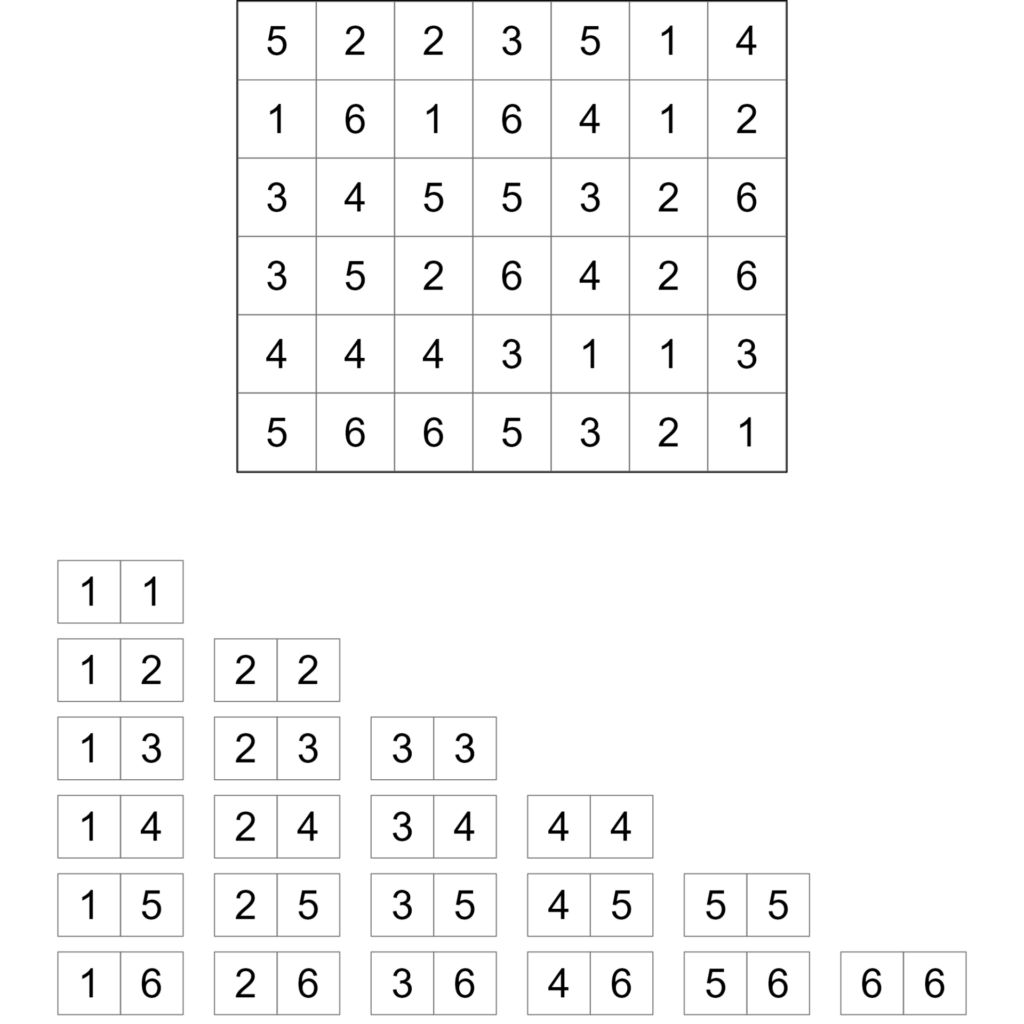
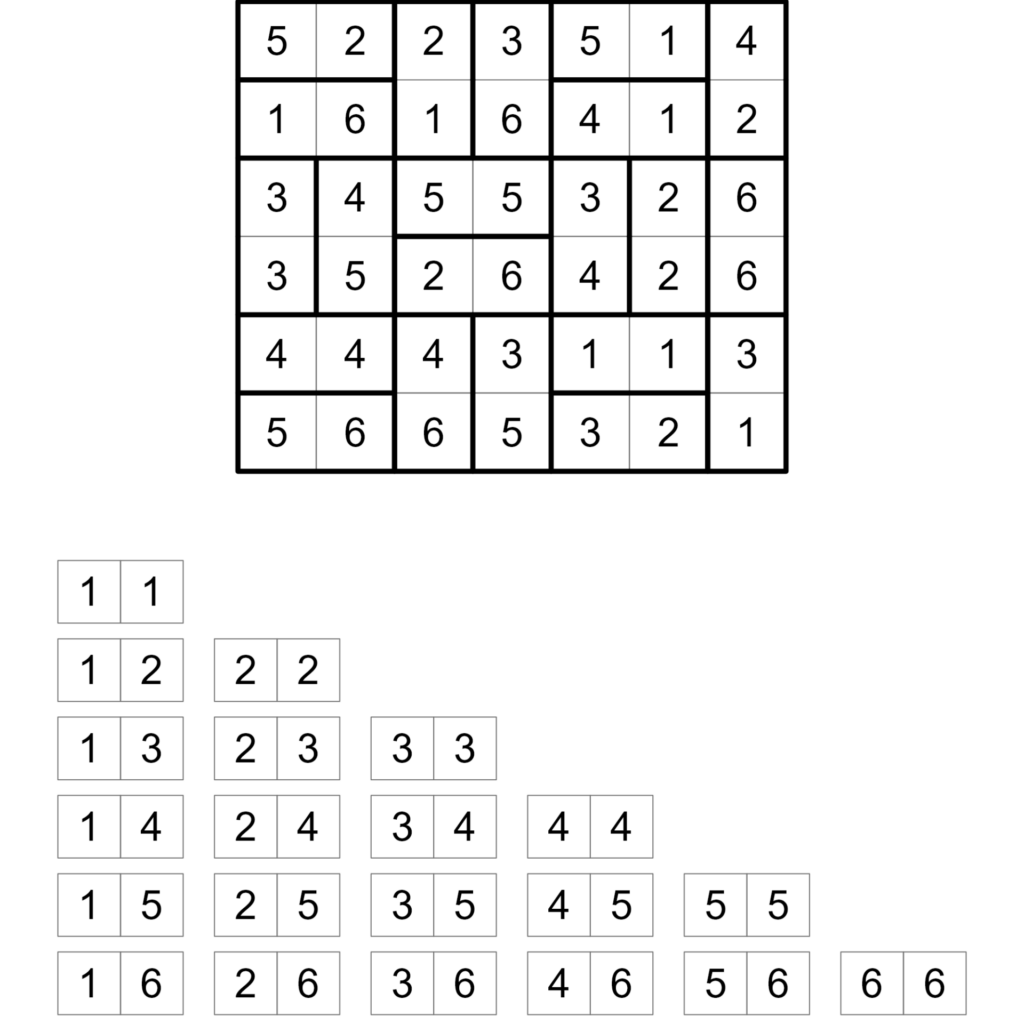
How Solvers Approach It
Domino Logic puzzles are entirely logical — no guessing required.
Players use deduction to eliminate impossible placements and identify definite connections.
Typical solving strategies include:
- Edge deduction: recognizing that tiles at the border must align within grid limits.
- Pattern grouping: noticing recurring symbols and tracking which combinations have already appeared.
- Process of elimination: crossing out impossible pairings until only one configuration remains possible.
Even simple grids can demand sharp logical thinking, while larger puzzles offer deep, satisfying challenges.
Puzzle Structure and Variations
Each puzzle uses all possible domino pairs once.
For a 6-set, that’s 28 tiles in total; for a 5-set, 15 tiles.
Smaller sets produce shorter puzzles, while larger sets increase both complexity and solving time.
Domino Logic can take many visual forms:
- Number puzzles – the most classic presentation.
- Color puzzles – ideal for younger solvers or visual thinkers.
- Letter puzzles – great for alphabet learning and classroom exercises.
- Image puzzles – allow thematic or seasonal sets for print or digital use.
These variations keep the logical structure intact while completely changing the visual identity and audience.

Difficulty and Logical Depth
The puzzle’s difficulty depends on how many clues are given and how densely the grid is filled.
More starting clues make puzzles easier; fewer clues require longer deduction chains.
Typical levels include:
- Trivial / Basic – simple grids with many clues.
- Hard / Extreme / Ambitious – minimal clues and complex pair interactions.
A 2–3 set puzzle is perfect for beginners or kids; 8–12 set puzzles challenge even seasoned logic solvers.
Educational and Creative Applications
Domino Logic puzzles naturally teach:
- Pattern recognition
- Deductive reasoning
- Spatial awareness
- Matching and sorting
For educators, they’re excellent logic exercises adaptable for any subject by changing the content type.
For puzzle creators and publishers, the same logical structure supports endless themes — from math to animals to holidays.

Why They’re So Versatile
Unlike many logic puzzles, Domino Logic isn’t bound to one style or audience.
You can make puzzles that feel mathematical and analytical, or visual and playful.
With variations in symbols, colors, and difficulty, the same underlying logic framework can generate thousands of unique, engaging puzzles.
That’s what makes Domino Logic both timeless and modern — a bridge between classic logic-solving and customizable puzzle design.
Outcome
You now understand what Domino Logic puzzles are and how they work.
Every puzzle hides one complete domino set and a single logical solution, blending structure, creativity, and reasoning.
In the next tutorials, you’ll learn how to generate your own puzzles in Puzzle Maker Pro — from beginner grids to full puzzle books.