
The Ultimate Guide to Polybius Box Logic Puzzles: History, Strategy, and Fun Facts
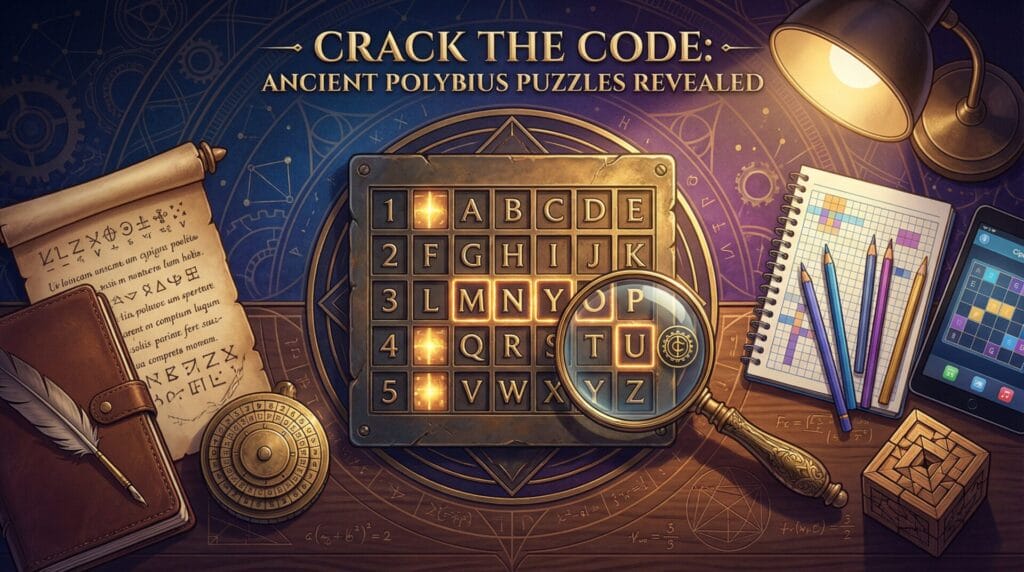
Polybius box logic puzzles, also known as Polybius square ciphers, are a fascinating type of substitution cipher with a rich history dating back to ancient Greece. While they may seem simple at first glance, these puzzles offer a surprising amount of depth and have found their way into everything from military communications to modern-day escape rooms and video games. This comprehensive guide will explore the history, theory, rules, and strategies behind Polybius box puzzles, providing you with everything you need to know to become a master solver. And if you’re interested in creating your own Polybius puzzles, software like Puzzle Maker Pro can help you generate them with ease.
What is the History of the Polybius Square?
The Polybius square was invented by the ancient Greeks Cleoxenus and Democleitus, but it was the historian and scholar Polybius who made it famous. In his work “The Histories,” Polybius described a system for sending coded messages over long distances using torches. This system, which became known as the Polybius square, was a significant advancement in military communication, as it allowed for the transmission of any message, not just a limited set of pre-determined signals.
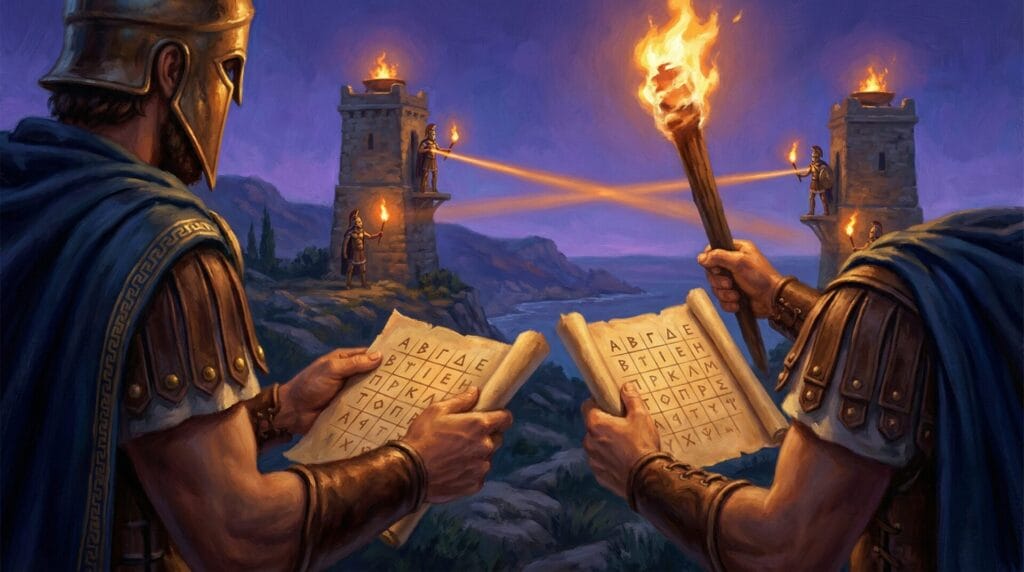
What made Polybius’s innovation so revolutionary was its flexibility and scalability. Before this system, military communications were limited to a set of pre-arranged signals, each representing a specific message. With the Polybius square, soldiers could transmit any message by breaking it down into its component letters and converting each letter into a pair of numbers. This pair of numbers could then be signaled using torches—one set of torches for the row number and another for the column number. This method allowed for rapid, flexible communication across distances, making it invaluable for military operations.
The original Polybius square used the Greek alphabet, arranged in a 5×5 grid. According to historical records, signalers on both sides had to first confirm that transmission was possible by raising two torches and waiting for a similar response. Once both parties confirmed readiness, the sender would raise the appropriate number of torches on the left side to indicate the row, then raise the appropriate number on the right side to indicate the column. This process, while time-consuming by modern standards, was remarkably efficient for its era.
The cipher has been used throughout history in various forms, from secret messages sent by Russian nihilist prisoners of the Czars to clues in complex treasure hunts and modern escape rooms. During the Vietnam War, American prisoners of war used variations of the Polybius square to communicate secretly with one another. Its enduring appeal lies in its simplicity and versatility, making it a timeless tool for both communication and entertainment. The fact that it has remained relevant for over two thousand years speaks to the fundamental elegance of its design.
How Does a Polybius Square Work?
The Polybius square is a 5×5 grid that is used to convert letters into pairs of numbers. The standard grid uses the English alphabet, with the letters I and J sharing a single square to fit the 26 letters into 25 spaces. Each letter is then represented by its coordinates in the grid, with the first number representing the row and the second number representing the column. This coordinate system is the key to understanding how the cipher works.
Here is an example of a standard Polybius square:
| 1 | 2 | 3 | 4 | 5 | |
| 1 | A | B | C | D | E |
| 2 | F | G | H | I/J | K |
| 3 | L | M | N | O | P |
| 4 | Q | R | S | T | U |
| 5 | V | W | X | Y | Z |
Encryption Process
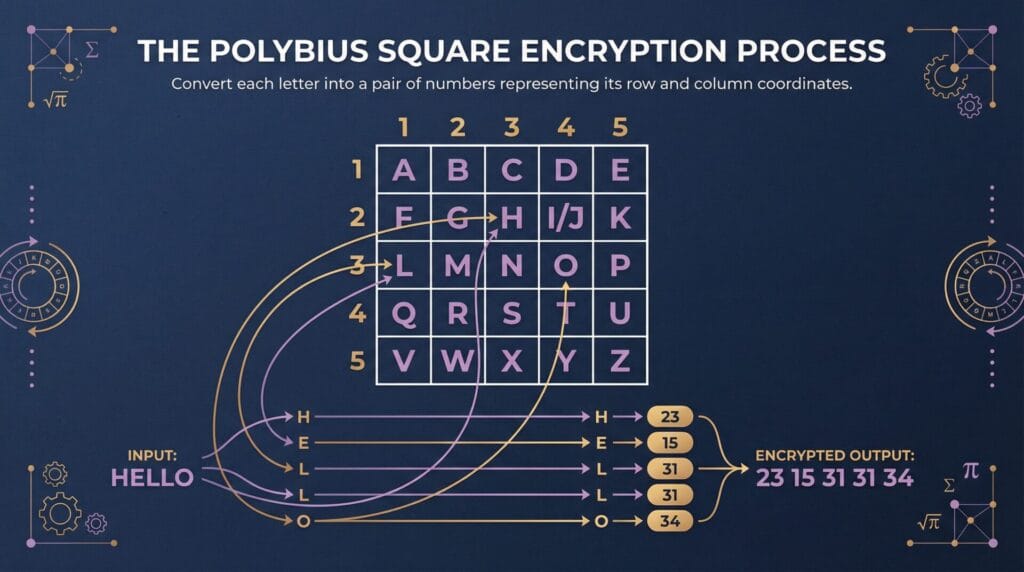
To encrypt a message, you simply replace each letter with its corresponding pair of numbers. For example, the word “HELLO” would be encrypted as follows:
•H is in row 2, column 3 → 23
•E is in row 1, column 5 → 15
•L is in row 3, column 1 → 31
•L is in row 3, column 1 → 31
•O is in row 3, column 4 → 34
So “HELLO” becomes “23 15 31 31 34”. The spaces between the number pairs are often included for clarity, but they can be removed to make the encrypted message more compact: “2315313134”.
Decryption Process
To decrypt a message, you do the reverse, replacing each pair of numbers with the corresponding letter from the grid. If you receive the encrypted message “2315313134”, you would break it into pairs (23 15 31 31 34) and then look up each pair in the grid to get the original message.
The beauty of the Polybius square lies in its simplicity. Once you understand the basic principle of coordinate mapping, you can encrypt and decrypt messages quickly and efficiently. This simplicity is what has made it so popular for centuries, and it’s also what makes it relatively easy to break with modern codebreaking techniques.
What are the Rules and Strategies for Solving Polybius Puzzles?
Solving a Polybius puzzle can be a fun and rewarding challenge. Here are some basic rules and strategies to get you started:
Identify the cipher type: If you see a message that consists of pairs of numbers between 11 and 55, there’s a good chance it’s a Polybius cipher. The fact that each number is between 1 and 5 is a strong indicator, as this corresponds to the 5×5 grid structure. If you see numbers outside this range (like 67 or 89), it might be a different cipher or a variation using a 6×6 or larger grid.
Look for a key: Sometimes, a keyword is used to create a mixed alphabet square, where the letters of the keyword are placed at the beginning of the grid, followed by the remaining letters of the alphabet in order. For example, if the key is “PUZZLE”, the grid would start with P, U, Z, L, E, then continue with the remaining letters (A, B, C, D, F, G, H, I/J, K, M, N, O, Q, R, S, T, V, W, X, Y). If a key is provided, you’ll need to reconstruct the grid before you can decrypt the message. This is often the easiest part of solving a keyed Polybius puzzle, as you simply need to arrange the grid according to the key.
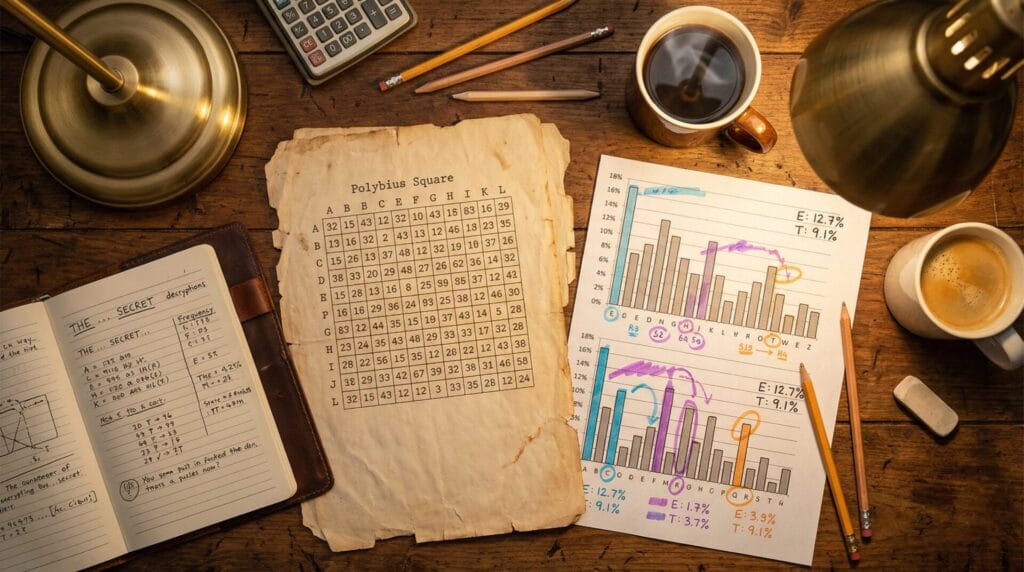
Use frequency analysis: If no key is provided, you can use frequency analysis to crack the code. In the English language, some letters appear more frequently than others (E, T, A, O, I, N, S, H, and R are the most common). By analyzing the frequency of the number pairs in the encrypted message, you can make educated guesses about which pairs correspond to which letters. This technique works best with longer messages, as shorter messages may not have enough data to reveal reliable frequency patterns.
Look for patterns: Even in a simple substitution cipher like the Polybius square, patterns can emerge. For example, repeated number pairs can indicate double letters in the original message (like “LL” or “EE”). Single-digit pairs that appear frequently might correspond to common short words like “A” or “I”. By looking for these patterns and using context clues, you can gradually fill in more of the grid.
How Can I Solve a Polybius Puzzle Without a Key?
Solving a Polybius puzzle without a key is a bit more challenging, but it’s definitely possible with the help of frequency analysis and pattern recognition. Here’s a more detailed look at how to do it:
Step 1: Count the frequency of each number pair. Go through the encrypted message and tally up how many times each pair of numbers appears. Create a frequency table showing each unique pair and how often it appears. For example, if “23” appears 15 times, “15” appears 12 times, and “31” appears 8 times, you would note these frequencies.
Step 2: Compare the frequencies to English letter frequencies. The most frequent number pair in the message is likely to correspond to the letter ‘E’, the most common letter in English. The next most frequent pair is likely to be ‘T’, and so on. However, be aware that this is not always accurate, especially with shorter messages. The longer the message, the more reliable the frequency analysis will be.
Step 3: Make educated guesses and test them. Based on the frequencies, start filling in the grid with your best guesses. As you fill in more letters, you’ll be able to recognize words and phrases, which will help you confirm your guesses and fill in the rest of the grid. If a guess doesn’t lead to recognizable words, try the next most frequent pair.
Step 4: Use context and pattern recognition. Look for common words and phrases in the decrypted text. If you see a pattern like “_ _ E”, it might be “THE”. If you see “_ O _”, it might be “FOR” or “NOT”. These context clues can help you fill in the remaining letters more quickly.
Here is a table of average letter frequencies in the English language to help you with your analysis:
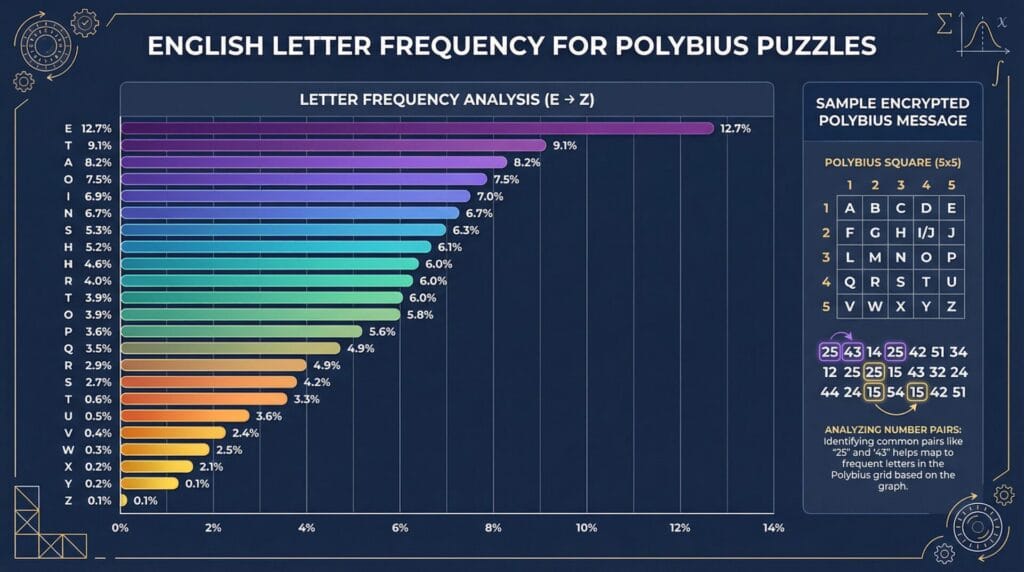
This frequency table is based on analysis of large bodies of English text. Keep in mind that the actual frequencies in a specific message may vary, especially if the message is short or uses specialized vocabulary.
What are Some Common Variations and Modern Innovations?
While the 5×5 grid is the most common form of the Polybius square, there are several variations that you might encounter. Modern puzzle design has taken the classic Polybius square to new heights, introducing creative twists that challenge even the most experienced solvers. Software like Puzzle Maker Pro is at the forefront of this innovation, allowing creators to push the boundaries of traditional puzzle design.
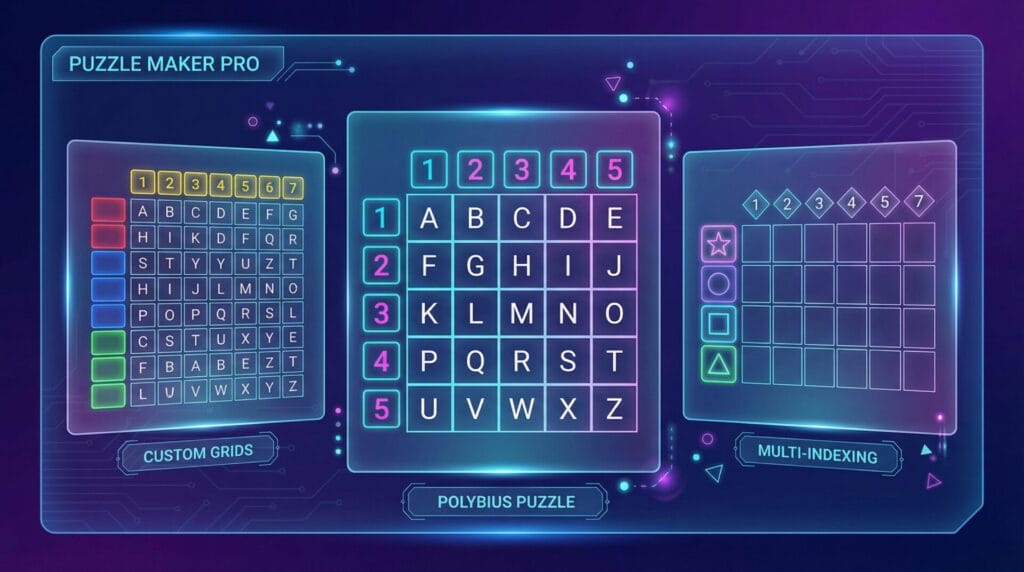
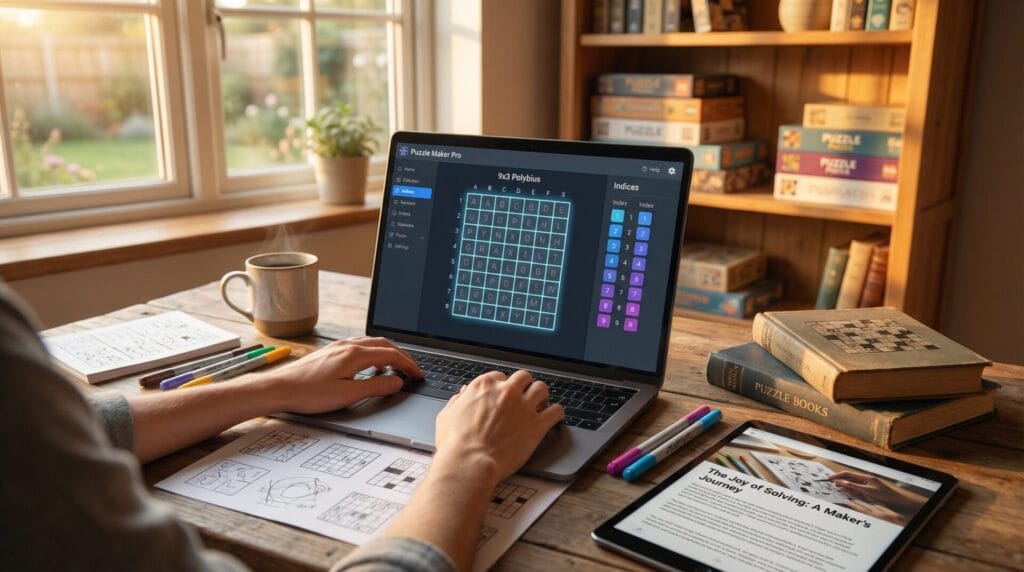
- Custom Grid Dimensions: Instead of the standard 5×5 or 6×6 grids, modern puzzle software like Puzzle Maker Pro allows you to specify custom box dimensions, such as 9×3 or 4×7. This flexibility opens up a world of creative possibilities for puzzle design, allowing you to create puzzles that are not only more challenging but also more visually interesting.
- Alternative Indexing Systems: Another groundbreaking feature found in Puzzle Maker Pro is the ability to use colors, images, or even different sets of letters and numbers as the index for the grid. Instead of the standard 1-5 numeric index, you could use a sequence of colors (e.g., Red, Blue, Green, Yellow, Purple) or a set of images (e.g., a star, a circle, a square, a triangle, a diamond). This adds a whole new layer of complexity and creativity to the puzzle, as the solver must first figure out the indexing system before they can even begin to decrypt the message.
- Mixed Alphabet Squares: As mentioned earlier, a keyword can be used to create a mixed alphabet square, which makes the cipher more difficult to break.
- Combination with Other Ciphers: The Polybius square can be combined with other ciphers, such as the Bifid cipher or the Trifid cipher, to create more complex and secure encryption methods.
Where are Polybius Puzzles Used Today?
Despite its ancient origins, the Polybius square is still widely used today in a variety of contexts:
Escape Rooms: Polybius puzzles are a popular choice for escape rooms, as they provide a fun and challenging way to hide clues and messages. Escape room designers appreciate the Polybius square because it’s familiar enough that most players have heard of it, but challenging enough to require some thought and effort to solve. It’s also easy to integrate into the narrative of an escape room, as it fits naturally into themes involving codes, ciphers, and secret messages.

Video Games: The cipher has made appearances in several popular video games, including the “Call of Duty” and “Indiana Jones” franchises. In Indiana Jones and the Great Circle, players encounter a Polybius square puzzle as part of the “Father and Son” mystery, where they must use the cipher to unlock a safe. These game implementations have introduced the Polybius square to millions of players who might not otherwise encounter it.
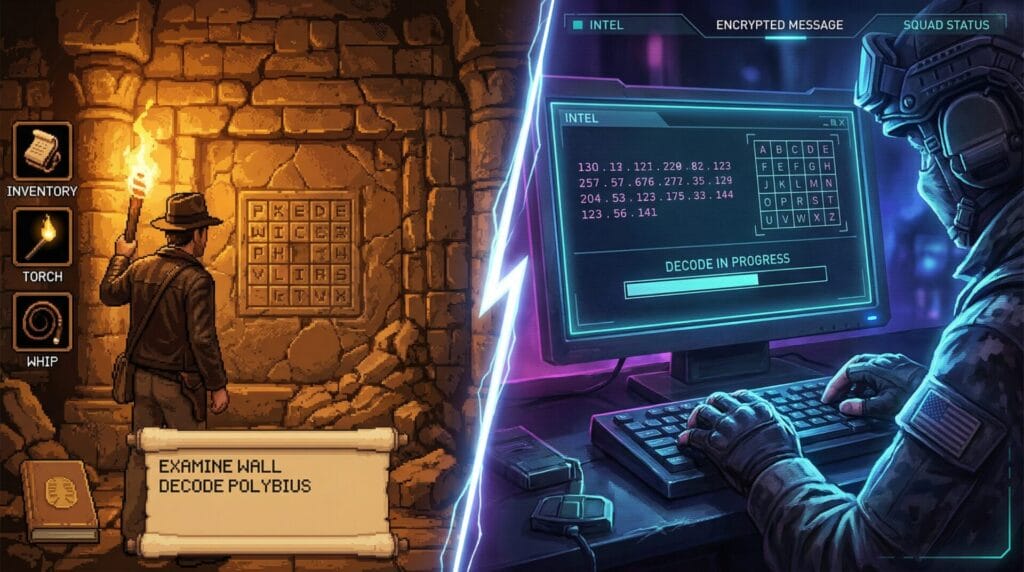
Puzzle Books and Online Challenges: You’ll find Polybius puzzles in many puzzle books and online cryptography challenges, where they are used to test the skills of amateur and professional codebreakers alike. Books like “Pen and Polybius: A Cipher Solver’s Puzzlebook” and “Cryptograms Puzzle Book” feature dedicated sections on Polybius puzzles, ranging from beginner to advanced difficulty levels.
Educational Settings: Cryptography teachers use Polybius puzzles as an introduction to substitution ciphers and frequency analysis. The simplicity of the cipher makes it ideal for teaching the fundamental concepts of cryptography without overwhelming students with complex mathematics.
Puzzle Generator Software: With software like Puzzle Maker Pro, you can easily create your own Polybius square puzzles that stand out from the crowd. This powerful tool not only allows you to customize the grid and choose your own keywords but also offers innovative features that take Polybius puzzles to the next level. You can specify custom box dimensions (e.g., 9×3, 8×4), creating unique grid layouts that break away from the traditional square format. Furthermore, Puzzle Maker Pro allows you to use colors, images, or different sets of numbers and letters as the index for your grid, adding a creative and challenging twist to your puzzles. These features make Puzzle Maker Pro an invaluable tool for puzzle creators who want to design truly unique and engaging experiences for their audience.
What are Some Fun Facts About the Polybius Square?
Ancient torch signaling: The original Polybius square was used to send messages with torches, with one set of torches indicating the row and another set indicating the column. This method allowed soldiers to communicate across long distances without needing to be within earshot of one another. The system was so effective that it remained in use for centuries and influenced the development of later signaling systems.
The Polybius video game legend: The name “Polybius” is also associated with an urban legend about a mysterious arcade game from the 1980s that was said to have addictive and psychoactive effects on its players. According to the legend, the game appeared in arcades around Portland, Oregon in 1981 and was said to brainwash players with subliminal messages. While the game itself never existed, the legend has become a fascinating part of video game folklore and has inspired numerous works of fiction and media.
Strength and weakness: The simplicity of the Polybius square is both its greatest strength and its greatest weakness. While it’s easy to learn and use, making it accessible to anyone, it’s also relatively easy to break with modern codebreaking techniques. A skilled cryptanalyst can crack a Polybius cipher in a matter of minutes using frequency analysis and pattern recognition. This is why, in modern times, the Polybius square is primarily used for entertainment and educational purposes rather than for serious security applications.
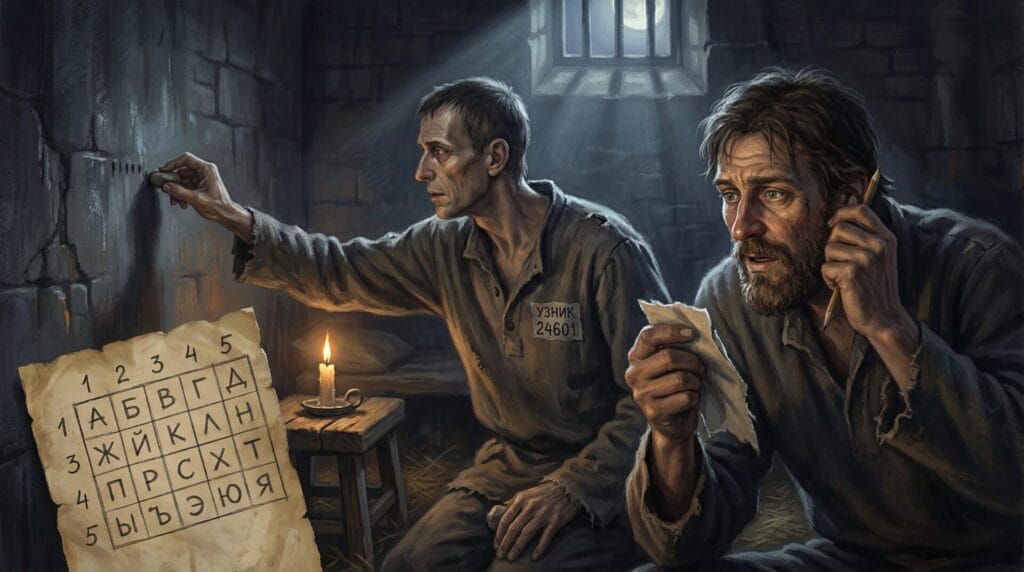
Historical usage by prisoners: The Polybius square has been used by prisoners throughout history to communicate secretly. Russian nihilist prisoners of the Czars used variations of the cipher to send messages to one another, and American prisoners of war during the Vietnam War used modified versions of the Polybius square to communicate with their fellow prisoners. These real-world applications demonstrate the enduring utility and ingenuity of the cipher.
Conclusion
The Polybius box logic puzzle is a timeless classic that has captivated puzzle enthusiasts for centuries. From its ancient origins as a tool for military communication to its modern-day applications in games and entertainment, the Polybius square continues to be a source of fascination and challenge. The cipher’s elegant simplicity—converting letters to coordinate pairs—makes it accessible to beginners while still offering enough depth to challenge experienced codebreakers.
What makes the Polybius square so enduring is its versatility. It can be used as a simple substitution cipher for beginners, combined with other ciphers for increased complexity, or modified with custom keys to create unique puzzles. Whether you’re interested in cryptography from a historical perspective, enjoy solving puzzles as a hobby, or want to create engaging content for your audience, the Polybius square offers something for everyone.
If you’re interested in creating your own Polybius puzzles, tools like Puzzle Maker Pro make the process straightforward and efficient. You can generate puzzles of varying difficulty levels, customize the grids and keywords, and create engaging challenges for your friends, students, or audience. The combination of historical significance, practical utility, and entertainment value makes the Polybius square a puzzle type that will likely remain popular for centuries to come.
Whether you’re a seasoned codebreaker or a curious beginner, we hope this guide has inspired you to explore the world of Polybius puzzles and to try your hand at solving—or creating—your own. The journey into the world of cryptography and puzzle-solving is a rewarding one, and the Polybius square is an excellent place to start.